

AVGO: AI firing on all cylinders; a fiercer rival to NVDA?---

AVGO released Q1 FY26 results (ended Jan 2026) after the US market close on Mar 5 (Beijing time). Details follow.
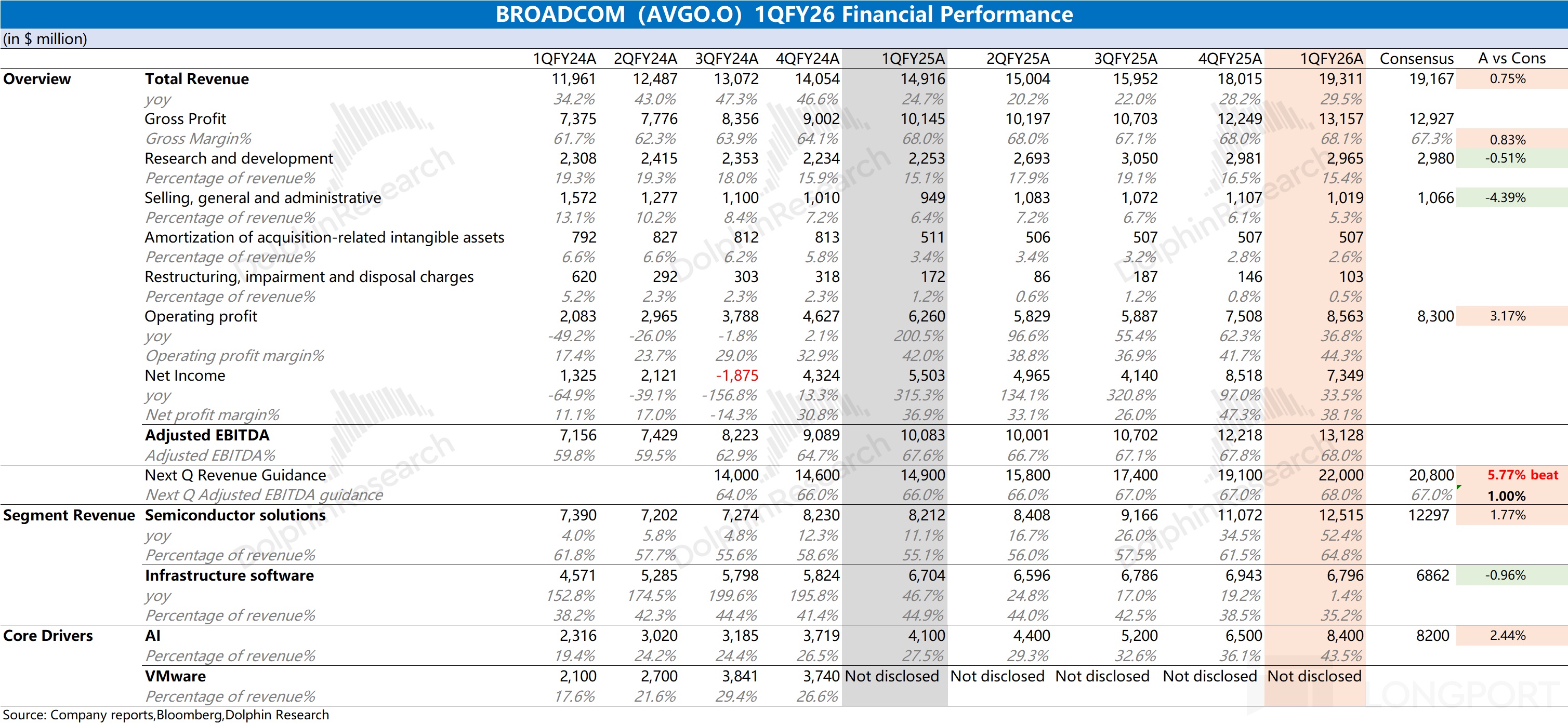
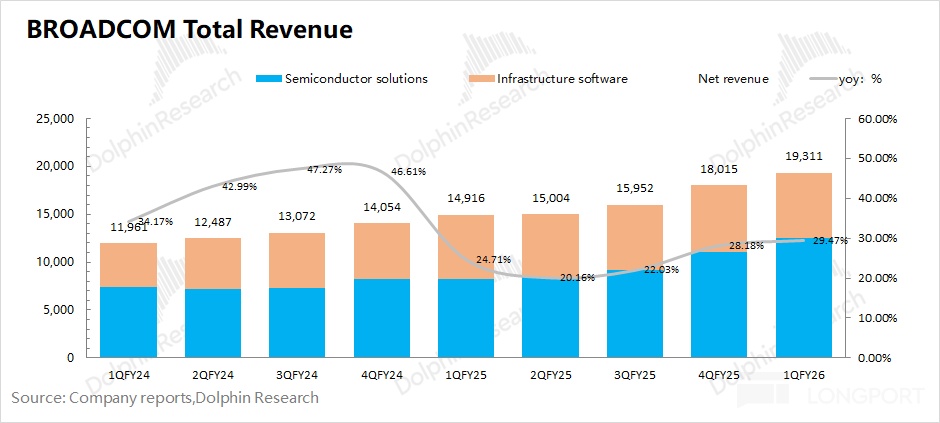
1. Overall results: Q1 revenue was $19.3bn (+29% YoY), in line with the Street ($19.2bn). QoQ rose by $1.3bn, driven by AI. GPM was 68.1%. On an operating basis (ex acquisition amortization and restructuring), GPM was 75.8%, down 80bps QoQ, reflecting mix shift as custom ASICs carry lower margins.
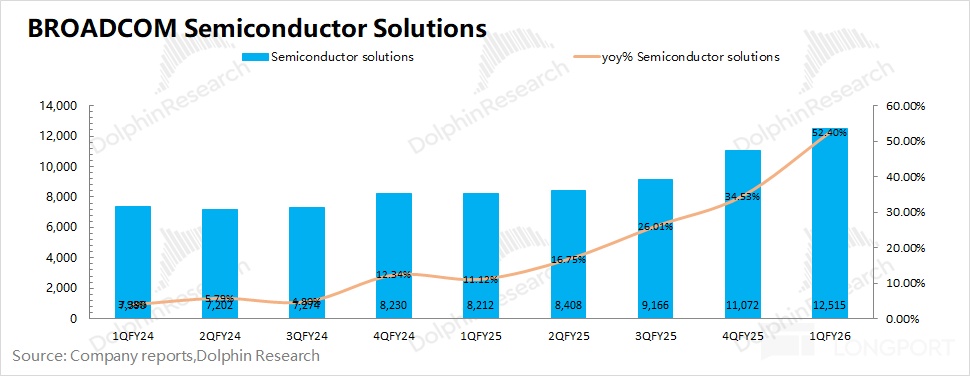
2. Semiconductor: Revenue was $12.5bn, up $1.5bn QoQ, with AI contributing most of the increment. Details:
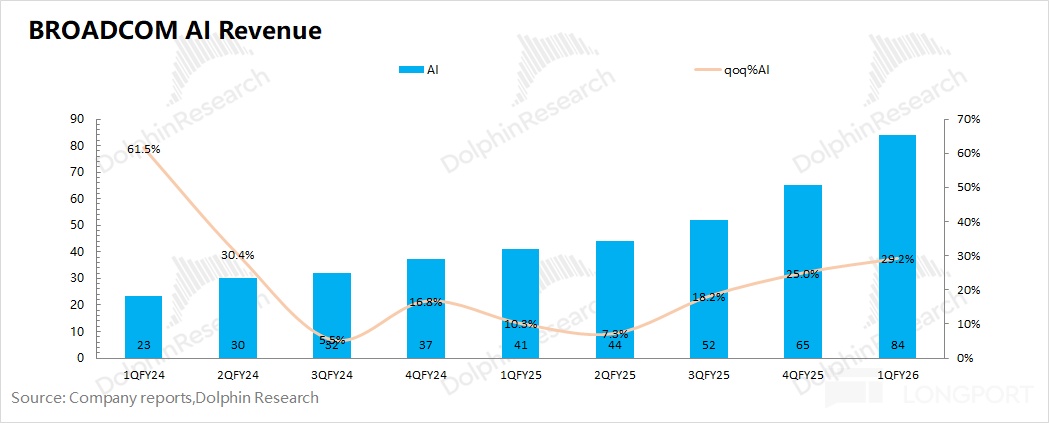
①$Broadcom(AVGO.US) AI: $8.4bn, up $1.9bn QoQ, ahead of the Street ($8.2bn). Growth was led by higher Google TPU shipments across the quarter. Google and Meta have recently raised 2026 capex outlooks, and AVGO expects AI revenue of $10.7bn next quarter, up $2.3bn QoQ.
② Non-AI: $4.1bn, roughly flat YoY. Non-AI trends were stable.
3. Infrastructure software: Revenue was $6.8bn, +1.4% YoY. Earlier growth stemmed from VMware integration and pricing changes (moving from perpetual licenses to subscriptions). The M&A-driven surge has ended, and future growth will hinge on VMware’s subscription-led organic expansion.
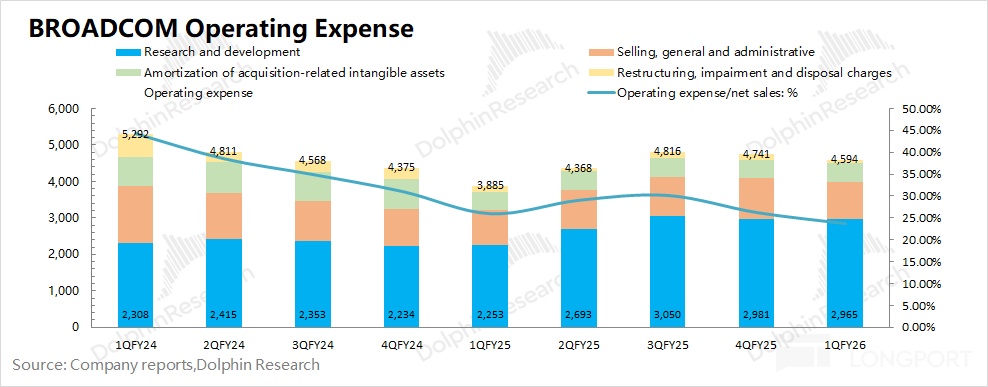
4. Opex: Core opex (R&D + S&M) was $3.98bn, down slightly QoQ. Scale benefits helped lower core opex ratio to ~21%. Over the past two years, stock-based comp has increased materially (now nearly half of opex). Ex SBC, core opex was $2.04bn, down $90mn QoQ.
5. Inventory: $2.96bn this quarter, up 30% QoQ. Unlike the usual single-digit QoQ moves, the jump reflects strong demand and deliberate early stocking.
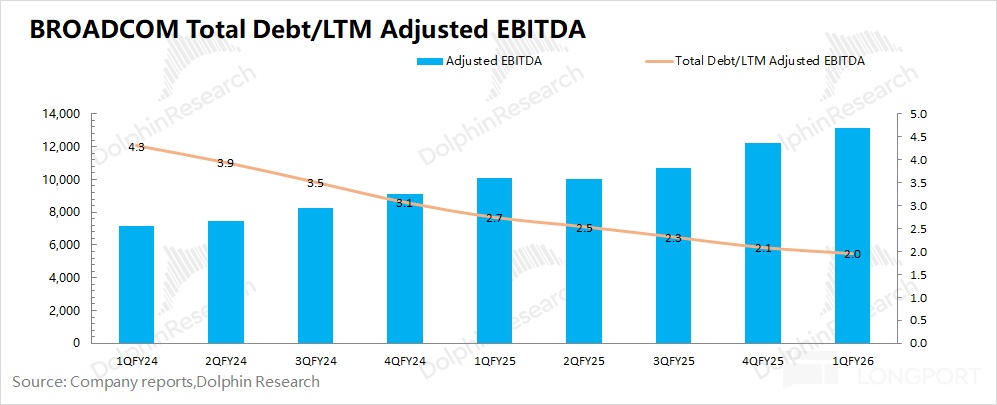
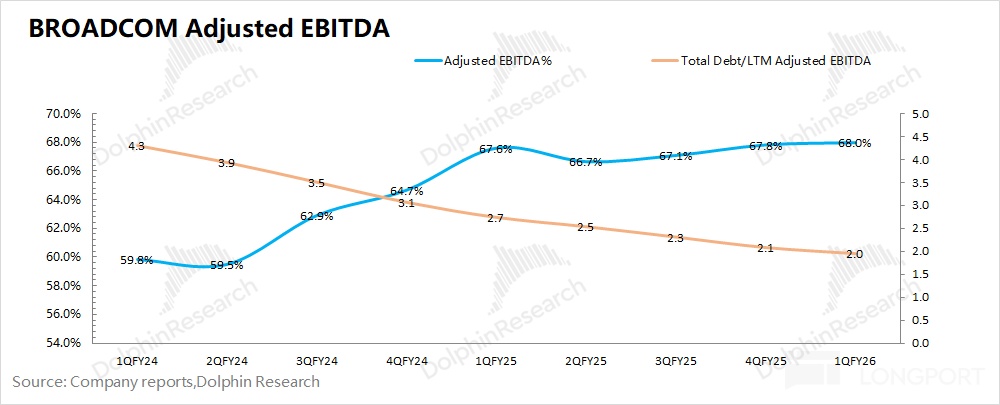
6. VMware integration: Dolphin Research tracks Total Debt/LTM Adj. EBITDA, which fell further to 2 this quarter. The ratio has returned to pre-acquisition levels, indicating VMware’s debt impact has been absorbed within two years.
7. Guidance: Q2 FY26 revenue is guided to around $22.0bn, above the Street ($20.8bn), with Adj. EBITDA margin at 68% vs. Street 67%. AI revenue is expected to rise to $10.7bn next quarter.
Dolphin Research view: AI growth accelerates; explicit guidance lifts confidence
AVGO’s revenue and margins met expectations. Top-line growth was primarily driven by AI. On an operating basis, GPM was 75.8%, down slightly QoQ due to the larger mix of lower-margin ASICs.
For next quarter, revenue is guided to $22.0bn, up $2.7bn QoQ and above consensus ($20.8bn). Growth should be led by AI.
1) M&A impacts: Total Debt/LTM Adj. EBITDA fell to 2, back to pre-deal levels, indicating VMware’s debt impact was absorbed within two years.
2) AI performance: AI revenue was $8.4bn this quarter, up $1.9bn QoQ. Management guides Q2 AI revenue of $10.7bn, up $2.3bn QoQ, above the Street ($9.7bn).
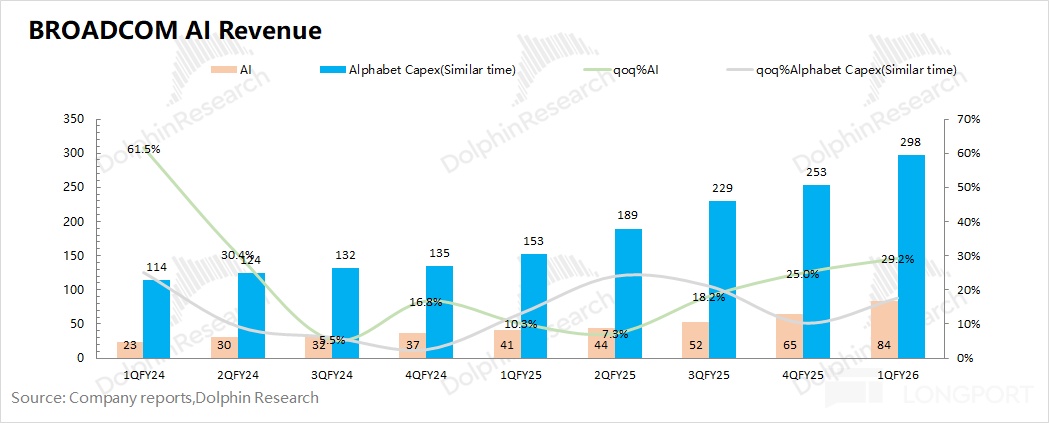
With VMware integration done, investor focus is squarely on AVGO’s AI trajectory:
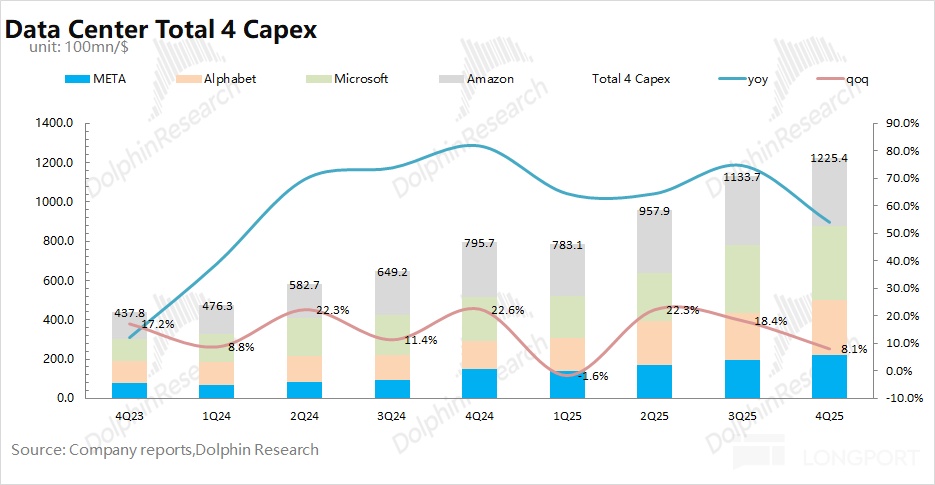
a) Hyperscaler capex is the engine: Hyperscalers are the key buyers of AVGO custom ASICs, directly shaping AI expectations. Based on guidance, Dolphin Research estimates combined 2026 capex of Google, Meta, Microsoft and Amazon could reach $660bn, with YoY growth over 60%, underpinning the AI chip market.
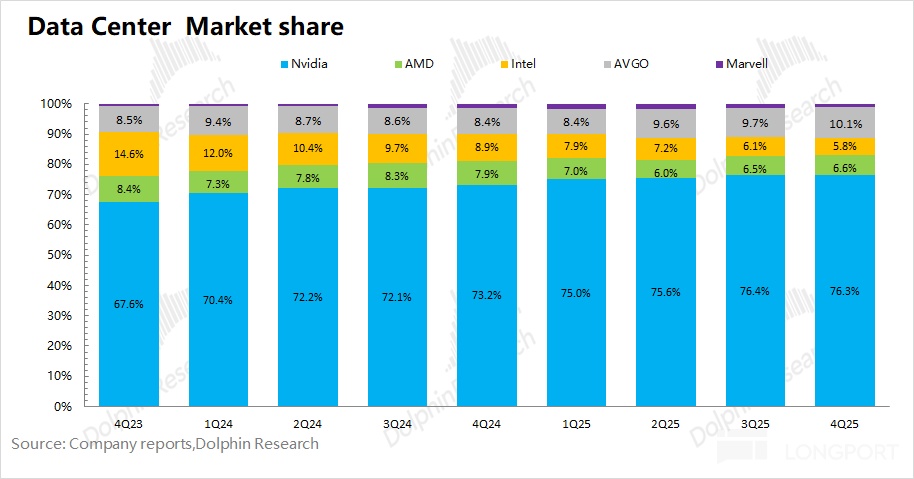
b) AI chip share: Nvidia remains dominant, with AVGO playing catch-up. AVGO’s AI chip share is ~10% today and could rise toward ~20%, supported by demand from Google TPU and Anthropic.
c) Product iteration: AVGO has secured orders from Google, Meta and OpenAI. Google’s TPU is the core product currently, and its performance will directly drive AI revenue.
TPUv7 is in mass production. Versus Nvidia GPUs, TPUv7 in FP8 is broadly comparable to Nvidia’s B200 (mass production in Q4 2024), leaving Google roughly a year behind.

The biggest differences today: ① Google supports up to FP8, emphasizing stability and large-scale cluster efficiency. ② Nvidia prioritizes speed, introducing NVFP4 in Blackwell to double inference throughput vs. FP8.
Putting (a+b+c) together, hyperscalers are still lifting capex and AVGO’s share is rising. Yet the stock has been muted, likely due to concerns about capex sustainability. Meta guides 2026 capex of $115–135bn, over 50% of revenue, well above the prior 20–25% range.
Google and Microsoft are also pushing capex to 40%+ of revenue. Meta’s revenue growth is ~15–20%, while 2026 capex/revenue hits 50–60%, suggesting limited room to increase further. That implies hyperscaler capex growth may not be sustainable at current levels.
Hence, the market widely expects capex growth to slow sharply around 2027, ending the high-growth, multiple-expansion phase. For AVGO in FY26, this is a period of earnings growth and valuation digestion, with the multiple now below 30x.
Industry headwinds weigh especially on Nvidia. AVGO faces clearer risks: while it is a cost-down option for cloud operators, Google may diversify to Taiwan vendors or in-house. For example, Google’s next-gen TPUv8 is being co-developed by AVGO and MediaTek (MTK). If legacy clients do not add orders, the market worries about share shifting to Taiwan alternatives.
Order growth from existing clients is a key question. Also, unlike Nvidia’s structurally rising margins, AVGO’s margin pressure from ASIC mix is another investor concern. With a current mkt cap of ~$1.5tn, AVGO trades at ~27x PE on FY26 post-tax core operating profit (assumes +74% YoY revenue, 72% operating GPM, 9.7% tax). AVGO’s valuation remains above Nvidia (~20x PE), reflecting ASIC share gains, even as sector multiples have corrected.
On forward growth, management provided a 2027 AI outlook. Across six core AI customers (Google, Anthropic, Meta, OpenAI, etc.), combined compute demand approaches 10GW, implying over $100bn in AI revenue.
Explicit guidance should ease near-term worries and support sentiment. More important will be management’s detail on Taiwan outsourcing vs. in-house and margin trajectory, the key overhangs on valuation.
Dolphin Research’s detailed take on AVGO’s results follows below:
I. AVGO’s key businesses
Recent growth has been driven by AI and the VMware consolidation, making custom AI ASICs and VMware pricing strategy the focal points. By segment:
1) Semiconductor solutions: Benefiting from AI revenue growth, mainly demand for custom ASICs from Google, Meta and ByteDance. Non-AI was largely flat. AI: Incremental growth mainly from Google TPU shipments. AVGO now has six core AI customers (including Google, Anthropic, Meta, OpenAI, etc.), with OpenAI becoming a substantive customer.
For 2027, the six customers’ combined compute demand is near 10GW, implying $100bn+ in AI revenue. Anthropic exceeds 3GW, and OpenAI will ramp its first XPU (>1GW).
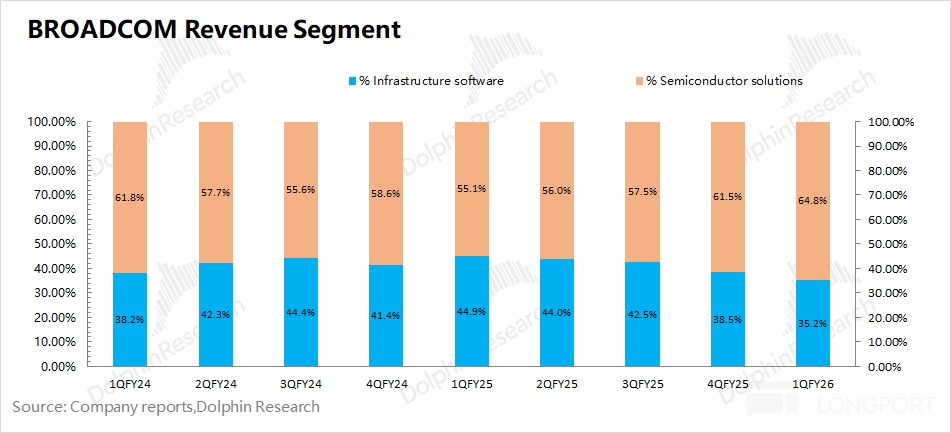
2) Infrastructure software: With VMware consolidated, software is ~40% of revenue. AVGO raised VMware prices as it shifted from perpetual to subscription, which boosted revenue, but that impact is fading.
II. Consolidated results: AI is the core driver
2.1 Revenue
AVGO delivered Q1 FY26 revenue of $19.3bn (+29.5% YoY), in line with the Street ($19.2bn). YoY growth was mainly AI-driven. QoQ, total revenue rose $1.3bn, with AI adding $1.9bn QoQ and software down sequentially.
2.2 Gross profit
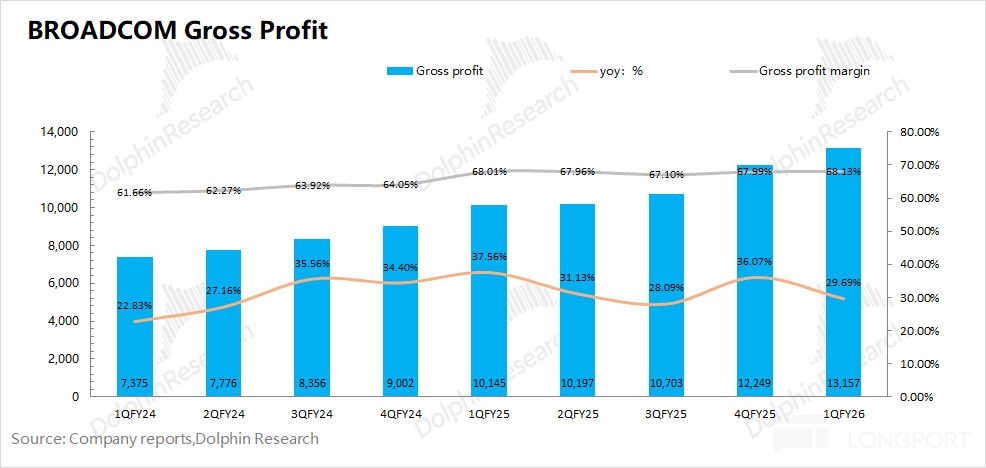
Gross profit was $13.2bn, +30% YoY. Reported GPM was 68.1%, up slightly QoQ. On an operating basis (ex amortization and restructuring), GPM was 75.8%, down 80bps QoQ, due to the higher mix of lower-margin custom ASICs.
2.3 Operating expenses
Opex was $4.6bn, down slightly QoQ. Ex SBC, core opex (R&D + S&M) was $2.04bn, down $90mn QoQ. Post VMware consolidation, AVGO’s opex optimization is largely complete.
2.4 Profit
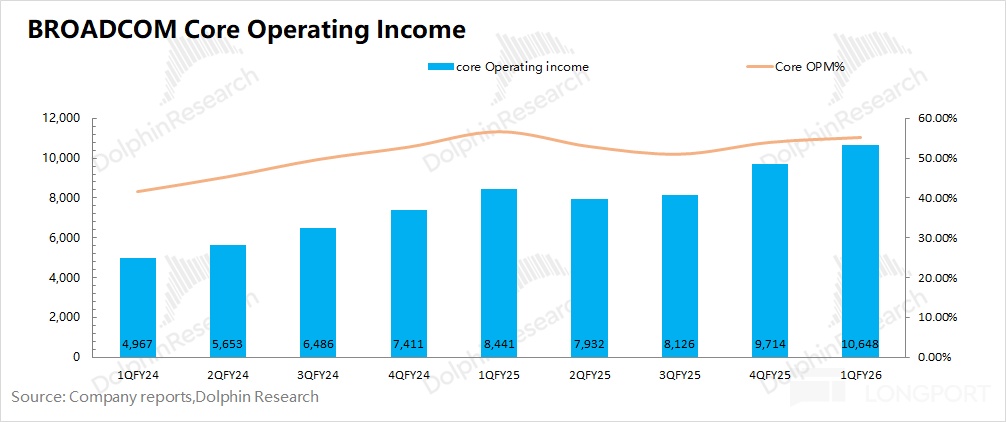
Net income was $7.35bn in Q1 FY26. Dolphin Research prefers core operating profit (= GP - R&D - S&M) as a cleaner view. Core operating profit was $10.65bn, up $900mn QoQ, driven by AI.
2.5 EBITDA
AVGO emphasizes Adj. EBITDA% given its M&A-heavy model. Dolphin Research estimates Q1 FY26 Adj. EBITDA% at 68%, vs. prior guidance of 67%. Leverage improved: Total Debt/LTM Adj. EBITDA fell to 2, back to pre-deal levels on AI-driven EBITDA growth. This suggests VMware’s impact was digested within two years, and AVGO may resume pursuing new deals.
III. Segment detail: six customers could contribute $100bn in AI revenue
AVGO’s two pillars are semiconductor solutions and infrastructure software. Within these: 1) Semiconductor solutions: networking (AI), wireless, storage connectivity, broadband, industrial & other. 2) Infrastructure software: VMware, CA, Symantec, Brocade, etc.
3.1 Semiconductor solutions
Q1 FY26 semiconductor revenue was $12.5bn, +52% YoY. Growth was mainly AI-driven, with non-AI stable.
1) AI
AI is the core earnings driver. AI revenue was $8.4bn, up $1.9bn QoQ, re-accelerating on Google TPU shipments. AI revenue is currently concentrated in three customers (Google, Meta, ByteDance). With Google and Meta lifting capex, AVGO guides Q2 AI revenue of $10.7bn, up $2.3bn QoQ.
AVGO’s ASIC roster now includes six disclosed customers: Google, Meta, ByteDance, Anthropic, a fifth customer (~$1bn), and newly OpenAI. This indicates prior framework agreements are converting and OpenAI is now a substantive customer. Near term, focus remains on output from the three current customers, especially the ramp of TPUv6 and TPUv7. Orders from Anthropic and the fifth customer (~$1bn) will ship in H2 2026, making full-year AI revenue back-half weighted.
Addressing growth uncertainty, management outlined a 2027 AI outlook: with six core customers (Google, Anthropic, Meta, OpenAI, etc.), combined compute demand is near 10GW, implying $100bn+ in AI revenue. Anthropic tops 3GW, and OpenAI will mass-produce its first XPU (>1GW).
The outlook should bolster near-term confidence. That said, hyperscaler capex ratios are already elevated. Meta’s 2026 capex/revenue >50% limits further upside, which remains a key overhang for company and sector multiples.
2) Non-AI
Non-AI semiconductor revenue was $4.1bn this quarter, roughly flat YoY. The non-AI portfolio includes enterprise storage, broadband, wireless, and industrial & other. Enterprise networking, broadband and server storage grew YoY, offsetting seasonal weakness in wireless.
3.2 Infrastructure software
Q1 FY26 infrastructure software revenue was $6.8bn, +1.4% YoY. VMware integration impacts have been digested; focus shifts to organic growth.
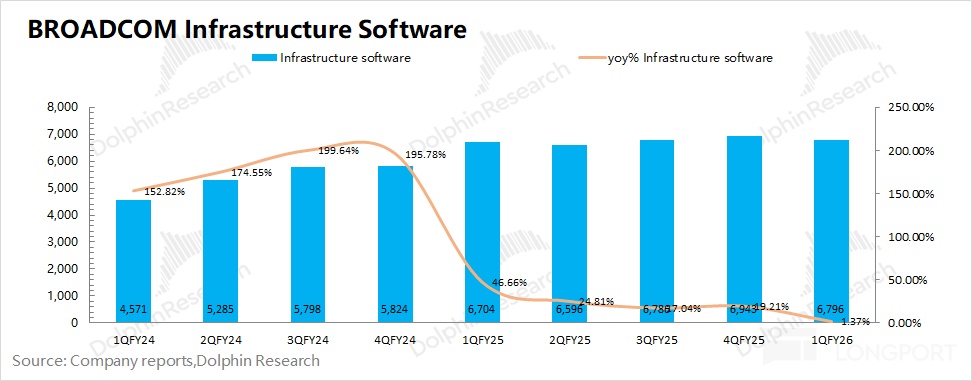
Software comprises VMware plus legacy CA, Symantec and Brocade. The legacy stack runs at roughly $2.0bn per quarter, so the key watch is VMware. Dolphin Research estimates VMware contributed about $4.6bn this quarter. License-to-subscription migration is now above 85%. As subscription penetration rises, VMware and software revenue should still grow, but not at M&A-integration pace.
With the leverage ratio down to 2, VMware has been absorbed. AVGO is no longer breaking out VMware detail; AI is the primary focus.
<End here>
Risk disclosure & statement:Dolphin Research Disclaimer & General Disclosure
The copyright of this article belongs to the original author/organization.
The views expressed herein are solely those of the author and do not reflect the stance of the platform. The content is intended for investment reference purposes only and shall not be considered as investment advice. Please contact us if you have any questions or suggestions regarding the content services provided by the platform.
