

Mingming Is Busy: 10k Stores Are Easy, 10k SKUs Are Hard — Can the Rich Valuation Hold?

On the evening of Mar 31 Beijing time, $BUSYMING(1768.HK) released its 2H25 results. As this is its first annual disclosure post-listing, expectations were muted, and, in Dolphin Research's view, the print raised no red flags. $BUSYMING(01768.HK)
Key takeaways are as follows. Further details below.
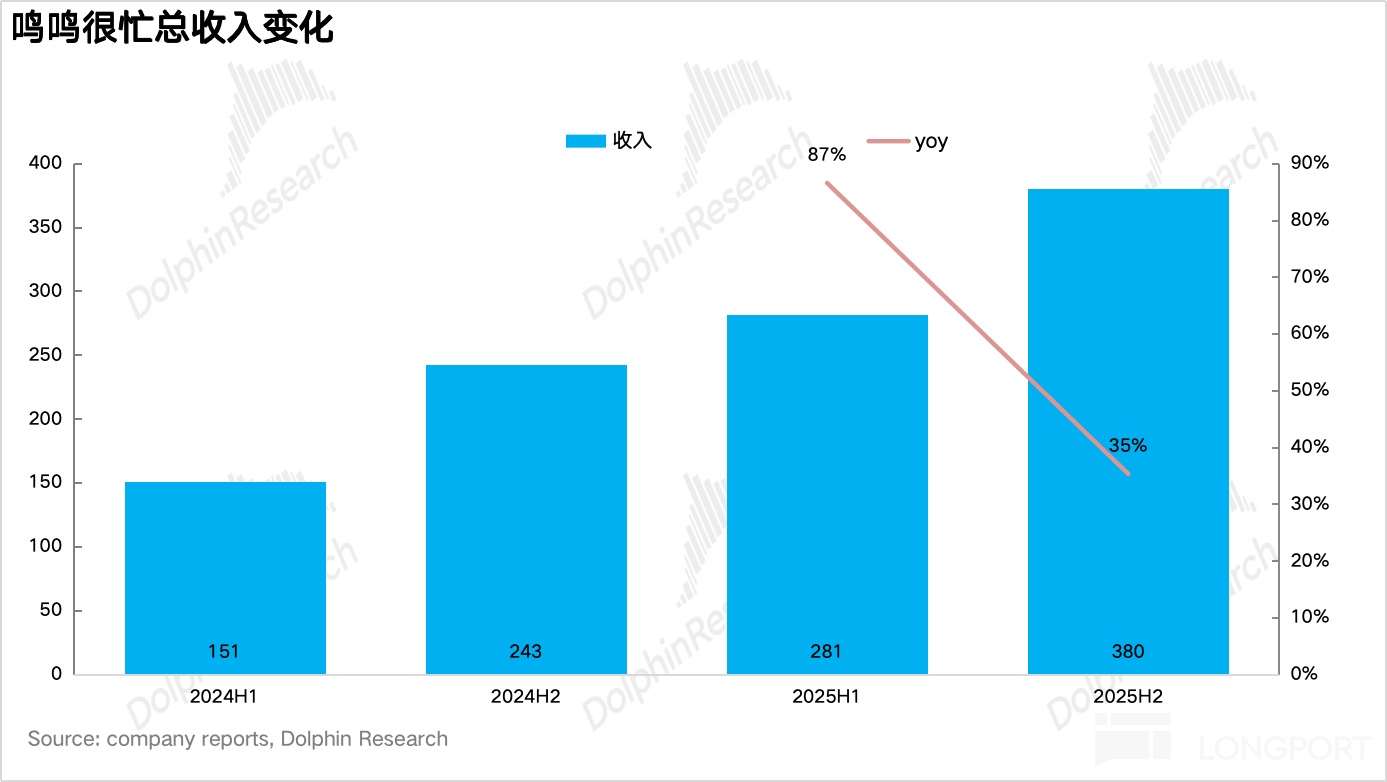
1) Revenue slightly beat. Driven by rapid store openings, 2H25 revenue came in at RMB 38.1bn, +35.5% YoY, modestly ahead of market consensus. This is almost on par with last year's full-year revenue, underscoring the company's high-growth phase.
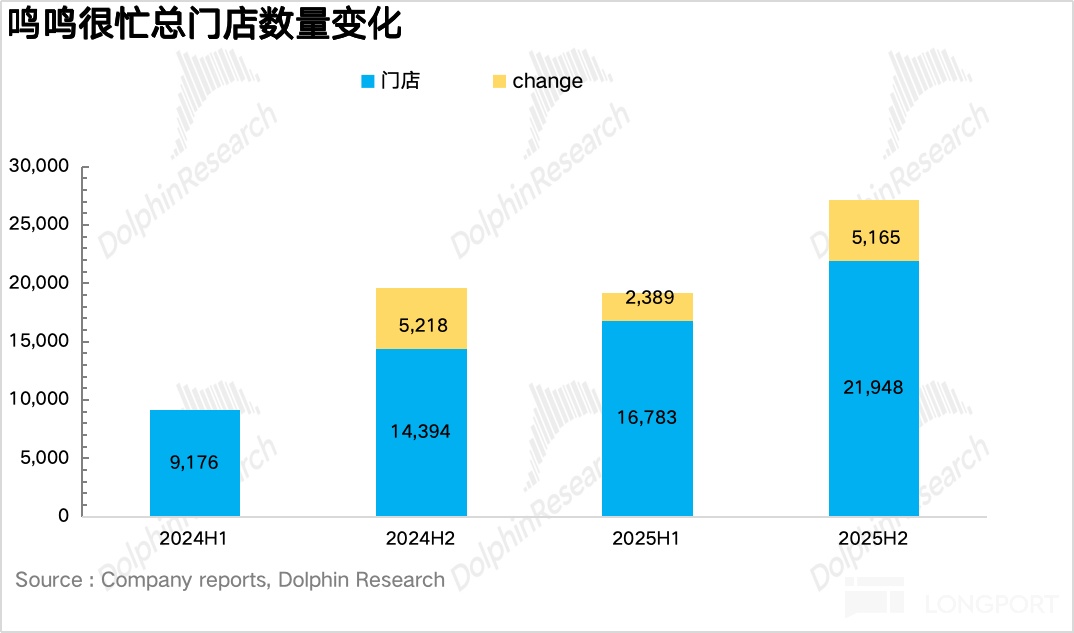
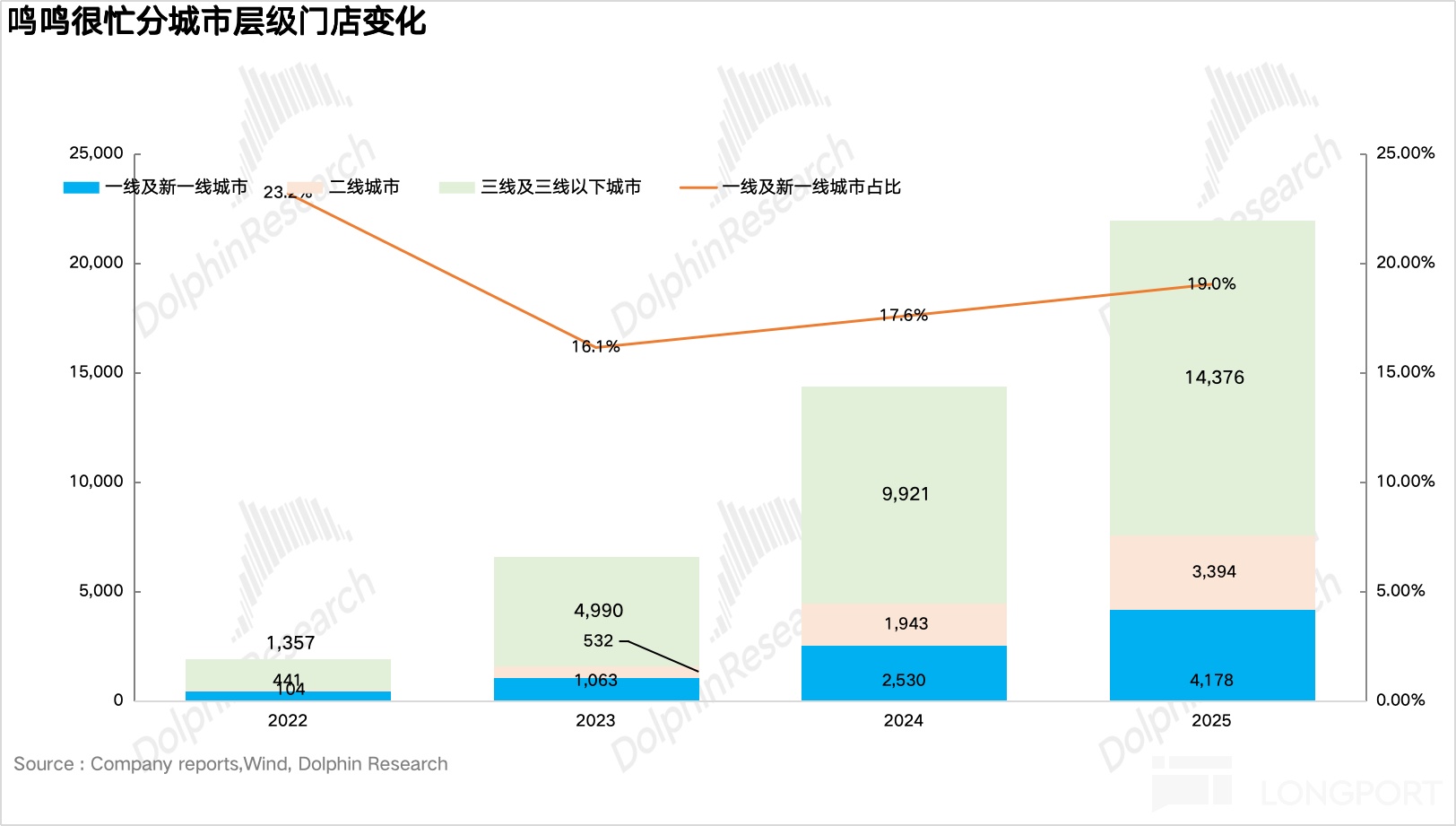
2) Total stores surpassed 20k. In 2H25, net store adds were 5,165, a clear acceleration vs. 1H, taking total stores past 20k. Dolphin Research believes the integration of Zhaoyiming Snacks with the Snack Busy teams is unlocking supply chain and operating synergies, improving franchisee appeal. Structurally, as mass-market snacks already have high penetration in lower-tier cities and counties, new stores in 2H skewed to Tier-1 and New Tier-1 cities, with the mix up 1.4ppt to 19%.
3) Same-store declines narrowed vs. 1H. While the company did not disclose the exact figure, channel checks suggest 2H saw a low single-digit same-store decline, narrowing from a double-digit drop in 1H. By volume/price split, rapid near-term store densification likely diluted basket size, which Dolphin Research views as the main drag on SSS.
From a volume/price perspective, the swift densification of stores led to dilution effects. Dolphin Research therefore infers that lower ticket sizes were the key driver of the SSS softness.
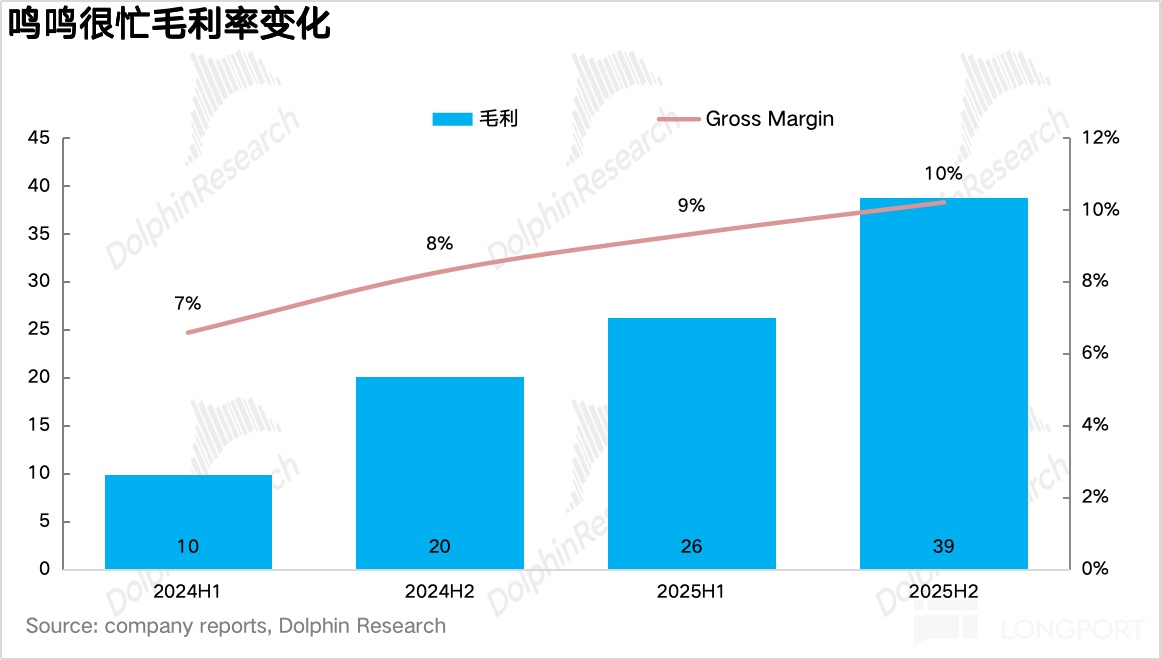
4) GPM crossed into double digits. With larger procurement scale improving bargaining power with upstream suppliers, and with a sizable ramp in own-brand SKU mix in 2H, GPM expanded 190bps to 10.2%.
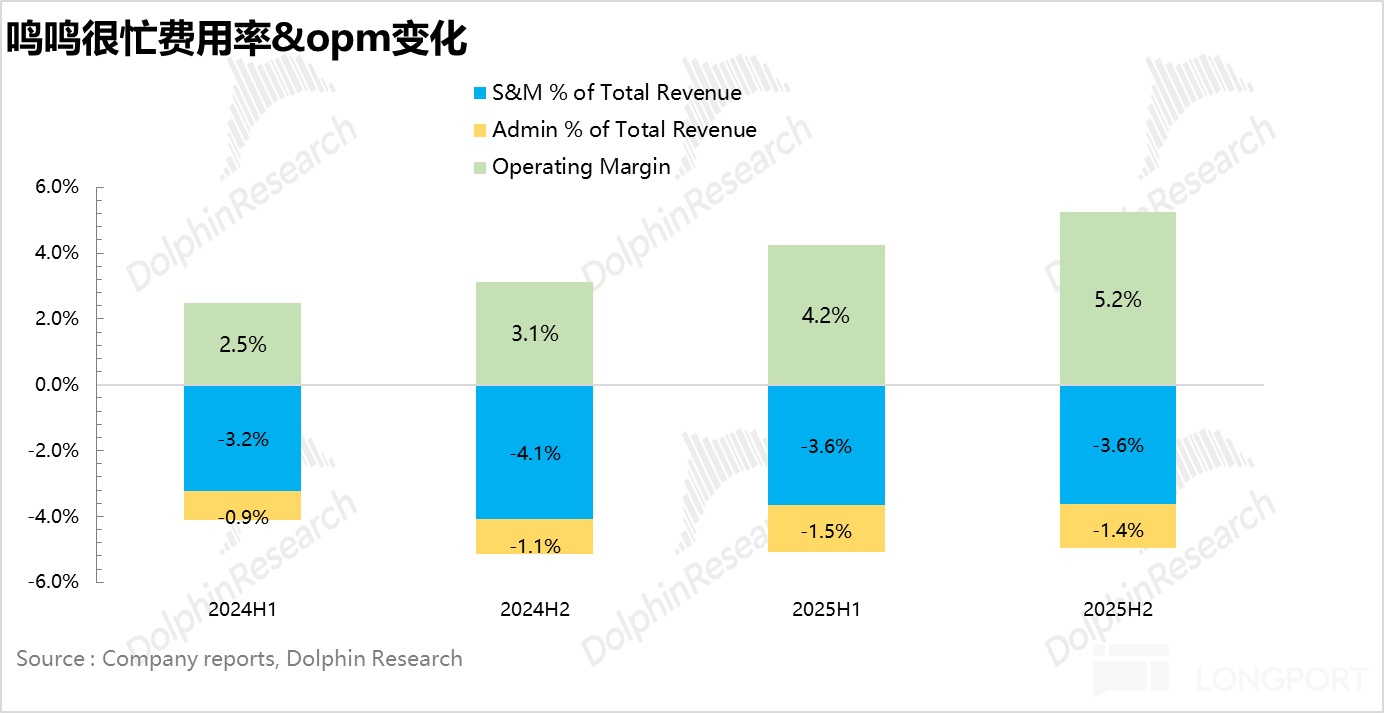
5) Operating leverage unlocked earnings. On selling expenses, as industry competition eased, the company cut defensive promo subsidies and franchise marketing incentives. With private-domain members increasing, reliance on external traffic also fell, driving selling expense down 50bps to 3.6%. Admin expenses rose on one-off IPO-related professional fees, and core OPM reached a record 5.2% in 2H.
6) Financial snapshot:
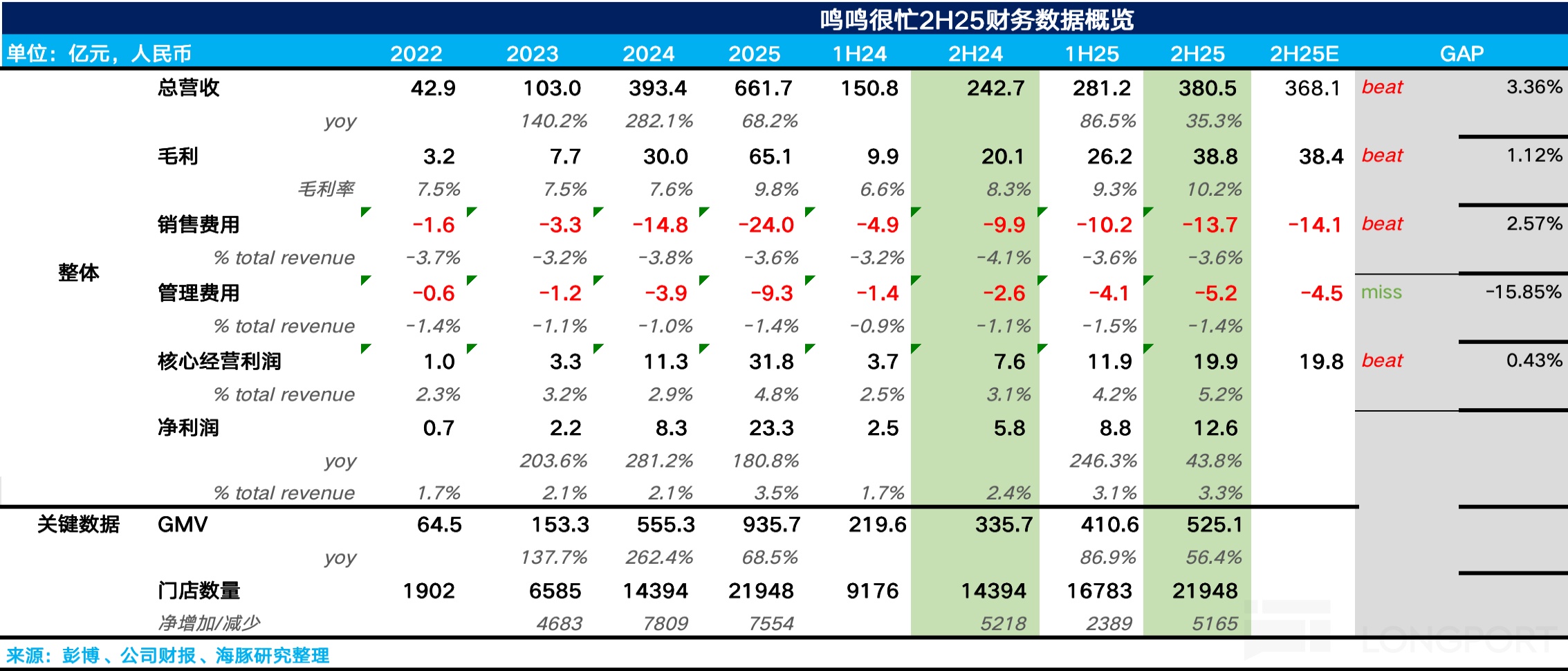
Dolphin Research's take:
On a standalone 2H25 basis, we view growth quality as solid. As store openings accelerated, the SSS decline narrowed; more importantly, GPM gains helped alleviate prior concerns over profitability. That said, looking ahead for a high-growth name like this, the key is the durability of growth.
On the store-opening front, Dolphin Research previously laid out detailed math here: 鸣鸣很忙:从 “万店” 很忙到 “万品 “很忙,是陷阱还是馅饼?. In an optimistic case, the upper bound is ~35k stores.
Given the store base has already reached ~22k, and considering prime-city rents and site competition are far tougher than in counties, with longer cycles from site acquisition to property coordination, a slowdown in store growth from 2026 looks highly likely. We therefore expect a deceleration in expansion momentum at the store level.
For SSS growth, for both franchisees and brands, the outlook hinges on the degree of transition from a 'snack shop' to a 'community discount grocer'. This strategic shift will likely determine the long-term SSS trajectory.
Based on the latest checks, although an all-category discount grocer can deliver higher basket sizes and GPM than mass-market snacks, the addition of low-turn items such as personal care and staples (rice/flour/oil) reduces sales per sqm. On that basis, Dolphin Research believes the transition is not yet successful.
We do not deny that extending beyond snacks is a necessary path to lift SSS over the medium to long term. However, given the uncertainty around how each category impacts sales per sqm, we see limited near-term uplift from category expansion. Execution will likely rely more on refined levers such as assortment selection and product-mix optimization.
On valuation, after a sustained pullback in the share price and assuming 5,000 new stores in 2026 per guidance, a low single-digit SSS recovery, and modest operating leverage, we model ~28% profit growth to RMB 3.0bn net income, implying ~23x PE for 2026. That still screens rich vs. our 2026–2029 EPS CAGR estimate of 16%. Given the high uncertainty around a full-category discount transition, we suggest waiting for valuation to fall below ~15x, or roughly HKD 51.7bn mkt cap, before considering entry.
Detailed read-through of the results:
I. Headline: Revenue slightly beat
Driven by rapid store openings, 2H25 revenue was RMB 38.1bn (+35.5% YoY), modestly ahead of the RMB 36.8bn market estimate. This is nearly equivalent to last year's full-year revenue, indicating the company remains in a high-growth phase.
For the full year, revenue reached RMB 66.2bn, +68% YoY. The trend shows a slowdown from the >100% YoY hyper-growth seen over the prior two years.
II. Store openings accelerated in 2H
In 2H25, net adds were 5,165 stores, a sharp acceleration vs. 1H, taking the total above 20k. One driver, in our view, was a tactical easing of franchise policies in 2H25 to 'sprint' ahead of the 2026 listing. In addition, as Zhaoyiming Snacks and Snack Busy completed deeper integration, supply chain and operating systems connected more smoothly, enhancing franchisee appeal (in 2024, post-merger, the teams were still integrating management and systems).
Structurally, as mass-market snacks have reached high penetration in lower-tier cities and counties, 2H new stores were concentrated in Tier-1 and New Tier-1 cities, with their share up 1.4ppt to 19%, following a classic 'rural-surrounds-urban' path. This mix shift underscores the push into higher-tier markets.
III. SSS declines narrowed vs. 1H
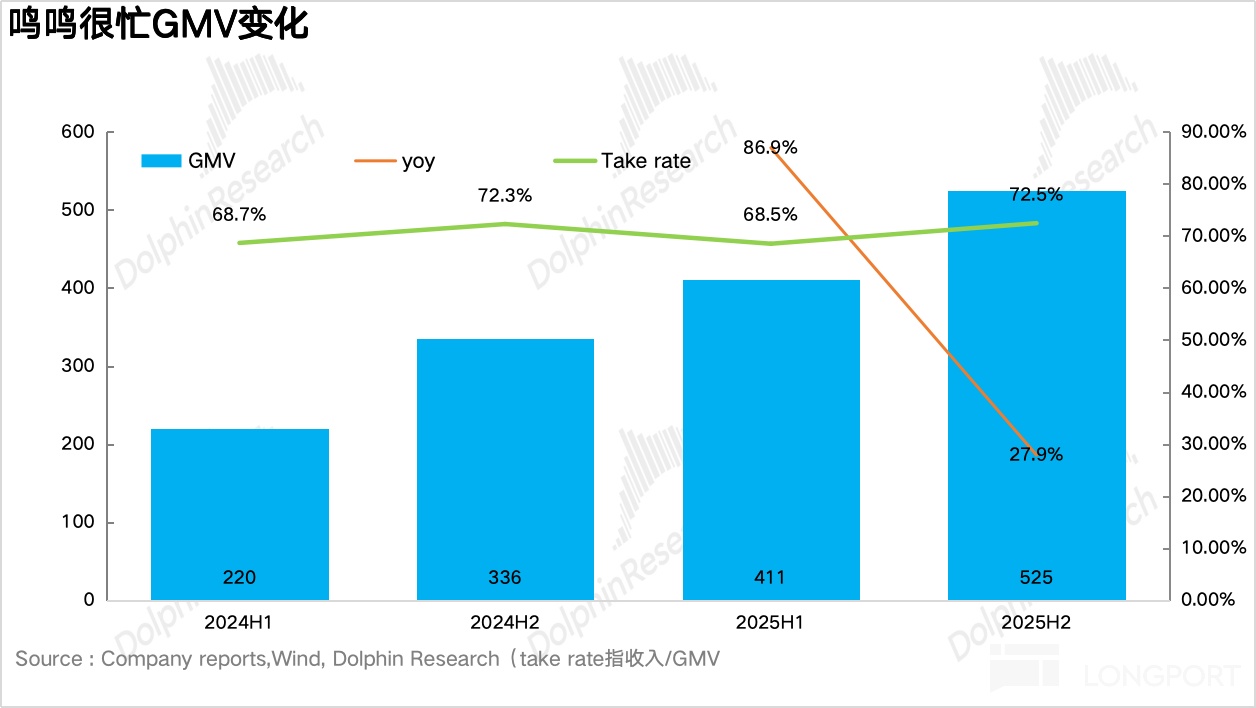
In 2H25, total GMV reached RMB 52.5bn, +28% YoY. The revenue/GMV metric implies the take rate rose to 72.5%, a new high. Given GMV excludes customer returns and discounts (i.e., retail net flow), Dolphin Research infers the GMV share of net flow increased mainly due to softer competition post-merger reducing franchisee discounts, and a higher share of self-operated products (which, net of taxes, are recognized as revenue).
On SSS, while undisclosed, channel checks indicate a low single-digit decline in 2H, narrower than the double-digit drop in 1H. By volume/price, the rapid densification likely diluted average ticket size, which we view as the core driver of SSS pressure.
IV. GPM crossed into double digits
With enhanced bargaining power from larger procurement scale, plus a sizable increase in own-brand SKU mix during 2H, GPM expanded 190bps to 10.2%. These drivers should continue to support margins if mix and scale gains sustain.
V. Operating leverage boosted profitability
On selling expenses, easing competition allowed the company to pare back defensive promo subsidies and franchise marketing incentives. With private-domain members rising, dependence on external traffic fell, taking the selling expense ratio down 50bps to 3.6%.
Admin expenses rose on one-off IPO-related professional fees. As a result, core OPM reached a record 5.2% in 2H.
<End here>
Longbridge Dolphin Research historical pieces on '鸣鸣很忙':
Deep dives
Dec 5, 2025: '鸣鸣很忙:“零食界拼多多” 凭何练就?'
Dec 24, 2025: '鸣鸣很忙:从 “万店” 很忙到 “万品 “很忙,是陷阱还是馅饼?'
Risk disclosure and statements: Dolphin Research disclaimer and general disclosure
The copyright of this article belongs to the original author/organization.
The views expressed herein are solely those of the author and do not reflect the stance of the platform. The content is intended for investment reference purposes only and shall not be considered as investment advice. Please contact us if you have any questions or suggestions regarding the content services provided by the platform.
