


BMNR extreme value derivation 01.12

Over the past week, the crypto market has been relatively flat, with BTC fluctuating around 91k and ETH around 3.1k. Perhaps the market is still waiting for the conclusion of this Thursday's crypto bill review to determine the direction, as the market structure bill is a key component in advancing the implementation of the GENIUS Act. The current focus is on "stablecoin yield," and predictions from Polymarket also indicate a high likelihood of the bill passing, but the question is at what cost.
Apart from this, for BMNR, the shareholder meeting resolution on the 15th is even more critical, as it will determine the ceiling for the company's future growth. The shareholder meeting will primarily vote on four proposals, with the most important being Proposal 2, which seeks to increase the ATM equity financing limit from 500 million shares to 50 billion shares. The rationale for this increase has already been analyzed previously, so we won’t repeat it here—each investor must make their own judgment.
I’d like to speculate on the impact of the voting results. Currently, BMNR approved a 500 million share ATM equity financing application in June 2025 and has already used around 430 million shares, leaving less than 70 million shares. At the current stock price and ETH price, the maximum purchase would be 700k ETH, and without an increase in the limit, the 5% accumulation target cannot be met. The implications of the resolution are as follows:
- If rejected, the company's growth potential will be locked. Submitting a new proposal and waiting for a vote would take at least another six months, during which the inability to accumulate ETH on a large scale would mean missing market opportunities and losing liquidity. A rejection of management’s proposal would also signal a lack of investor confidence in the company’s strategy—a clear negative.
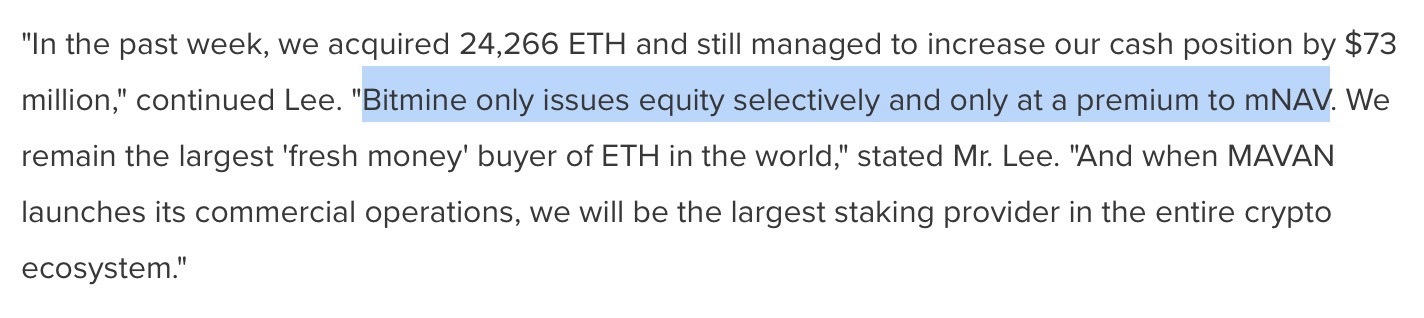
- If approved, Tom Lee has already promised that the company will only conduct ATM financing when mNAV > 1. The company would resolve the financing limit issue in one go, ensuring ample resources to execute more investment plans and prepare for a future transfer to Nasdaq (arbitraging regulatory differences), which is more crypto/tech-friendly.
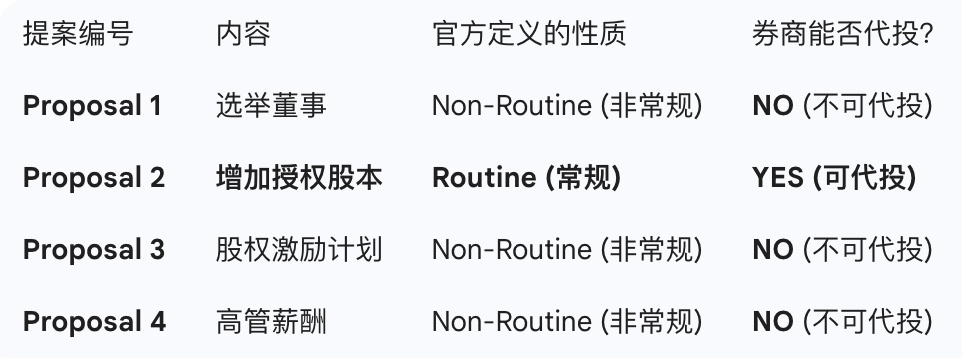
I suspect it’s highly likely to pass. For institutional investors, they’re betting on the company’s future growth potential, so if they continue to hold shares, there’s no reason to vote against it. Retail investors might oppose it due to fears of share dilution, but many may not even participate in the vote. This situation gives brokers discretionary power. According to NYSE Rule 452, how brokers handle non-voting retail investors depends on the nature of the proposal:
- For non-routine matters (e.g., mergers, contentious director elections, executive compensation plans): If retail investors don’t vote, brokers cannot vote on their behalf.
- For routine matters (e.g., auditor approval, increasing authorized shares): If retail investors don’t vote, brokers have discretion—meaning they can vote on behalf of retail investors, with the unwritten rule being to vote in line with management’s recommendation.
For BMNR, the four proposals are bundled. The SEC filing clearly states that increasing authorized shares is a routine matter, falling within the scope of broker discretionary voting. The other three proposals cannot be voted on by brokers, so everything has been carefully designed by the company to ensure the most critical proposal—increasing authorized shares—passes.
Next, we’ll continue tracking mNAV to project extreme scenarios, with the next accumulation update due on the 19th.
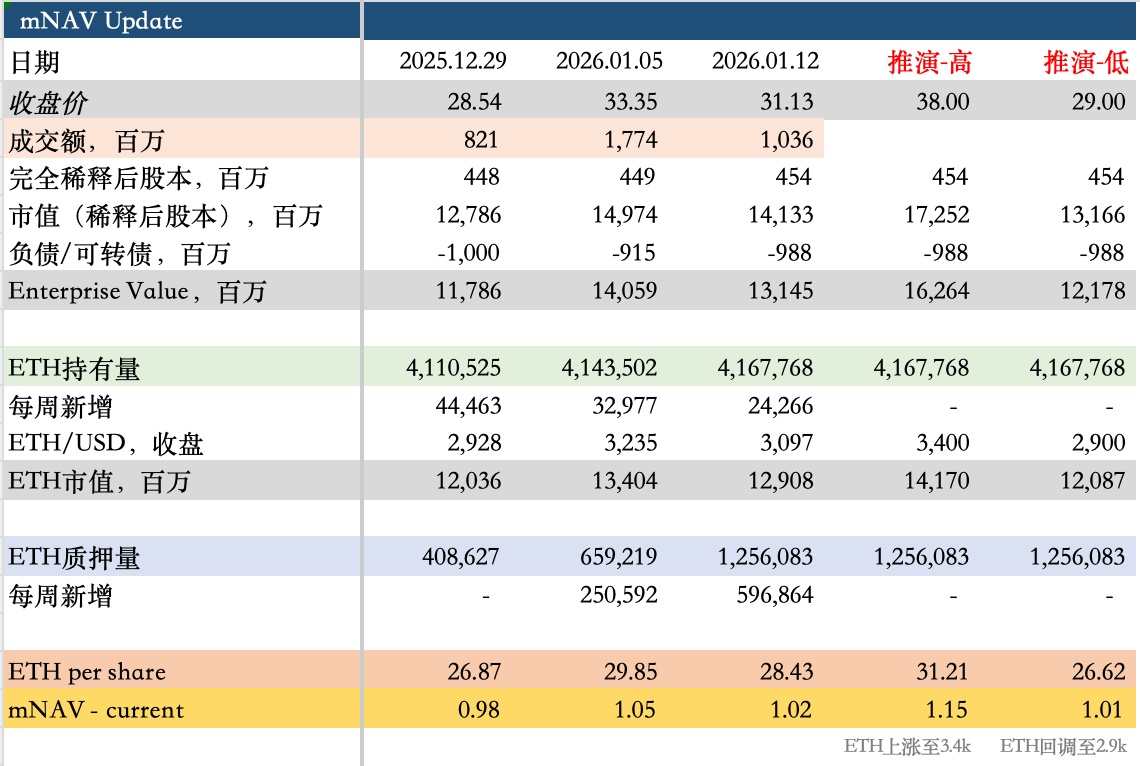
Core assumptions: As of this Monday, BMNR updated its accumulation progress, holding 4.16 million ETH, with 242k added last week. Cash positions grew to $988 million, while staking surged to 1.25 million ETH, with 596k newly staked last week. mNAV currently stands at 1.02. BMNR’s aggressive staking has cleared the ETM unstaking queue, and Tom Lee has explicitly stated that MAVEN will commercialize. Simultaneously, as the largest ETH holder and staking entity, BMNR will effectively function like an ETH central bank, offering stable yield services to institutions—this is BMNR’s biggest growth narrative moving forward.
Conclusion: If ETH rebounds to 3.4k, mNAV would recover to 1.15, implying a stock price of $38. If ETH drops to 2.9k, mNAV would remain at 1, implying a stock price of $29. The extreme range is thus $29–$38.
Not investment advice.
$BitMine Immersion Tech(BMNR.US)
The copyright of this article belongs to the original author/organization.
The views expressed herein are solely those of the author and do not reflect the stance of the platform. The content is intended for investment reference purposes only and shall not be considered as investment advice. Please contact us if you have any questions or suggestions regarding the content services provided by the platform.
