


Behind JPMorgan's stake in XtalPi, most likely:

$XTALPI(02228.HK) by Gemini, for reference only. However, regardless of the reason for holding positions, the capital market is very focused on XtalPi, making it a good betting target with excellent liquidity and concept. This does not affect my determination to realize the long-term value of XtalPi in the future;
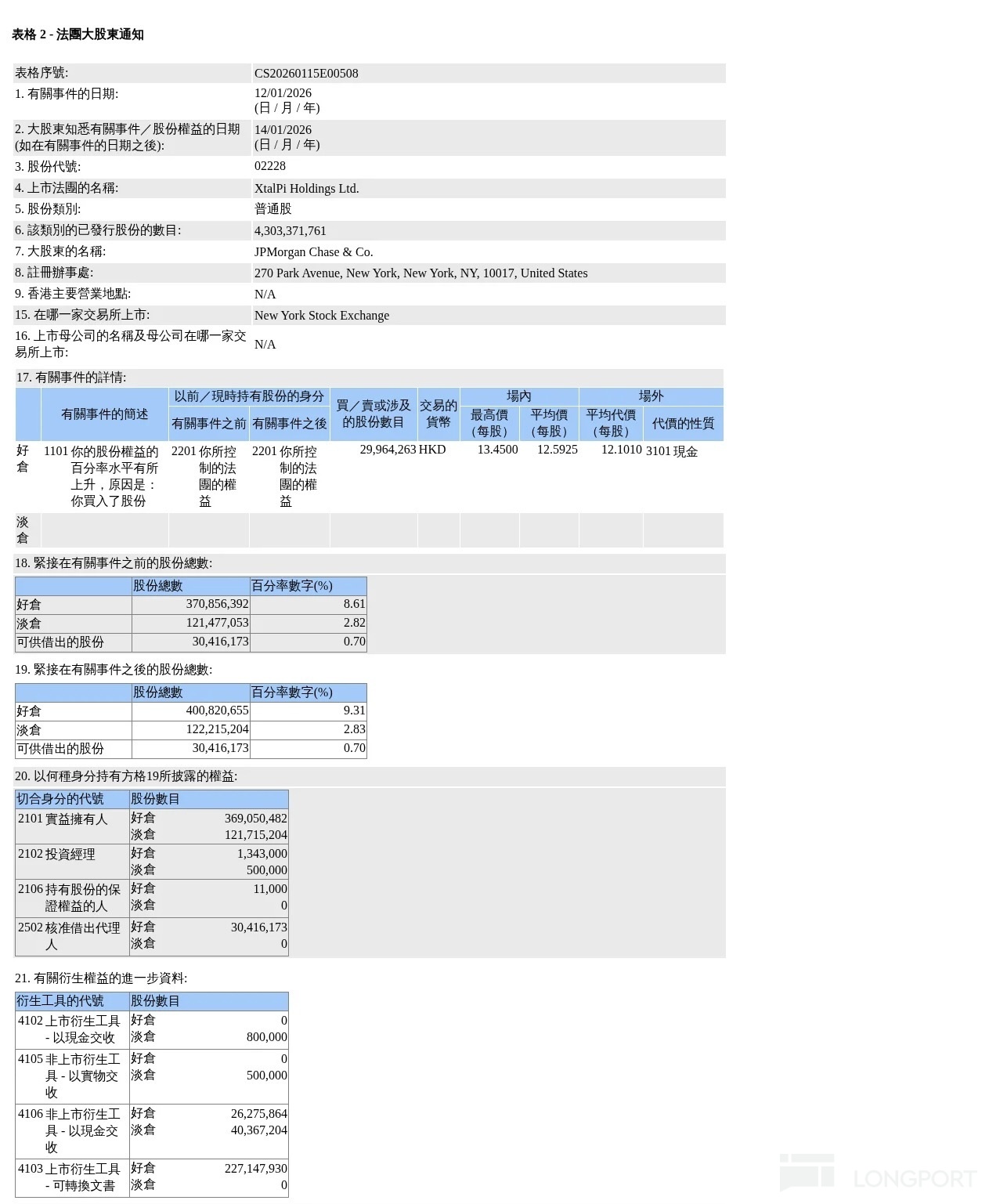
This chart (Form 2 - Disclosure of Interests) contains a wealth of information. By carefully dissecting the codes and data within it, we can clearly discern the motivation behind JPMorgan Chase & Co.'s (JPM) recent increase in holdings.
Conclusion first:
JPMorgan's holdings in XtalPi are largely not long-term value investments (Buy and Hold) because it is "optimistic" about the company, nor are they simply "client positions" held on behalf of retail investors as a brokerage.
The truth is: Its role is more like a **"market maker and financier of structured products". Most of its holdings come from derivatives (mainly convertible bonds) and the hedging positions ** built to offset the risks of these derivatives.
Detailed detective process: The data speaks
To answer your question, we need to look at the breakdown data in items 20 and 21 of the form, where the devil is in the details.
1. Is it buying as a "fund manager"? (i.e., "attracted to XtalPi's good looks")
Answer: Basically no.
Evidence: See code 2102 (Investment Manager) in item 20 of the form.
Data: This portion holds only 1,343,000 shares.
Interpretation: This represents the holdings of JPMorgan's asset management department (funds that actively select stocks for clients). Among its total holdings of approximately 400 million shares, this portion accounts for less than 0.4%. Therefore, this is definitely not JPM's fund managers thinking XtalPi is "good-looking" and making a large-scale position.
2. Is it holding on behalf of clients as a "broker"?
Answer: A small portion is.
Evidence: See code 2502 (Approved Lending Agent) in item 20 of the form.
Data: This portion holds about 30.41 million shares (about 7.6%).
Interpretation: This is usually a stock pool held as a custodian or securities lending agent for lending business (e.g., lending to short sellers). This is a channel business, not its own money.
3. Is it for "derivatives and hedging"?
Answer: Yes, this is the main reason!
There are two key pieces of evidence supporting the hypothesis of "investment bank designing derivatives + hedging":
Key Evidence A: "Beneficial Owner" is a mixed bag
Data: In item 20 of the form, code 2101 (Beneficial Owner) holds a whopping 369 million shares, accounting for the vast majority of the position.
Interpretation: For investment banks, "Beneficial Owner" usually does not mean they want to be shareholders, but rather refers to positions held for their own trading books (Proprietary Trading). This is usually to hedge the risks of derivatives sold to clients.
Key Evidence B: Item 21's "Convertible Bonds" are the real trump card
Data: See item 21 of the form (information on derivative interests). Code 4103 (Listed Derivative Instrument - Convertible Instrument) shows it holds rights to 227 million shares.
Interpretation: This is very critical! It shows that of JPMorgan's total long position of 400 million shares, more than half (about 56%) are actually not stocks but convertible bonds (Convertible Bonds).
This usually means JPM was a financier of XtalPi before or after its IPO, purchasing the company's convertible bonds. Under accounting standards and HKEX disclosure requirements, holding "bonds convertible into shares" is also considered a "long position."
Key Evidence C: Complex hedging operations
Data: Item 21 also includes code 4106 (Unlisted Derivative Instrument - Cash Settled). Here, it shows 26.27 million shares of Long (long position) and 40.36 million shares of Short (short position).
Interpretation: This is typical **"Total Return Swaps"**. JPM sells clients (likely hedge funds) the gains or losses of XtalPi (if clients go long, JPM is effectively short). To offset the risk, JPM must buy XtalPi shares in the secondary market (establish a hedging Long position).
Summary: What does this increase in holdings mean?
Back to the news you saw: "JPMorgan increases holdings by about 29.96 million shares".
Based on the above analysis, the most likely scenario for this purchase is:
Hedging adjustment (Delta Hedging): As XtalPi's stock price fluctuates, the risk exposure (Delta) of JPM's massive convertible bonds (227 million shares of rights) and swap trades (over 40 million shares of short positions) changes. To maintain risk neutrality, the model automatically calculates the need to buy 30 million shares of spot to hedge.
Client swap demand: Some clients may be going long on XtalPi through JPM's swap tools (Swap). As a market maker, JPM must buy shares in the market to "back-to-back" lock in the risk.
The copyright of this article belongs to the original author/organization.
The views expressed herein are solely those of the author and do not reflect the stance of the platform. The content is intended for investment reference purposes only and shall not be considered as investment advice. Please contact us if you have any questions or suggestions regarding the content services provided by the platform.
