
Humanoids: Why Dexterous Hands Are the Bottleneck?

Humanoid Robots: Why dexterous hands are the hard stop?
Following the previous piece where Dolphin Research mapped the humanoid robot value chain, this article drills into dexterous hands and addresses a few key questions.
1) Why do dexterous hands matter? 2) Where are the bottlenecks? 3) What risks and opportunities come with fixing them? 4) What are the future directions and likely commercialization paths?
Enough preamble. Let's get to it.
I. Why focus on dexterous hands?
Elon Musk and $Tesla(TSLA.US) have repeatedly highlighted both the difficulty and value of hands. In multiple Optimus demos, market scrutiny has centered on hand manipulation progress.
Meanwhile, humanoid OEMs, especially in mainland China, have showcased rapid gains in motion control over the past year. They went from simple tricks to dancing and sparring with fluidity that surpasses most humans, yet these flashy moves mostly involve body joints and rarely the hands. This does not mean hands are unimportant. It underscores that hand manipulation is far harder than body joint control.
How important are hands? Imagine a humanoid with prosthetic-like hands: no matter how agile its body is, without dexterous hands it will not outperform wheeled/legged robots, or even basic industrial/collaborative arms, by much.
Hands are in fact the most critical subsystem on a humanoid. From an industrialization lens, they are also the hardest to realize.
A simple example: When humans decide to grasp an object, what informs that action?
First, vision. We see the object and, combining perception with reasoning, infer location, distance, type, and properties.
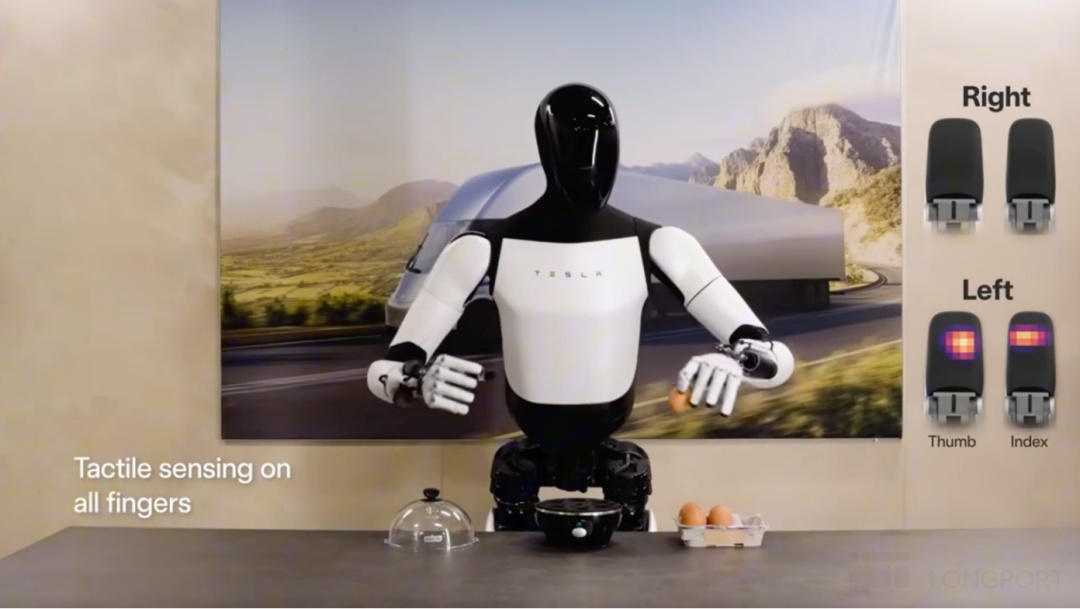
Then during execution, touch takes over. Fingers contact the object, and tactile nerves provide weight, stiffness, temperature, and friction cues, which shape the grasping strategy. For smooth vs. rough surfaces, our approach obviously differs.
Tactile granularity also differs from vision. A fine animal hair may be hard to see, yet is easy to feel with fingertips.
Figure: Optimus handling an egg and using tactile sensors
Source: Tesla, Dolphin Research
The above illustrates the challenge. To endow hands with such capability, where are the bottlenecks?
II. Where are the bottlenecks?
They split across hardware and software. On hardware: high-density integration and multi-modal sensing fusion. On software: large-model architecture and data accumulation.
1) Hardware: high spatial integration and multi-modal sensing
(1) Spatial integration is hard
In Tesla Optimus 2.5, more than 20 DoF components must fit into a tiny volume: motors, planetary gearboxes, micro ball screws, and tendon cables. These must meet high power density, precision, reliability, and life, while keeping cost low.
(2) High sensing requirements with many multi-modal sensors, the toughest being tactile
Sensors, especially tactile, are key. As discussed in our humanoid report, you need high precision with consistent, drift-free data, and robust fusion across modalities. This demands overcoming inherent differences between modalities. That covers hardware. Software obstacles are just as material, and likely take longer to resolve.
2) Software: large-model architecture and data accumulation
You might ask: a dexterous hand is just an actuator module, why software? Not quite.
(1) Algorithms: a core bottleneck
Humanoid control stacks are still evolving and the route is not settled. The consensus for the 'brain' points to end-to-end large models, though type and architecture remain open.
Conceptually, the brain handles perception-reasoning-decision, while the cerebellum receives commands and executes. But do cerebellar functions also require large models, or will classic control suffice? Should the brain sit in the cloud, on-head, centrally in the torso, or can some run at the edge in the hand? There is no standard answer.
Implication for hands: they are not pure hardware and will need embedded software, likely beyond small traditional motion-control loops. In short, the algorithmic challenges facing humanoids are the same ones facing dexterous hands. Moreover, within the full stack, controlling dexterous hands is one of the hardest problems. Multi-modal inputs are required to imitate human grasping, demanding strong multi-modal fusion.
Bottom line: hand R&D must deeply integrate with algorithms. It is not an isolated module.
(2) Data: arguably the biggest bottleneck today
Human motion data collection and labeling are extremely complex and costly, with very high accuracy requirements. Current humanoid datasets are far from sufficient.
Compare with autonomous driving. Global NEV sales are nearing 20 mn units annually, enabling far more data accumulation than robots can. Even so, autonomy is not yet mature. Humanoid perception and control are more complex than driving, implying even larger data needs. Data scarcity is therefore a severe constraint, and it disproportionately limits hand capability.
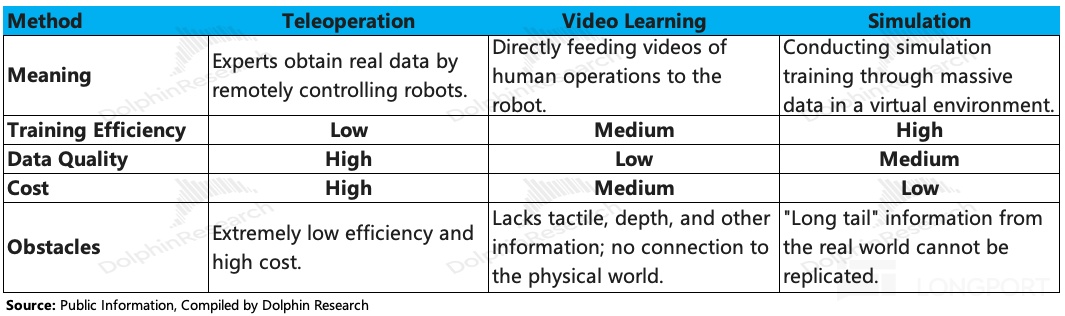
We noted above that complex whole-body motions are increasingly achievable under conditions, yet hands lag far behind. Simulation helps but exposes hand limitations.
With more realistic physics engines like Nvidia Isaac Sim, basic gait training can be done virtually at lower cost. But subtle long-tail scenarios (e.g., material friction nuances) and complex interactions remain hard to simulate faithfully, and these are precisely hand-heavy tasks.
Table: Pros/cons of training methods
That summarizes our view of the hand’s challenges. Next we look at hardware investment angles.
III. Which hardware matters, and which listed companies are involved?
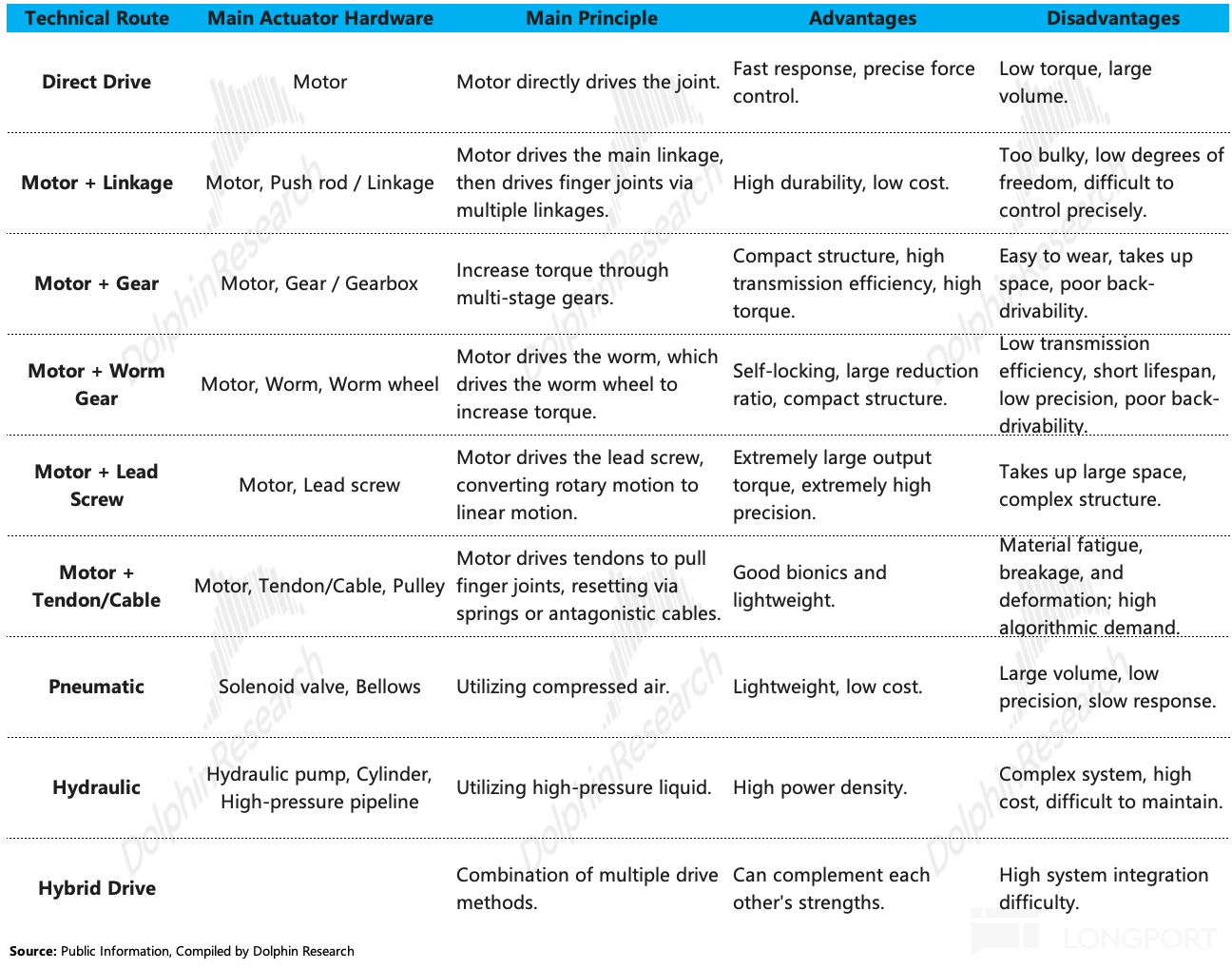
Dexterous-hand hardware paths are not yet converged; OEMs are still exploring. The lighthouse remains Tesla’s Optimus. In the latest demo, the actuator stack largely uses motor + planetary gearbox + micro screw + tendon architecture. We map hardware on that basis.
Table: Actuator technology comparison
(A) Decomposing the structure The hand has 22 DoF per side, akin to joints. Of these, 17 are actively driven by actuators, i.e., the motor + planetary gearbox + micro screw + tendon chain.
Figure: DoF of the hand and wrist
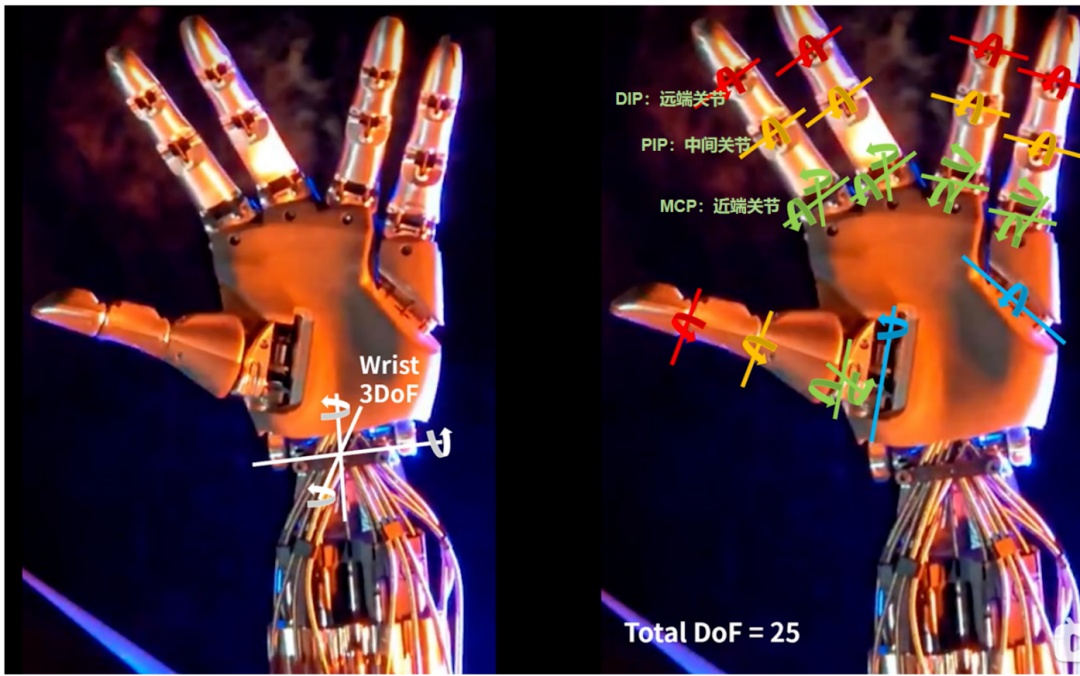
Source: Tesla, Dolphin Research
Details:
1) Motors: The prime movers, placed in the forearm. Early versions reportedly used six coreless motors, but with 17 active DoF in v2.5, the count likely far exceeds six. Per supply-chain chatter, they could be coreless or slotless brushless motors.
2) Planetary gearboxes: Also in the forearm and coupled to motors, they reduce speed and boost torque, similar to rotary joints in the body.
3) Micro screws: Convert rotary to linear motion and sit in the forearm. Why add screws after gearboxes? Size, precision, and life considerations.
4) Tendon module: Connects the screw nut to the fingers, routing through the palm to transmit linear force. Both active and passive joints link via tendons.
The drive chain is straightforward: a cerebellar command spins the motor, torque passes through the planetary gearbox, then to the micro screw, then to the tendon, and finally to the finger. Tendons play the role of human hand flexor/extensor tendons.
Figure: Optimus forearm
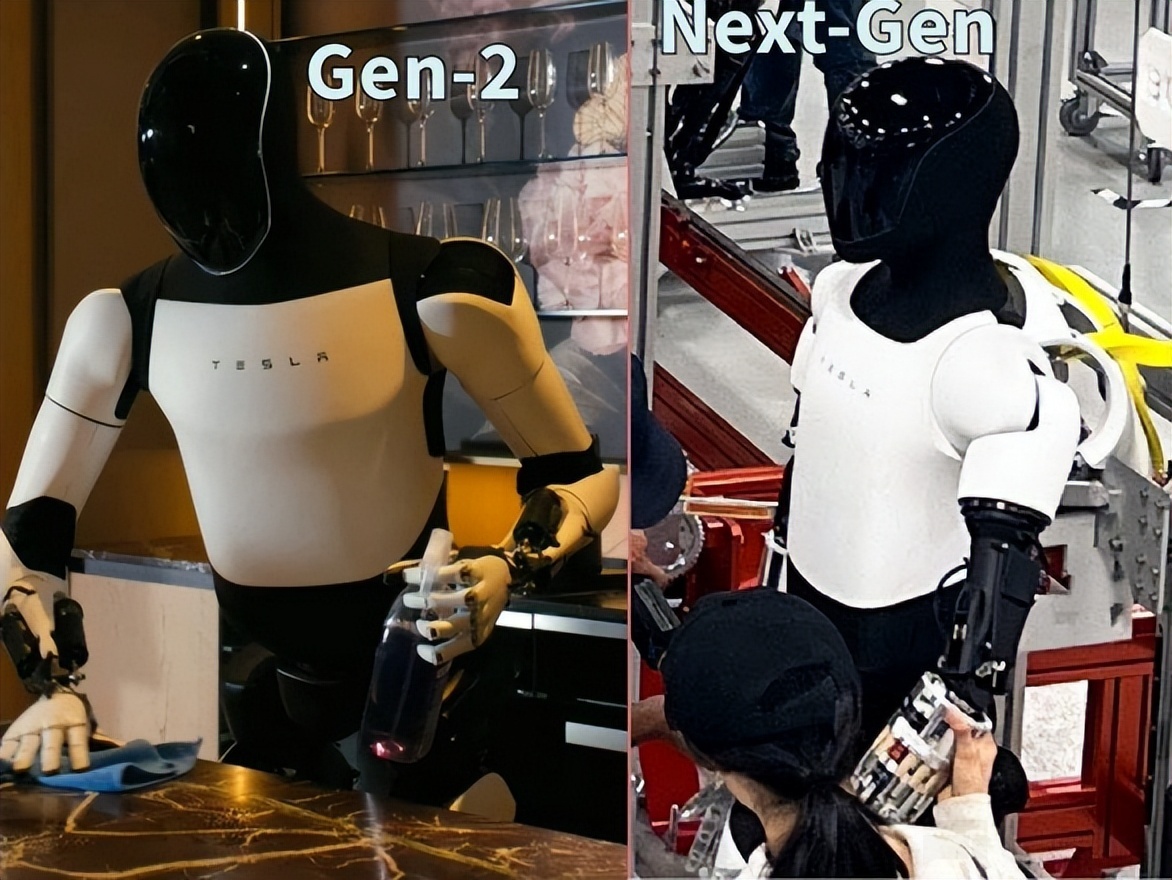
Source: Tesla, Dolphin Research
Various sensors are also used. Earlier versions placed tactile sensors at five fingertips; the latest likely expands coverage across the palm, with counts far above five.
(B) Value chain segments, hardware, and related companies
1) Tactile sensors
We have covered tactile sensing before, so here we focus on changes. Expect area and counts to increase, expanding from fingertips to the entire palm. Architectures may shift from pure piezoresistive to hybrid piezoresistive + capacitive. Even high-precision capacitive stacks still struggle to recover ultra-fine surface textures and contact mechanics, so further evolution is likely.
2) Actuation hardware: motors, planetary gearboxes, micro screws
Potential shifts: motors may migrate from coreless to slotted BLDC micro frameless units to cut cost, with later changes still possible. Screws may upgrade from micro ball screws to planetary roller screws to meet tighter precision, load, and life specs.
3) Tendons
A pivotal element in Tesla’s latest design. The core challenge is materials.
Unlike rigid parts, tendons deform, leading to issues: (1) creep over time with non-recoverable deformation; (2) elastic stretch during actuation causing hysteresis; (3) wear and potential breakage, degrading load capacity and life.
Materials include metal and high-performance polymers (typical: UHMWPE). UHMWPE is viewed as the scalable mass-production route. The most advanced offerings are from Royal DSM (now DSM-Firmenich). Other suppliers include Honeywell International, Toray Industries, and Mitsui Chemicals. Several mainland China firms are progressing through validation, including 南山智尚、同益中、恒辉安防。
Table: Tendon material options vs. properties
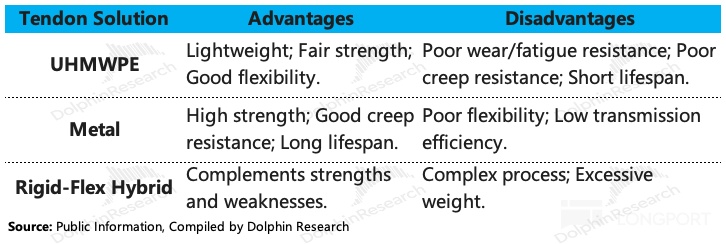
Figure: Schematic of a hybrid-driven tendon mechanism
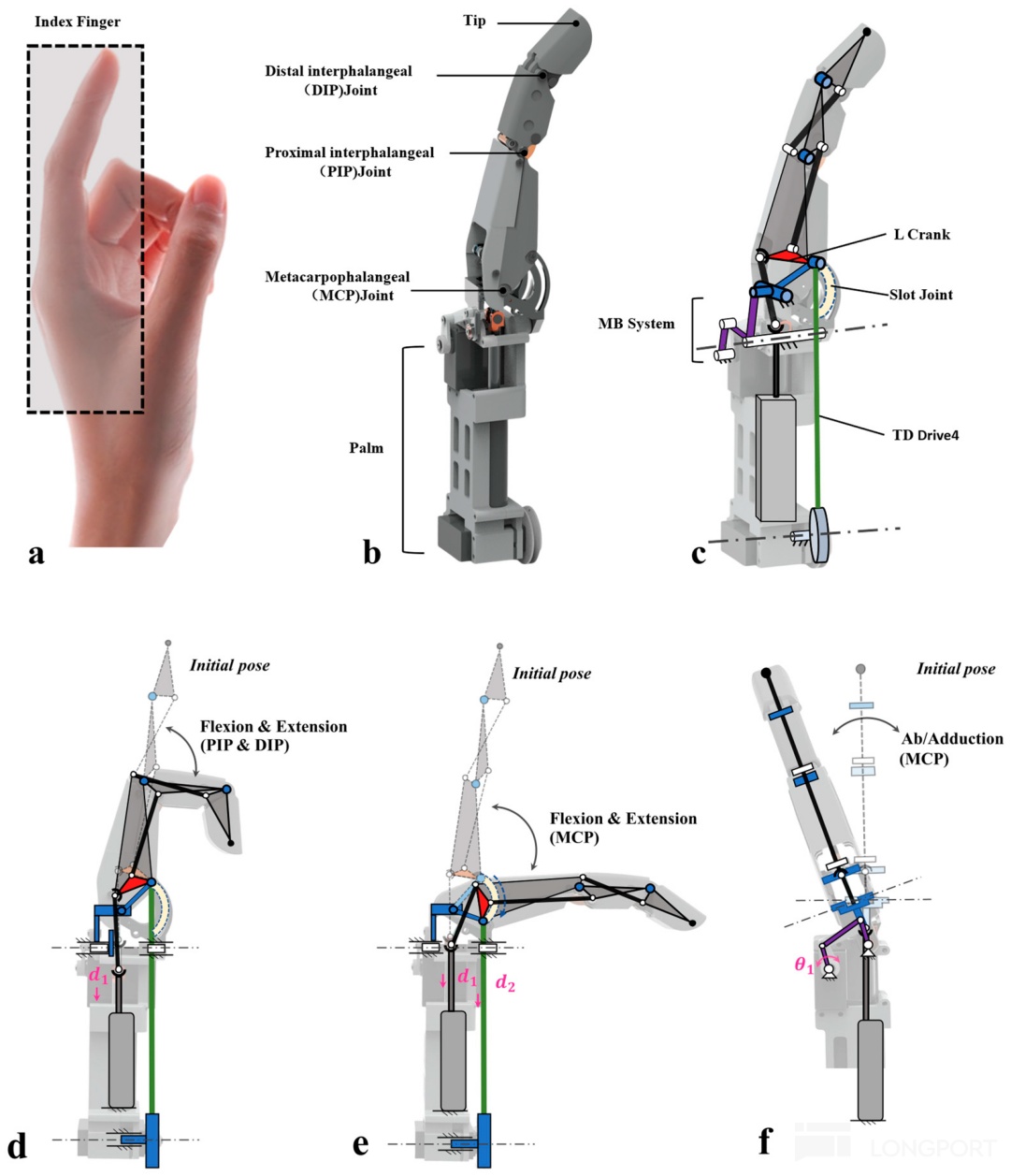
Source: 'Finger Unit Design for Hybrid-Driven Dexterous Hands', Chong Deng, et al., Dolphin Research
4) Assembly
As noted in our report on Sanhua, Tesla tends to outsource actuator assemblies rather than buy parts to build in-house. The hand follows the same assembly-first logic.
Multiple mainland suppliers are advancing collaborations with Tesla on hands. Per supply-chain feedback, faster movers include 新剑传动 (hand screws and hand assembly) and 浙江荣泰 (hand screws and hand assembly). Other potential players include system suppliers like Top Group and $SANHUA(02050.HK).
5) Independent hand developers
The humanoid boom is accelerating low-cost dexterous-hand solutions. But hands are modular and not confined to humanoids.
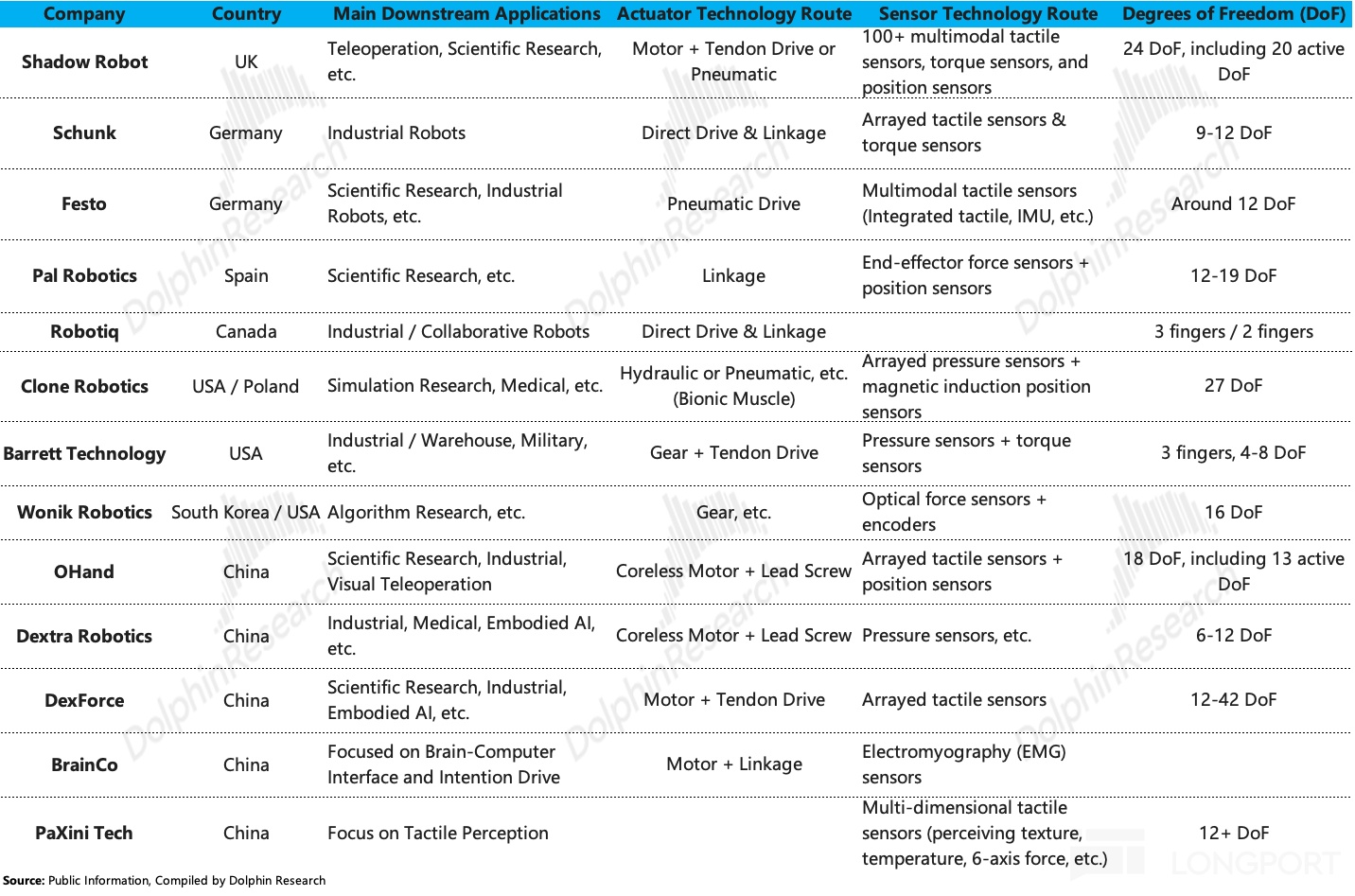
Mounted on a wheeled robot, a quadruped, or an industrial arm, they can add meaningful capability. Several global startups focus on hand R&D/production; while mostly unlisted, they offer a window into technology evolution and convergence paths.
Table: Landscape of dexterous-hand companies
(C) Where are the risks?
1) Technology paths not converged
Dexterous-hand solutions have not converged, which means current designs still fall short of needs. If a path becomes standard, it creates investable upside for aligned vendors; if abandoned, expectations will break.
Why analyze hardware now? Because understanding the what and why enables forward-looking judgment on likely shifts. For example, in Tesla’s latest design, many actuators sit in the forearm to shrink hand volume and boost DoF. But this raises structural complexity, control latency, and heat buildup.
Looking ahead, to mitigate these trade-offs, OEMs might sacrifice some finger DoF temporarily, which would hurt certain actuator parts. They might also add thermal hardware, which would benefit heat-management suppliers.
Based on the above, we see several iteration priorities:
(1) Further cost-down remains essential. (2) Sensing must be sensitive and precise enough to enable large-model effectiveness. (3) Integration and performance targets require careful actuation trade-offs, not only part-level swaps but potentially rethinking the entire power-transmission chain.
(4) Materials need advancement to balance flexibility, accuracy, and life. (5) Thermal management could become an incremental content area. (6) Watch cross-effects across subsystems, e.g., can tendon issues be mitigated via algorithmic error correction or added position-sensor feedback?
2) Supply chain not converged
The investment community is clearly bullish on humanoids. As many OEMs are unlisted, hardware names have become liquidity proxies.
If Tesla’s roadmap holds and the industry enters mass production in 2026, supply chains will likely consolidate. Early-stage validation often involves multiple vendors per component, but in mass production, OEMs typically settle on 2–3 suppliers per node. Those that do not make the final list risk expectations reset.
IV. Outlook beyond specific parts and companies
1) Are dexterous hands truly indispensable on humanoids?
From task generalization and environment fit, a five-finger hand is the natural end-effector choice. Humanity’s tools are built around human physiology.
Why not mount a spatula to fry food directly, instead of giving a robot a hand to hold the spatula? Because the hand is the universal interface to countless tools, akin to a low-level API or human language. Without hands, generality is out of reach.
Data and training efficiency also argue for hands.
One of the biggest bottlenecks is data. The most reliable data source is the real world. The most direct way to collect it is to observe and imitate humans. Without human-like hands, imitation breaks. Hands allow a direct mapping from human actions to robot actions, maximizing data efficiency and making transfer more natural and accurate.
2) Are dexterous hands ready for immediate commercialization?
Near term, use will concentrate in constrained settings. Optimus will likely first deploy hands inside Tesla factories for data collection and training, and in less cost-sensitive areas like research and education. Broad general-purpose use will take time.
As discussed, data is the main bottleneck and must be gathered in the real world over sufficient scenarios and time. That process cannot be skipped.
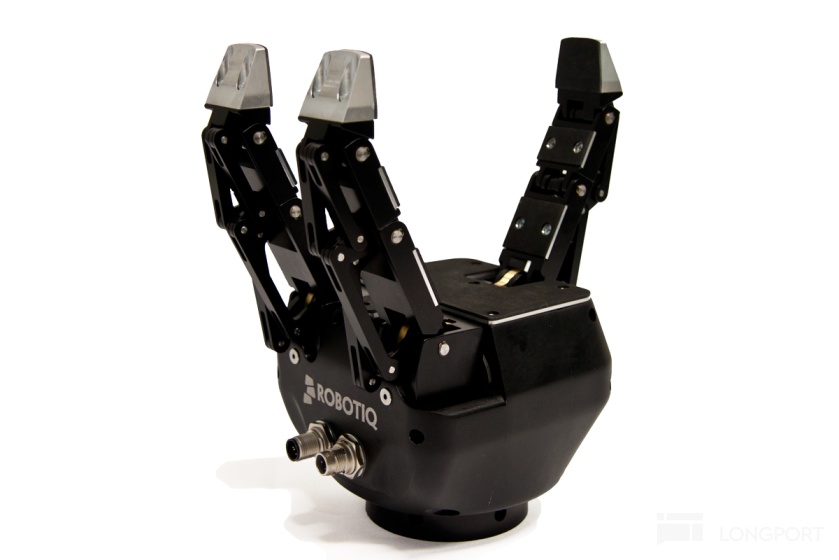
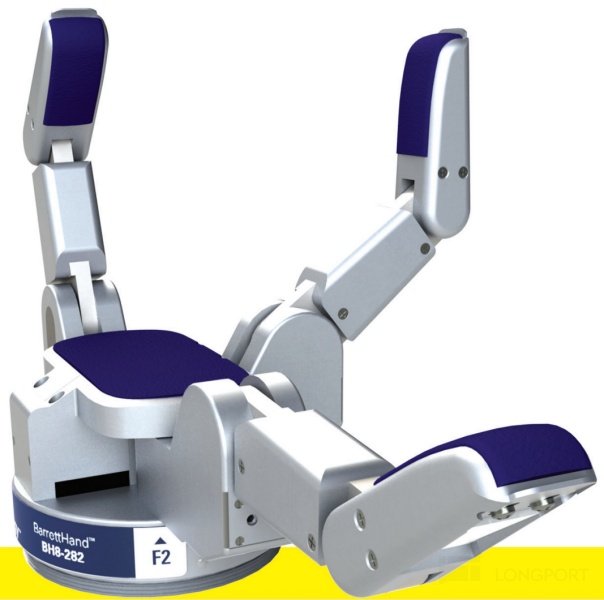
However, interim forms may commercialize earlier: two-finger or three-finger variants, fewer DoF, underactuated designs, or simplified sensing, tailored to semi-general, semi-specialized scenarios.
Figure: Robotiq three-finger gripper
Source: Robotiq, Dolphin Research
Figure: Barrett Technology 'BarrettHand' three-finger hand
Source: Barrett Technology, Dolphin Research
This kind of 'scenario downshift' mirrors autonomy’s path. Some players aimed straight at L4/L5, while others took a gradual route, launching L2/L3 ADAS to gain entry, fund R&D, and iterate.
In the past two years, before full autonomy, Tesla and leading mainland NEV makers rolled out scenario-based ADAS like highway NOA, urban commute NOA, and all-scenario NOA. Constraining scope and simplifying tech enabled commercially viable products. In parallel, these deployments collect data to improve algorithms and inch toward the end state. This balances cash flow sustainability with product iteration.
<End>
Related by Dolphin Research:
Humanoid Robots: The real hope for AI?
Sanhua: In the AI robot era, will the cross-sector veteran have the last laugh?
Risk disclosure and statement: Dolphin Research disclaimer and general disclosure
The copyright of this article belongs to the original author/organization.
The views expressed herein are solely those of the author and do not reflect the stance of the platform. The content is intended for investment reference purposes only and shall not be considered as investment advice. Please contact us if you have any questions or suggestions regarding the content services provided by the platform.
