

TSLA 2026: $20bn Capex, All-in AI Master Plan
Below is Dolphin Research's$Tesla(TSLA.US) 4Q25 earnings call Trans. For our earnings take, see 'Tearing Up the 'Bad Print' Script: Can Tesla Stage a Comeback?'
I. Core Takeaways
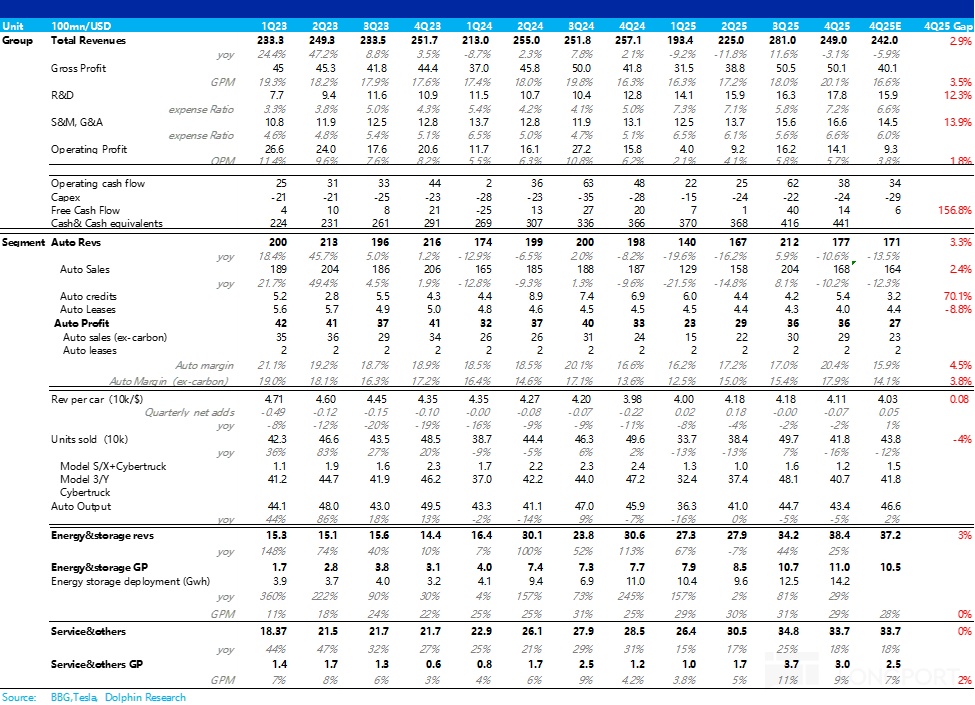
II. Call Details
2.1 Key Executive Remarks
CEO Remarks
1) Strategy
a) Mission update: Tesla has updated its mission to 'Amazing Abundance'. The aim is to use AI and robotics to drive society toward a high-income future for all.
b) Growth engine: The biz. is shifting away from a traditional auto-sales model. Future growth will be driven by AI.
2) Auto
Portfolio: Starting next quarter, Tesla plans to phase out Model S/X production and repurpose that capacity for Optimus. Legacy owners will continue to receive after-sales and support.
Demand and regions: In Q3, U.S. demand was pulled forward by expiring subsidies, which partially weighed on Q4.
Intl demand was strong, with APAC and EMEA resilient and several smaller markets (Malaysia, Norway, Poland, Saudi Arabia, Taiwan) posting record deliveries.
New models: Tesla aims to unveil the next-gen Roadster in Apr 2026. The target is a first public reveal in that month.
Capacity constraints: Into 2026, battery packs remain the core bottleneck to vehicle capacity expansion. Wider use of 4680 cells in non-structural packs is alleviating constraints.
3) Autonomy (FSD/Robotaxi)
Robotaxi:
Progress: In Austin, Tesla is running paid rides with no safety operator and no chase car, achieving fully driverless ops. More than 500 Robotaxi vehicles currently serve paying riders in the Bay Area and Austin, and the v14 software has been pushed with markedly better user feedback.
Expansion: Subject to regulatory approvals, fully autonomous vehicles are expected to cover roughly one-quarter to one-half of the U.S. by end-2026. Tesla also plans an Airbnb-like model that lets owners add their cars to Tesla's fleet for income.
CyberCab: CyberCab production is slated to start in Apr 2026. It has no steering wheel or pedals and relies entirely on autonomous driving. Longer term, annual output of this model is intended to exceed the combined volumes of all other models. The core goal is the lowest cost per mile and high utilization (50–60 hours/week), with a design closer to commercial vehicles than personal cars.
FSD:
FSD adoption continued to rise this quarter, with nearly 1.1 mn paying users globally, about 70% of whom are one-time purchasers. Starting this quarter, Tesla will fully shift to an FSD subscription model. Thus, net adds will mainly come from subs, which may pressure auto GPM in the near term.
4) Robotics (Optimus)
Product and tech: Optimus Gen3 is expected within months as a general-purpose humanoid, learning via observation, language, and video. It targets systemic advantages across dexterous hands, real-world intelligence, and scaled manufacturing.
Capacity plan: Fremont's S/X lines will be converted into an Optimus base, with a long-term annual target of 1 mn units. Given a greenfield supply chain, ramp will follow a relatively gradual S-curve.
Deployment stage: The focus remains R&D and internal pilots, with no material contribution to productivity yet. Scale-up is expected after late 2026.
Long-term impact: Optimus could meaningfully lift U.S. GDP. It is one of Tesla's most disruptive long-horizon growth vectors.
5) Energy
Megapack and Powerwall demand remains strong, with a healthy 2026 backlog and balanced regional mix. Megapack 3 and Mega Block should further increase deployment.
However, lower-priced competition, policy uncertainty, and rising tariffs may pressure GPM. Long term, Tesla believes solar is underappreciated and plans a 'ground solar + storage + space solar' system.
The goal is 100 GW/yr of solar cell capacity with a vertically integrated supply chain from raw materials to modules.
6) AI infra and chip supply chain
Chip R&D: Priority one is completing AI5 design, with AI6 targeted within a year. Chips will first serve vehicles and robots, with no external sales planned near term.
TerraFab: To address supplier capacity bottlenecks in 3–4 years and geopolitical risk, Tesla plans a U.S.-based mega fab integrating logic, memory, and packaging (TerraFab). This is a domestic, full-stack wafer facility plan.
7) xAI investment:
Tesla invested $2 bn in xAI to accelerate 'Master Plan Part 4', aiming to use Grok to manage large-scale autonomous fleets and robot production. The focus is tighter integration between Grok and Tesla's autonomy/robotics stack.
8) 2026 outlook:
CapEx: 2026 CapEx will exceed $20 bn, making it a heavy investment year. Funds will support six plants (including lithium refining, LFP, CyberCab, Semi, a new Megafactory, and an Optimus plant) and AI compute, excluding potential solar and semiconductor fab spends. AI initiatives and new-product spend will be spread throughout the year.
Cash and financing: Cash and investments exceed $44 bn, with a preference for internal funding. Bank financing is being considered to support Robotaxi fleet expansion.
CFO Remarks
1) Volume: In autos, U.S. demand surged in Q3 ahead of subsidy expiry, pulling forward some Q4 demand. Elsewhere, demand improved with record deliveries in Malaysia, Norway, Poland, Saudi Arabia, and Taiwan, and continued strength in APAC and EMEA.
As a result, order backlog into end-2025 is higher than in recent years. Note that these markets have not yet rolled out the latest FSD supervised.
2) Auto GPM: Ex-subsidies, auto GPM rose QoQ from 15.4% to 17.9%. Despite a 16% QoQ decline in deliveries, auto GP was roughly flat, helped by mix with higher APAC and EMEA shares.
Looking to 2026, as autonomy improves, the focus is to raise capacity across all plants. Battery pack supply remains the global constraint. Teams continue to iterate solutions, including wider use of 4680 cells in non-structural packs.
3) Energy: Deployments hit another record. Strong demand for Megapack and Powerwall across regions underpinned momentum. We appreciate customers and our teams for supporting sustained growth.
4) Services and other: GPM fell from 10.5% to 8.8%, mainly due to higher service-center labor costs as we staff ahead of growth. Supercharging GPM improved within this segment.
Robotaxi-related costs (currently small) are also included here. Given the early stage of fleet deployment and heavy validation testing, per-mile revenue and cost metrics are not yet meaningful.
5) Total GPM: Total GPM exceeded 20.1% this quarter, the first time in over two years. This came despite lower fixed-cost absorption and tariffs (over $500 mn in Q4).
Opex rose QoQ on higher stock-based comp and the start of cost recognition for a 2025 performance-award milestone viewed as likely achievable long term. AI-related and new-product spend on CyberCab, Semi, Optimus, and Megapack remains elevated.
We expect this to persist through 2026. Investment levels reflect our multi-year buildout phase.
6) Net income: NI was impacted by mark-to-market losses on Bitcoin holdings (BTC down 23%) and FX swings, mainly from large intercompany transactions. These external factors weighed on reported profitability.
7) FCF: FCF was $1.4 bn in the quarter. Q4 CapEx came in slightly below the prior $9 bn guide.
2.2 Q&A
Q: Under the Robotaxi vision, how does Tesla see the roughly 90 mn annual global auto market evolving over the next 5–10 years? How would this shift affect Tesla's prior strategy of expanding EV adoption via more models?
A: CyberCab is a purpose-built AV taxi defined by global mobility data. Over 90% of miles are driven with 1–2 passengers, so it uses a minimal two-seat layout with no steering wheel or pedals and no human takeover. Its edge is Tesla's decades of scale manufacturing, cost control, and production efficiency.
Production is expected to start in Apr, with an S-curve ramp from a low initial base to exponential growth before stabilizing at target run-rate.
Longer term, autonomy will reshape market size and structure, and this product fits the vast majority of 1–2 rider trips. We expect annual incremental demand in the millions, with CyberCab's long-term annual output exceeding the total of current legacy models.
Q: Will Tesla still launch products across different price bands and form factors to materially expand TAM?
A: We are expanding TAM by lowering vehicle cost and shifting toward TaaS rather than just selling cars. In recent months, we introduced the lowest-priced models ever globally, leveraging process iteration to reduce entry price without sacrificing performance.
Strategically, we will pivot from pure car sales to autonomy-led services. Multiple Robotaxi forms and sizes are planned, with CyberCab comprising the majority of volume.
With autonomy, premium mobility can scale to a market 5–10x larger than today. Over 95%—potentially up to 99%—of miles will be driven by autonomy rather than humans.
This shift moves us from a traditional automaker logic to a capacity-for-hire model centered on autonomous miles. The addressable market far exceeds that of selling cars alone.
Q: For existing models (ex-FSD), does Tesla still target a standalone vehicle GPM?
A: As mobility automates, the 'per-vehicle sales margin' lens is less relevant. The focus shifts to lifecycle costs and software-driven growth. Financially, our core focus is on reducing vehicle COGS to the minimum.
For autonomous vehicles, design has moved from driver-centric to rider and ops efficiency, with cost per mile as the key metric.
Asset utilization will be critical to profitability. Private cars average roughly 10–11 hours/week, while autonomous vehicles should reach 50–60 hours, about 5x higher utilization, so durability targets resemble commercial trucks.
Long term, aside from the next-gen Roadster slated for Apr reveal, the lineup transitions to autonomous vehicles. High utilization and software revenue will reshape the profit model.
Q: What still limits large-scale Robotaxi deployment (unsupervised FSD)? Is it model safety, human oversight, or other factors?
A: Over the past year, with safety-operator pilots, we pre-validated many scale challenges. Engineering has addressed most long-tail issues, and v14 shows a notable performance leap.
Key progress is the recent public launch of unsupervised Robotaxi service in Austin. Feedback suggests reliability is 'boringly' good, and some riders are asking to remove driver monitoring.
On infra, we are solving charging and service support in parallel. Our moat is the global charging and service-center network. This underpins a rapid fleet scale-up.
With this infrastructure, Tesla is uniquely positioned to absorb an 'autonomy wave' and scale faster than peers, shifting focus from code-only to building the operating ecosystem.
Q: If Cybertruck underperforms, how feasible is a conventional-looking pickup on current architecture and lines?
A: Cybertruck remains a segment leader, outselling other EV pickups amid peers cutting back. Our manufacturing lines are highly flexible, as seen with shared lines for Model 3/Y and S/X, and the Cybertruck line can adapt to other models.
However, our strategic focus has shifted. We plan to convert the Cybertruck line for fully autonomous variants. Intra-city and regional freight (hundreds of miles) presents a large TAM for an autonomous Cybertruck in local logistics. This is more strategic than reverting to a conventional pickup.
Q: How many Optimus units are deployed in Tesla factories, what tasks do they perform, and what is the impact on productivity?
A: Optimus remains early-stage R&D with no material production impact yet. Some basic tasks are being performed in factories, but older versions are retired as new ones roll out. Scale is still small, with emphasis on learning-by-doing. We expect meaningful volume only toward year-end.
Technically, Gen3 is highly human-like in form. This is not just industrial design but strategic: by mimicking human motion logic, robots can learn and replace existing stations more easily, lowering training overhead.
Despite headlines about layoffs elsewhere, Tesla plans to increase total headcount as output rises (e.g., Fremont). Optimus is not a near-term labor-replacement play but an incremental productivity lever to lift the factory ceiling alongside humans.
Q: When will FSD reach 100% unsupervised driving?
A: Technically, FSD already runs unsupervised. In Austin, we are offering fully autonomous rides to the public with no safety driver or chase car, but broader rollout will be deliberately gradual.
The main challenge is long-tail urban scenarios, such as high-risk intersections like Wilshire and Santa Monica in LA. These are error-prone even for humans, so FSD must be extremely reliable there.
We will relax monitoring based on safety data. As versions iterate and safety improves exponentially, we will proportionally reduce required driver monitoring until global unsupervised operation is achieved.
Q: Any surprise learnings from Robotaxi pilots? How large are the active fleets in the Bay Area and Austin?
A: Thanks to long-running fleet telemetry, deployment brought few surprises, with effort focused on long-tail issues. This directly enabled unsupervised service in Austin.
Over 500 Robotaxi vehicles are in paid operation across the Bay Area and Austin, above public trackers at ~200. Deployments flex with demand peaks, and the fleet is expected to double roughly every month.
Our advantage is pre-built infrastructure. Unlike others starting from scratch, we leverage years of service centers and charging to support a driverless fleet. This combination of installed infra and algorithm iteration enables rapid replication and scaling globally.
Q: Why step up chip R&D, and could external chip sales become a key valuation driver?
A: AI5 design and execution is the top challenge, more important than other lines of business. AI5 is progressing well, with AI6 targeted within a year. Priority is to meet internal compute needs across vehicles, Optimus, and data centers.
In 3–4 years, chip capacity—especially AI logic, memory, and RAM—will likely bottleneck Tesla's growth.
Even with best-case allocations from TSMC, Samsung, and Micron, capacity may fall short. Hence the plan for a U.S. 'TerraFab' integrating logic, memory, and packaging to mitigate supply and geopolitical risks. Building a fab is extremely hard, but Tesla has built and run auto, battery, lithium refining, and large-scale storage plants. Without our own fab, supplier output would constrain us, with memory potentially a bigger constraint than AI logic.
We have agreements with TSMC (AZ) and Samsung (TX), but there is no large-scale advanced memory fab in the U.S. today. We hope Micron (ID) adds that capacity in coming years—Idaho is famous for potato chips, but we need computer chips.
We are partnering across chips and memory, but we likely must attempt a large integrated fab ourselves. Otherwise, supply chains could fundamentally constrain us, especially in adverse geopolitical scenarios. Building a fab is imperative—failing to do so would be the crazy choice. More details will follow.
Given tight internal needs, external chip sales are unlikely before 2030. The chip program's value will show up by powering outsize growth in autonomy and robotics.
Q: With 2026 CapEx guided above $20 bn, how will it be allocated, is this level sustainable, and how will you finance it under potential cash outflows?
A: The 2026 CapEx will focus on capacity and AI infra: six new plants entering production this year with heavy construction and equipment spend, larger compute for Optimus and autonomy training, and expansions at existing plants.
Note this guide excludes potential TerraFab and a solar cell fab. Management sees a multi-year infrastructure investment cycle with sustained high spend given long build cycles and strategic importance.
Financially, Tesla has over $44 bn in cash and equivalents to cover initial needs. For longer-dated gaps, we have discussed bank financing and plan to use Robotaxi cash flows for secured or structured funding.
For mega-projects like TerraFab, additional debt or other direct financing may be used to optimize the capital structure. We are leveraging the balance sheet to support the pivot to AI and energy infra.
Q: What is the strategy behind investing in xAI, and how will you collaborate?
A: The move extends 'Master Plan Part 4' to accelerate core AI capabilities via external collaboration. Beyond shareholder interest, there are two key synergy areas.
- Large-scale autonomous fleet management: As fleet size surpasses tens of millions, heuristic or manual management breaks down. Grok will serve as the orchestration brain to optimize complex scheduling networks.
- 'Conductor' for Optimus swarms: During large infra builds involving Optimus, Grok would coordinate thousands of robots like a symphony conductor.
Q: Given tight memory-chip supply, are there near-term procurement bottlenecks? Would you de-feature products as in 2021's MCU shortage, and how do you bridge medium to long term?
A: Our edge under chip constraints is very high 'AI intelligence density'. Per GB of memory, our models deliver at least an order of magnitude more functional efficiency than typical foundation models, reducing hardware dependency at scale.
Supply approach: Short term (next 3 years), we have mature logic and memory solutions sufficient for scaling. Longer term (3+ years), as Optimus and fleets expand exponentially, global fab capacity—existing and planned—will be insufficient.
Survival baseline: Unlike cars that can add a steering wheel for human driving, Optimus absolutely depends on AI chips—without them it is a metal mannequin. A domestic TerraFab is therefore a strategic necessity to address bottlenecks and geopolitical risk.
Q: With many Chinese humanoid-robot startups, how will Tesla stay ahead? What differentiates Optimus?
A: China will be the strongest competitor in humanoids, with world-class scaling and rapid AI iteration, especially in open-source. Outside Chinese firms, we do not yet see other threatening competitors.
Our moat is solving three top-tier challenges that no one else combines today.
First, dexterous hands with human-level DoF and dexterity, a very hard hardware problem.
Second, real-world AI from FSD heritage for complex physical environments.
Third, scaled manufacturing and delivery, converting lab prototypes into million-unit products via decades of auto automation know-how.
Chinese players are evolving fast, but Optimus still leads known Chinese projects in real-world AI depth and precision mechatronics for joints and hands. This remains our core edge.
Q: How do you view R&D intensity and cross-component synergies (batteries, chips, memory)? What advantages come from a highly integrated in-house model?
A: Our in-house push from chips and batteries to lithium refining stems from survival-driven urgency, not expansion for its own sake. The philosophy is 'only the paranoid survive', especially on geopolitical risk.
While others overlook supply-chain disruptions, we are building AI chip, battery, and refining capacity to ensure business continuity. Facilities like the Corpus Christi lithium refinery and Austin cathode plant use new state-of-the-art, highest-efficiency processes.
Much of this capex is because external suppliers cannot meet our scale or technical needs. Tesla is now the largest—and only—lithium and cathode refining capability in North America.
By vertically integrating these custom hardware stacks into autonomy, robotics, and energy, we eliminate scaling bottlenecks. We also widen the cost and iteration-speed gap vs. competitors dependent on external supply chains.
<End>
Risk disclosure and statements:Dolphin Research Disclaimer and General Disclosure
