


AI Endgame: Power Calls the Shots?---

In 2025, the AI narrative pivots sharply: with the full rollout of $NVIDIA(NVDA.US) Blackwell and even higher-wattage compute clusters, power density in data centers is set to surge exponentially. Goldman Sachs projects that by 2027, the power density per rack in AI servers will be 50x that of typical cloud racks five years prior.
This exponential jump in power draw is colliding head-on with a North American 'hard wall' built of cement, steel, and aging copper.
On one side is insatiable demand for trillion-scale FLOPS per second. On the other is an average grid age of 40+ years, transformer shortages of up to 30%, and grid expansion cycles of 5–10 years, trapping the system in infrastructure inertia.
Accordingly, Dolphin Research frames the North American power shortfall around two core questions.
1) Is the shortage a cyclical supply-demand gap in the near to medium term, or a long-run structural issue?
2) How will the shortage be addressed, and which subsectors offer investable opportunities behind the fixes?
This report focuses on the first question, explaining how a highly developed nation can end up short of power.
I. U.S. power demand: Re-shoring plus AI compute ushers in a new upcycle
By end-2025, PJM capacity auction prices spiked from $28.92/MW-day to $269.92/MW-day. This 9x jump signals a shift from pricing in risk premia to outright survival anxiety.
Exploding gas turbine orders and aggressive expansions at Caterpillar and Mitsubishi Heavy reflect Big Tech moving off-grid for self-supply, seeking to bypass a paralyzed public grid with behind-the-meter generation.
Microsoft CEO Satya Nadella said: 'Power availability is the biggest bottleneck now, even more than chips.' Jensen Huang added: 'It is power availability, not GPUs, that will determine the scale and speed of AI expansion.' The AI contest has thus shifted its decisive lever from chips to power plants.
Facing an energy gap that threatens national competitiveness, the U.S. federal government flipped to 'wartime mode' in 2025.
In Jan, the White House declared a non-wartime 'energy emergency', elevating power security to a national security priority.
In Apr, it ordered the grid to marshal all available energy resources, temporarily prioritizing compute survival over decarbonization ideals and putting coal and gas back on the front line.
In Sep, the DOE launched the 'Power Acceleration Program' to compress permitting timelines for large grid projects through executive action.
By 2026, the AI wave had spread across legacy industries, morphing into a full value chain rebuild spanning upstream energy, power equipment, and grid flexibility retrofits. We next examine what has changed on the demand side.
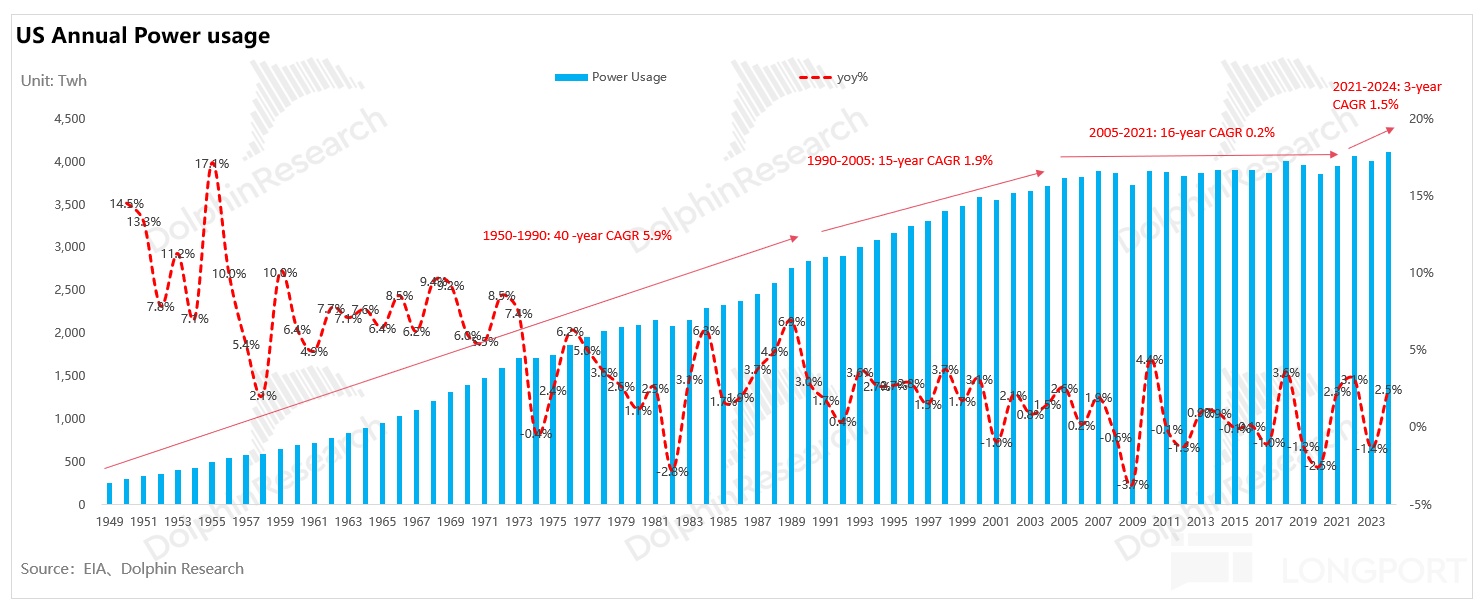
Looking across U.S. power history, end-use demand has cycled through three phases: growth, plateau, and recovery.
High-growth (1950s–1990s): Post-war boom, heavy industrialization, and residential electrification (e.g., AC and appliances) drove robust load growth (CAGR ~6%).
Plateau (1990s–2020s): The dot-com bust and the 2008 crisis slowed the economy, while the shift from heavy manufacturing to services and efficiency gains capped demand. Aggregate consumption oscillated in a range for 15 years with minimal net growth.
Re-acceleration (2021–present): Demand turned a historic corner. Policy-wise, Biden’s IRA and CHIPS Act subsidies, combined with Trump-era re-shoring emphasis, catalyzed reindustrialization, while the industry side saw a buildout of AI data centers driving major incremental load.
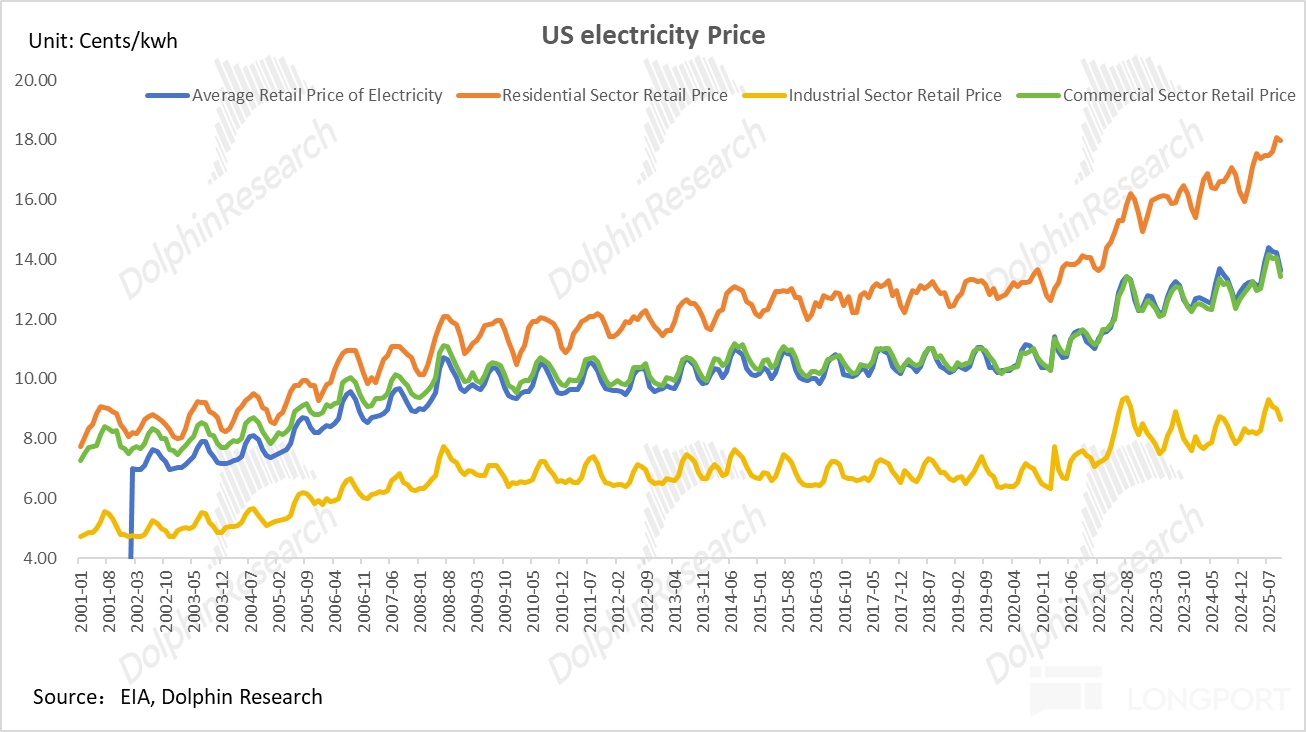
With both drivers resonating, U.S. power demand re-entered a growth channel, averaging ~1.5% CAGR in 2021–2024. Power prices also began to accelerate from 2022.
By user mix:
Commercial demand is the core growth engine, with data centers as the primary driver. By end-2024, U.S. data center load reached ~35 GW, roughly doubling from 2020.
Industrial demand is also recovering, with re-shoring of high-end manufacturing such as wafer fabs and EV battery plants providing a solid floor.
Core tension: The shift from total consumption to peak load
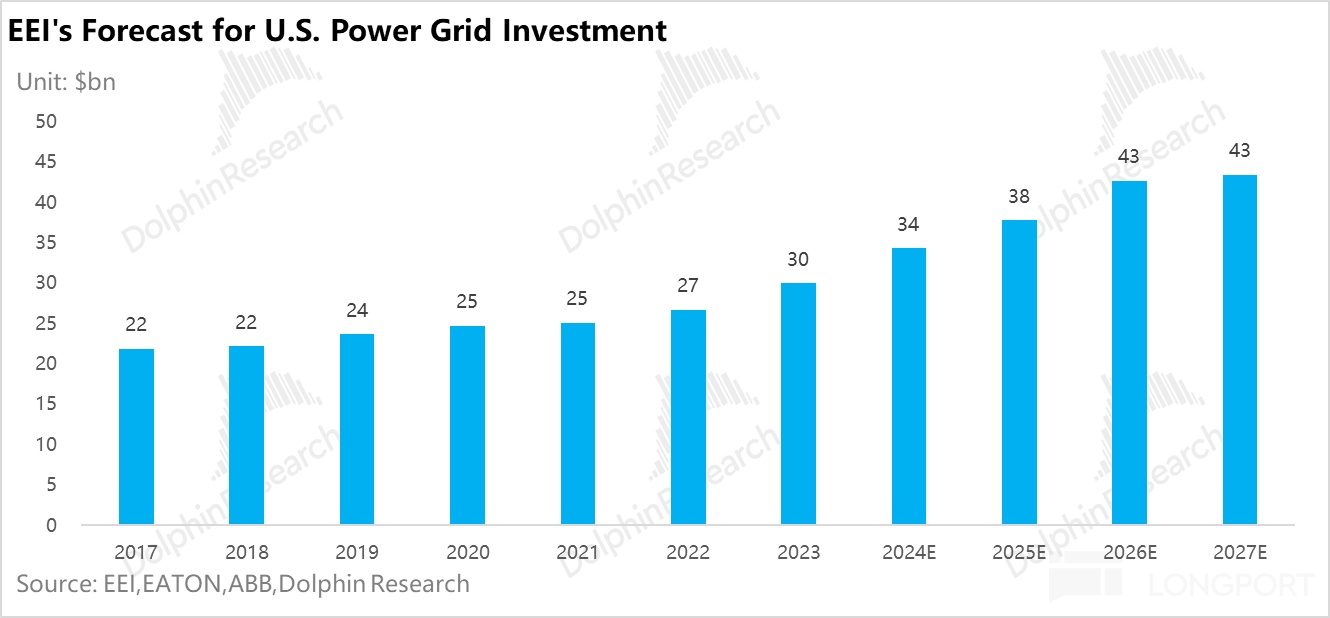
NERC data show U.S. grid peak load (load × time = energy) peaked in 2006 and then flatlined, resulting in persistently slow capacity-expansion capex on the grid side (only topping $30 bn in 2024). The North American grid has aged severely, with average service life approaching 40 years.
AI data centers are changing the game: they are ultra–power-dense and run near 24/7 at high utilization during training, lacking the curtailment elasticity of legacy industrial loads. They are hard to shift or shed.
Once peak-load growth on the demand side outruns buildout of effective capacity on the supply side, a capacity shortfall becomes inevitable. This triggers the NA power crunch, raising the price floor and elevating blackout risks.
We first size 2025–2030 incremental load in North America.
① AI data centers: the core load driver
We estimate incremental peak load and its drivers bottom-up. The framework is as follows.
a. New DC interconnection capacity (GW) = GPU shipments × per-chip TDP × system power factor × PUE.
TDP: thermal design power per chip. System power factor: power draw from non-GPU essentials (CPUs, memory, networking, PSU losses), typically 1.3–1.5.
PUE (power usage effectiveness): total DC energy / IT energy. It captures extra power for facility overheads such as cooling, distribution, and lighting, and is a core metric for DC efficiency.
b. Incremental DC peak load ≈ incremental interconnection capacity × peak demand factor. The factor measures the true capacity occupation in operations (actual max load / nameplate).
Based on this, we review where the NA increments come from.
a. Primary driver: Explosive CSP capex in North America
GenAI is propelling a historic expansion of data centers, led by North American hyperscalers (CSPs). They are the absolute main force behind capacity additions.
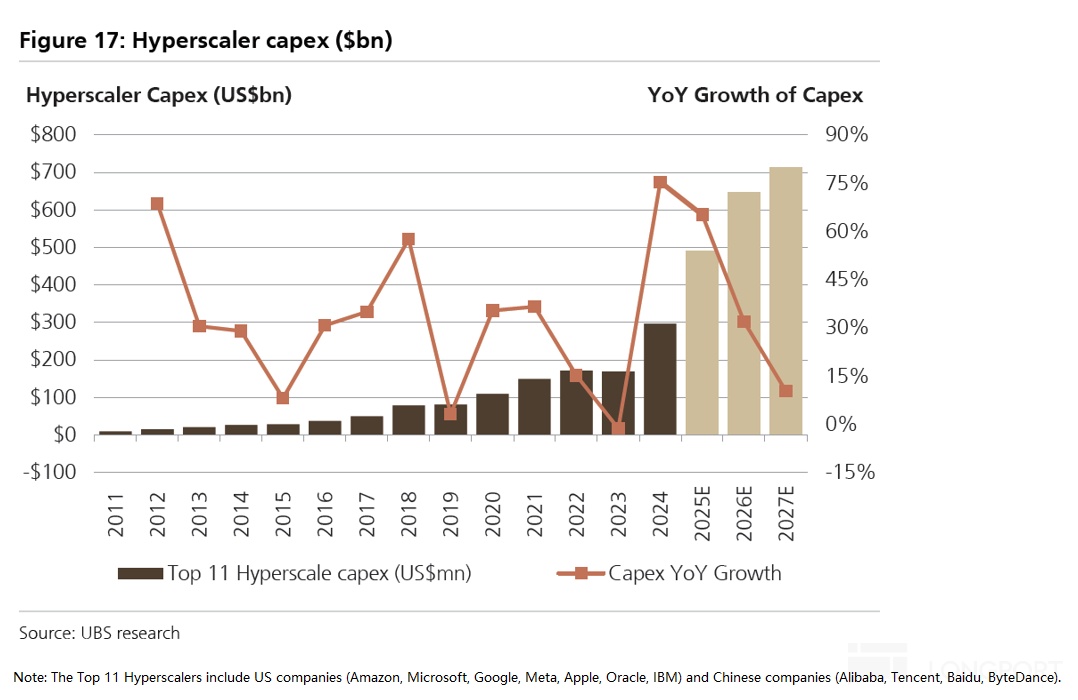
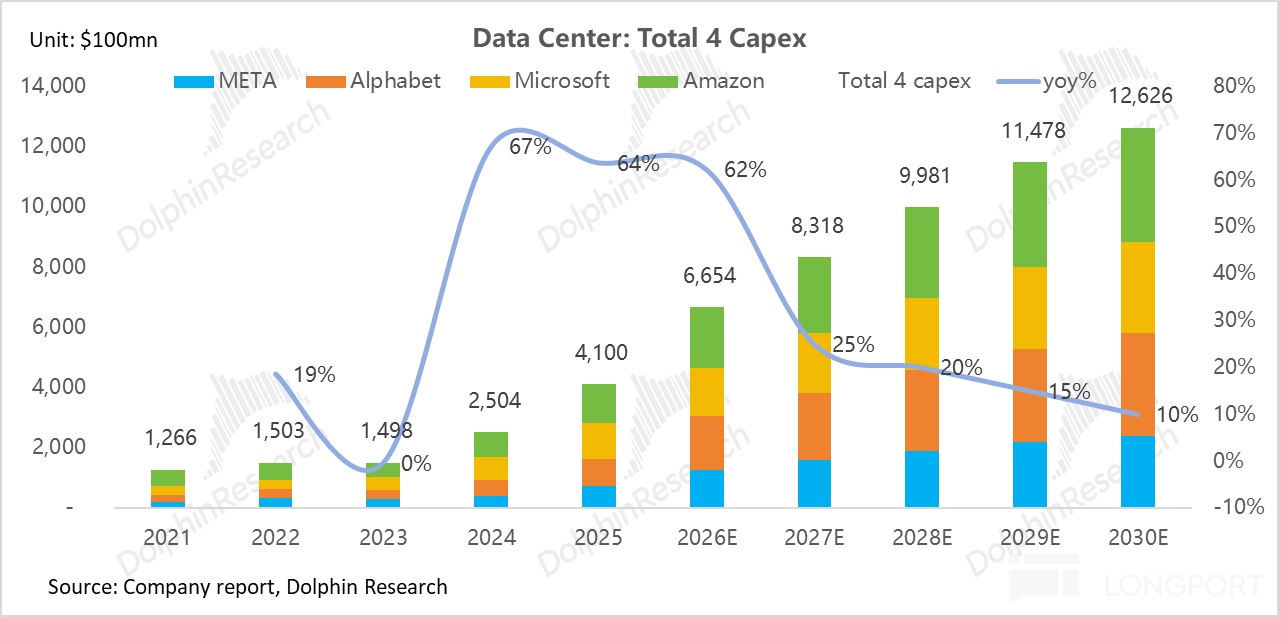
Amazon, Microsoft, Google, and Meta shifted into an arms race from H2 2023. Their total capex rose from ~$150 bn in 2023 to an estimated $406 bn in 2025 (CAGR 60%+).
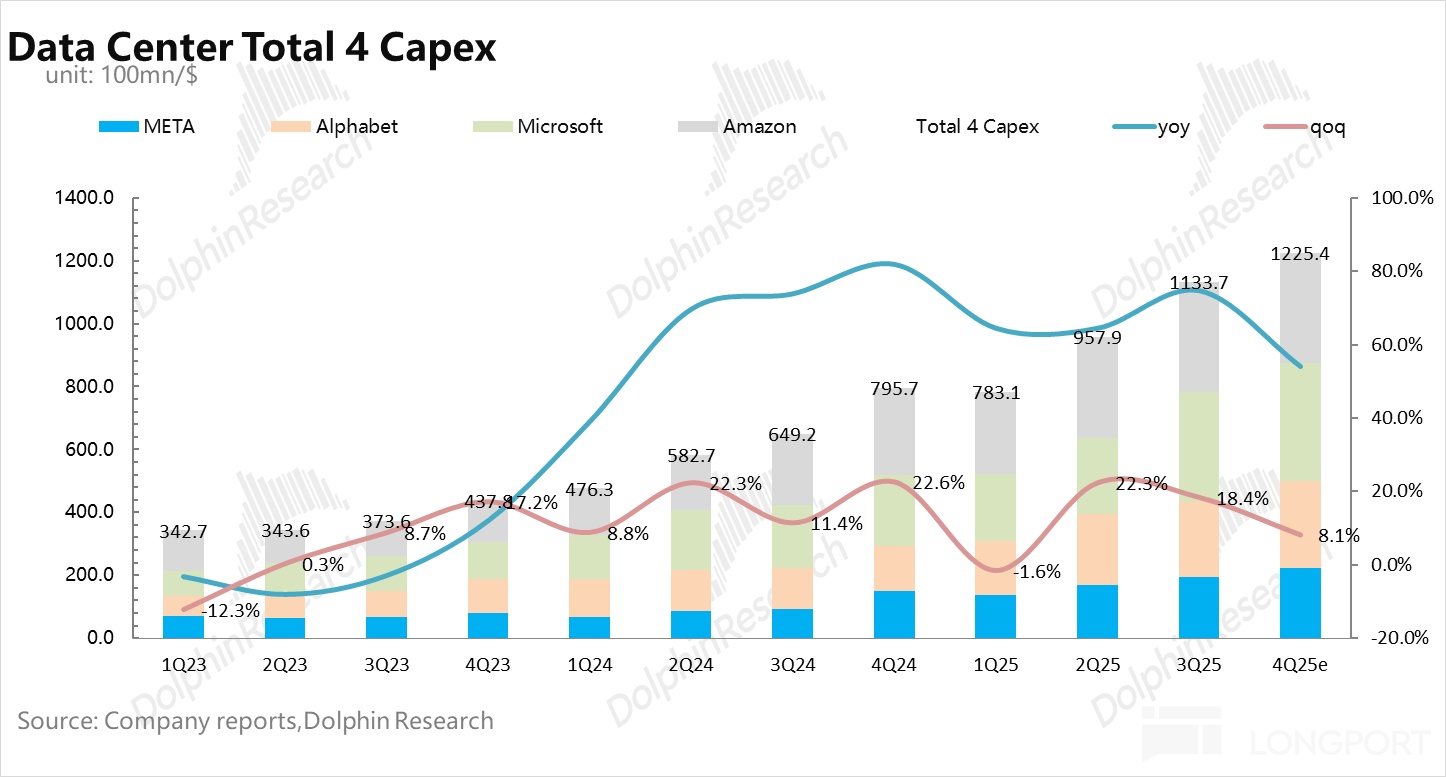
Chinese internet majors (BAT + ByteDance), constrained by chip supply, still lag U.S. peers in scale (2025E ~ $60 bn). Yet they form another significant growth pole of global AI infra.
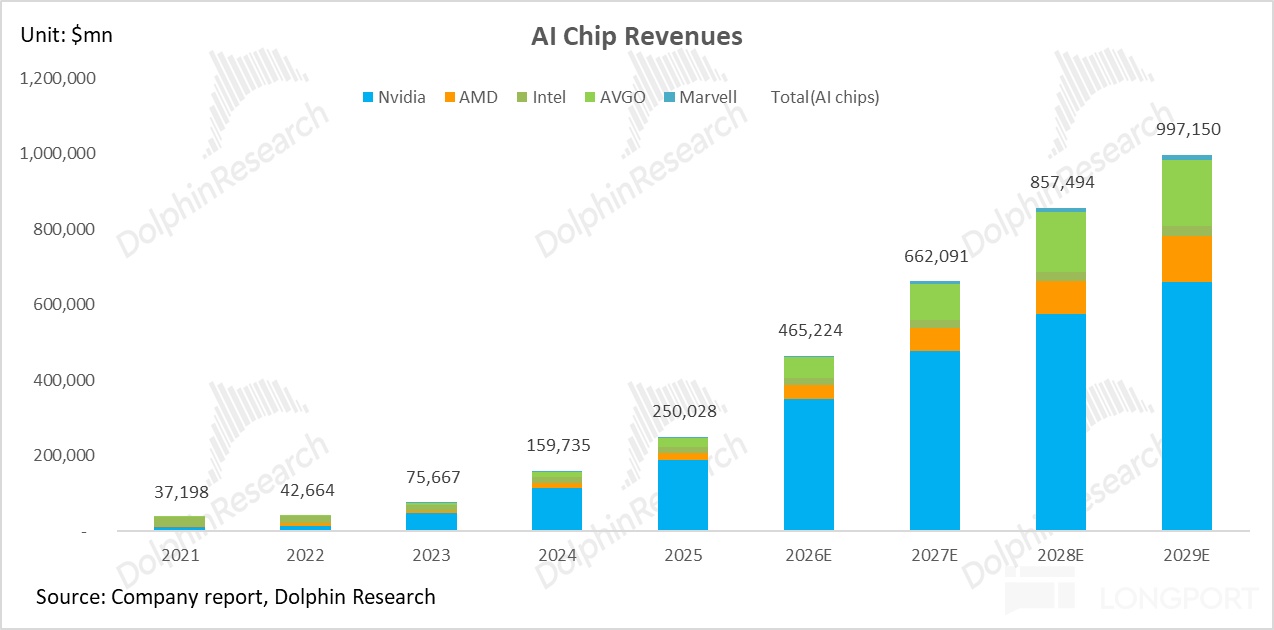
Together, the top 11 global tech giants are set to lift combined capex from ~$180 bn in 2023 to nearly $500 bn in 2025. This arms race directly drives AI chip shipments upstream and the continued explosion of DC scale.
b. Brutalism in compute: compute equals power
As Moore’s Law slows, AI chips have entered a high-compute, high-power era. Power density per node is surging.
Per-chip heat density spikes: NVDA GPU TDP has jumped from ~700W in the H100 era to 1,200–1,400W for Blackwell (GB200/GB300). The next Rubin architecture and superchip platform are expected to exceed 2,000W+, pushing power delivery and cooling to extremes.
Cluster scale expands exponentially: LLM training and inference are pushing single-DC deployments from the 'thousands of accelerators' tier toward 'hundreds of thousands'.
For example, OpenAI and Oracle’s planned Stargate project in Texas may deploy 450k+ GB200s, with total load potentially exceeding 1.2 GW, akin to a mid-sized city. This stresses both energy supply and the grid.
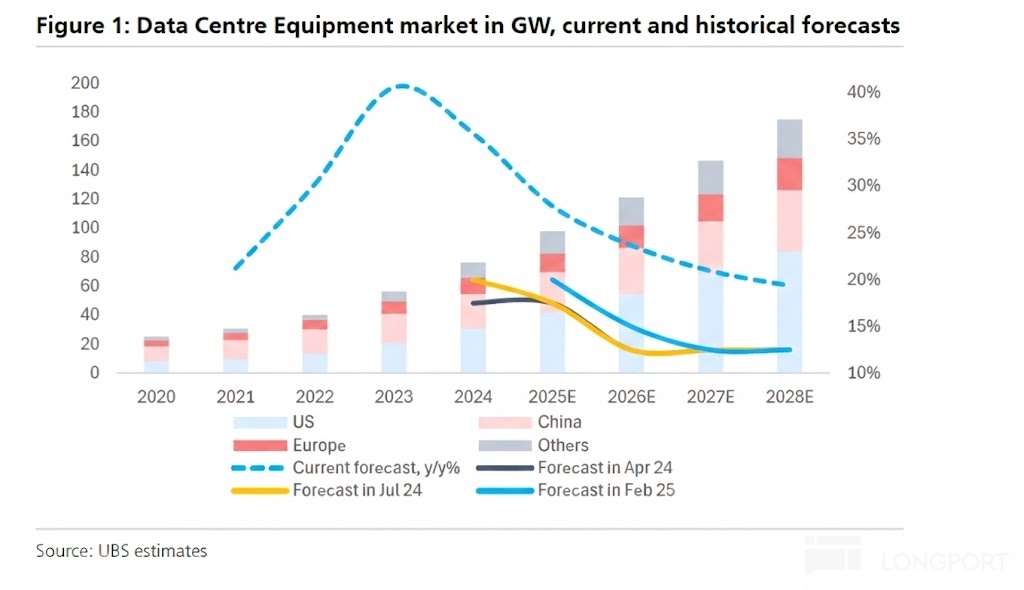
Grid Strategies estimates 10 GW-scale data centers will be online by 2026. By 2030 and earlier, about 50% of planned DCs will reach GW scale.
c. AI DCs: from tidal swings to rigid full-load
Traditional DCs (dispatchable, elastic loads): Focused on cloud, storage, and networking, they show a day-night tidal pattern. Virtualization and overbooking enable cross-tenant time-shifting, flattening the load curve with peak load factors generally below 60% and leaving ample buffer for the grid.
AI DCs (rigid, impulsive loads): With AI training surging, DCs are becoming rigid industrial loads that the grid must prioritize. Their operational profile leaves little room for curtailment.
At the macro level, they reset regional base load: Training clusters pursue extreme parallel efficiency, often running for weeks or months near full load (peak load factor >90%), forming a high, flat line.
A single GW-scale project is like adding a mid-sized city out of nowhere, instantly consuming regional transmission headroom and forcing long queues and expansion bottlenecks for grid interconnection.
At the micro level, they are millisecond assassins hitting the grid’s heart: Highly synchronized GPU tasks cause sharp power steps in microseconds/milliseconds when switching between compute and communication or idling and full load.
NERC reports a large DC whose load fell from 450 MW to 7 MW in 36 seconds, tantamount to unplugging a mid-sized power plant. Such high dI/dt events act as a power sledgehammer on an already old grid.
These swings can trigger voltage flicker and harmonics, even relay trips and local blackouts. Deploying SVG/supercapacitors or storage has become a necessary shield to smooth this sledgehammer.
We outline several sizing approaches for U.S. incremental DC capacity.
a. Pipeline-based (under construction and planned):
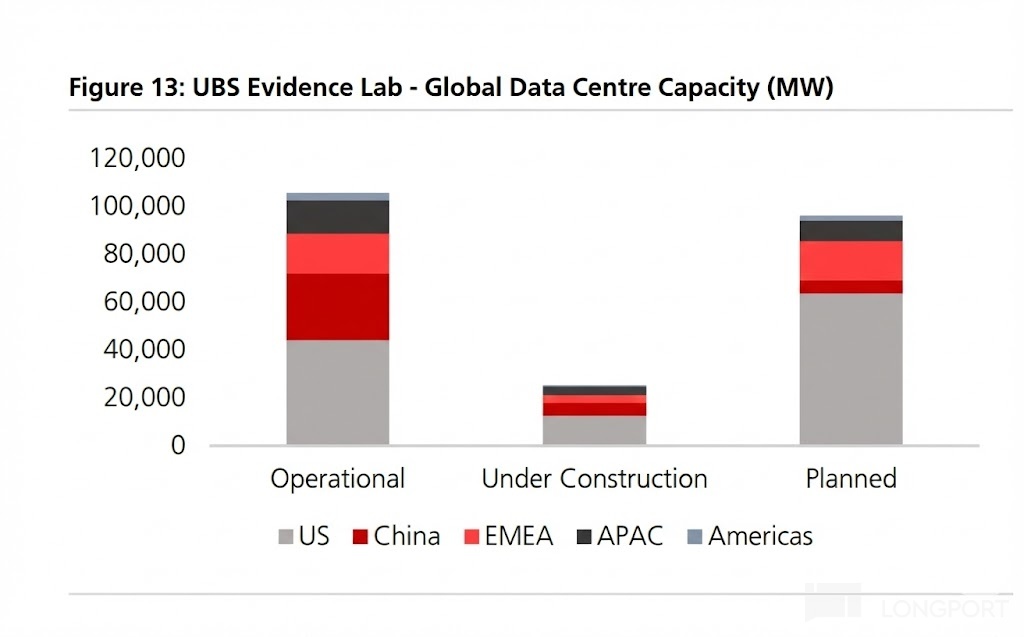
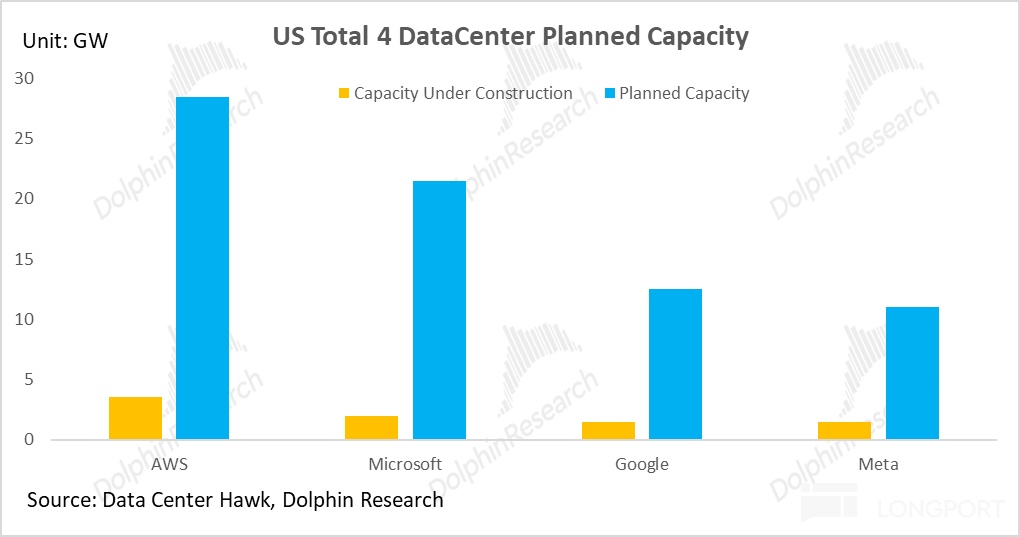
Per UBS, by end-2025 global operating DC capacity is 105 GW, with 25 GW under construction and 100+ GW in planning. That pipeline is sizable and front-loaded.
Without binding constraints in power and land, a full AI DC build from planning and civil works to IT deployment is typically 18–24 months. New players like CoreWeave, with faster NVDA GPU access and modular prefabrication, can compress the cycle to 12–18 months.
Assuming the 125 GW reserve fully enters service by 2030 with no further adds, global DC capacity would add 125 GW in 2026–2030 to reach 225 GW by 2030, a 5-year CAGR of ~16%.
For the U.S., end-2025 operating DC capacity is 44 GW, with 10 GW under construction and ~70 GW in planning. The U.S. remains the dominant region.
On the same assumptions, the U.S. would add 80 GW in 2026–2030 (64% of global adds), taking total to 124 GW, a CAGR of ~23%.
Given AI DCs’ high concurrency and load factors, if we assume 100% of added capacity maps to peak load, the U.S. grid faces an 80 GW incremental peak-load shock over the next five years.
b. Capex-based sizing:
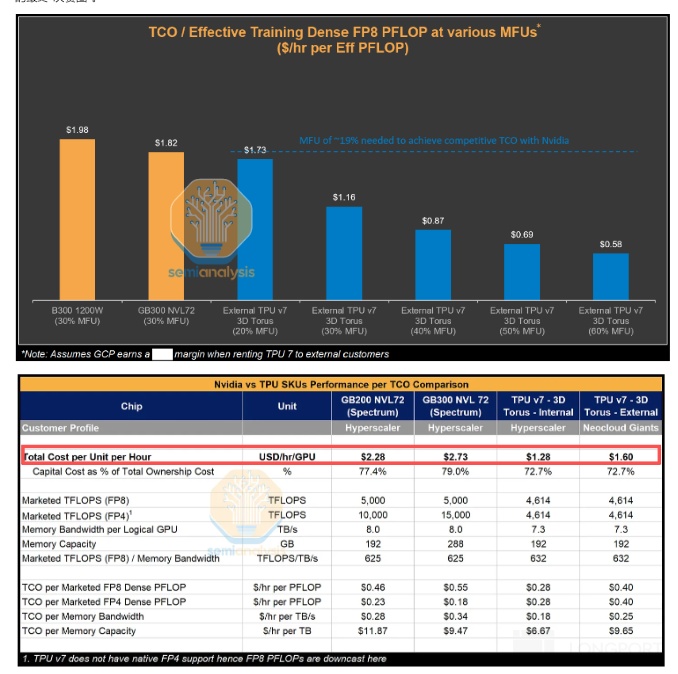
Per Jensen Huang, 1 GW of DC capacity costs ~$50–60 bn to build, including ~$35 bn for chips and systems. We use a midpoint of $55 bn/GW for an all-NVDA build.
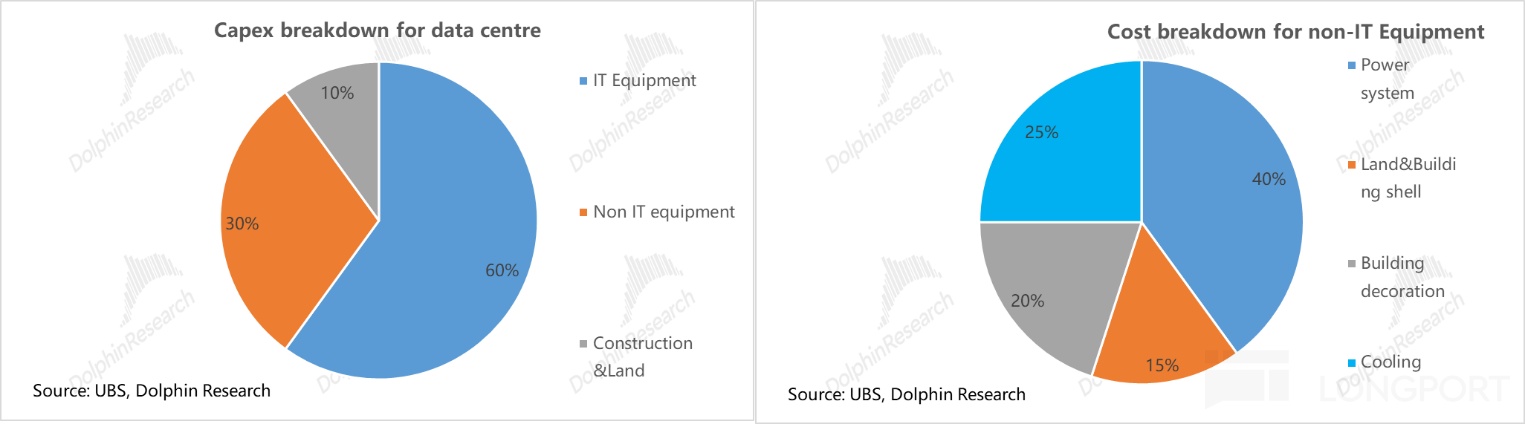
As Google’s TPUs penetrate inference and select training, costs should fall meaningfully. TPU v7 has a 41% lower unit-TCO per compute vs. GB300 and capex per GW could be roughly half of a GPU-heavy stack (~$27.5 bn/GW), aided by power and cooling advantages.
Assuming a 65% GPU / 35% TPU mix over the next five years, the weighted build cost is ~$45.4 bn/GW. Under 80–120 GW of incremental capacity in five years, annual AI investment would be ~$0.7–1.0 tn.
If AI DC-related spend is 80–90% of total CSP capex, then 2026–2030 average CSP capex would be ~$0.9–1.2 tn per year (2026E ~$650–700 bn), broadly consistent with a steep growth runway (5-year CAGR ~25% in 2026–2030).
c. Supply-side validation via FERC filings:
The Federal Energy Regulatory Commission requires annual filings from all utilities to monitor capacity, interchange, and peak-load forecasts across planning regions. This is the foundational ledger for U.S. grid planning.
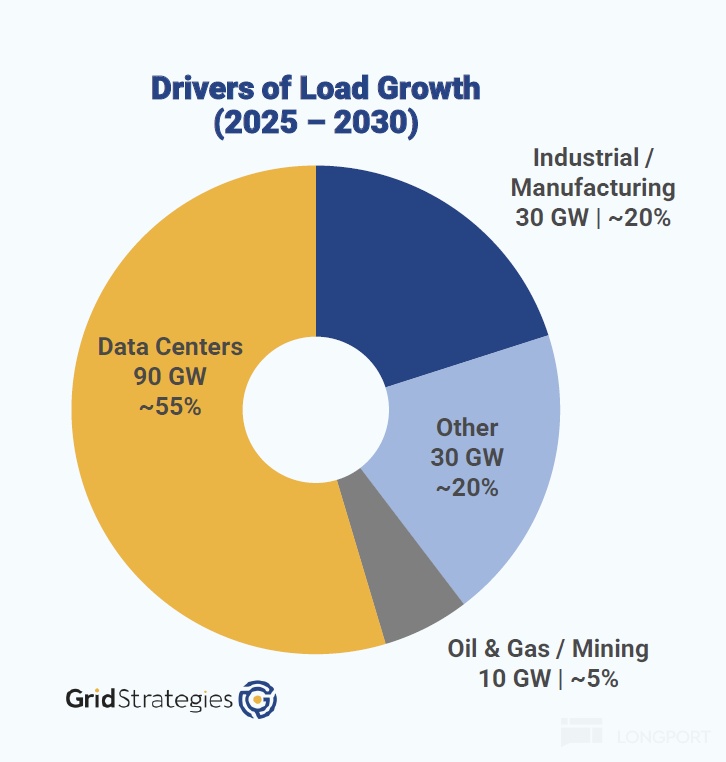
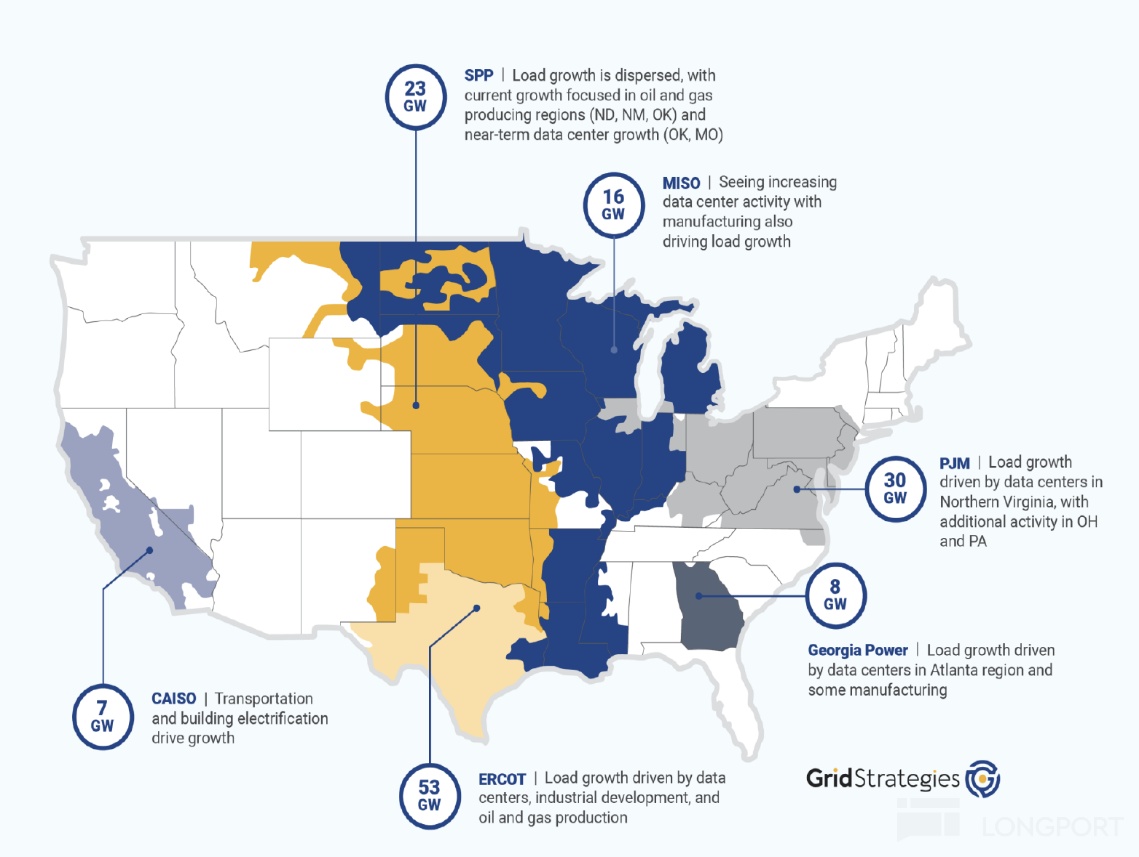
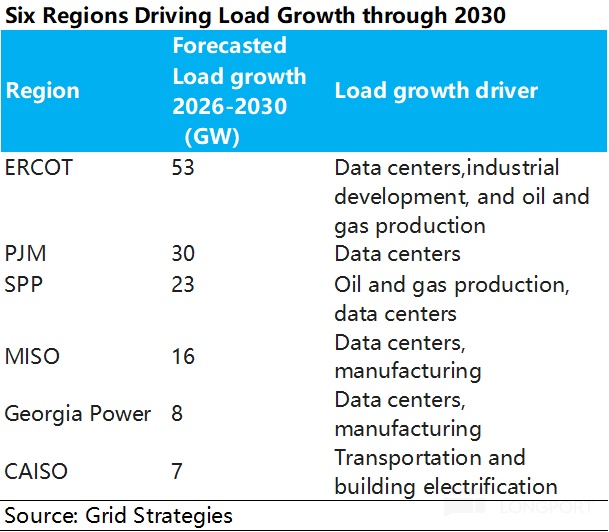
North American utilities have sharply raised 5-year peak-load forecasts, with a planned total increase of 166 GW. Data centers dominate this power supercycle.
a. DCs are expected to contribute ~90 GW of incremental load. b. Industrial/manufacturing re-shoring adds ~30 GW, and end-use electrification adds ~30 GW (residential heat pumps and EV infra). c. Oil and gas/mining adds the remaining ~10 GW.
Based on the above, Dolphin Research makes the following 5-year NA demand forecasts.
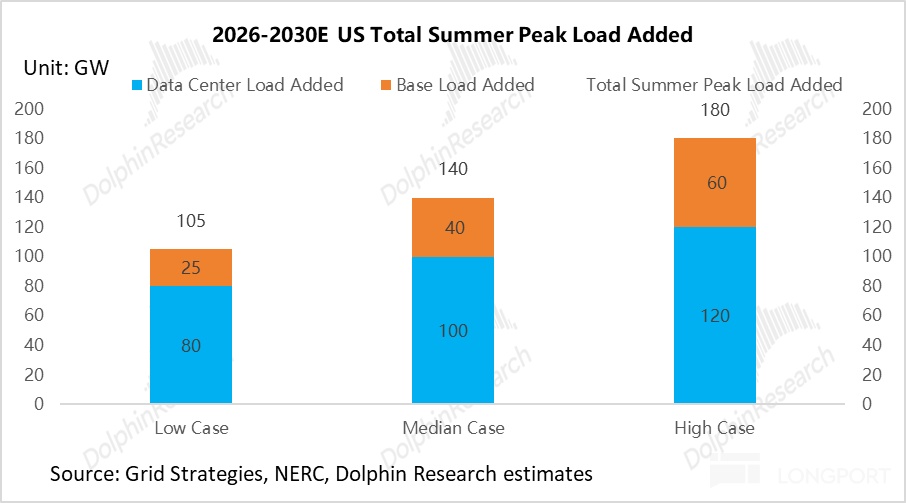
① AI DCs: incremental peak-load assumptions of 80 GW / 100 GW / 120 GW (bear/base/bull). The bull case may still be conservative versus Big Tech’s aspirations.
OpenAI, for instance, has a 250 GW compute infra plan for 2033, implying the energy ceiling for AI may be far higher than commonly assumed.
② Base load: While FERC projects 76 GW of adds from end-use electrification and re-shoring, EV adoption has slowed and re-shoring is complex in practice. We assume 25/40/60 GW of base-load adds over five years (CAGR 0.6%–1.5%).
Total peak adds: combining the two drivers, we estimate NA 5-year incremental peak load at 105/140/180 GW in bear/base/bull (CAGR 2.4%/3.2%/4%).
II. Supply: Dual bottlenecks in generation and grid equipment
2.1 Generation: heavy retirements of reliable capacity, limited firm replacements
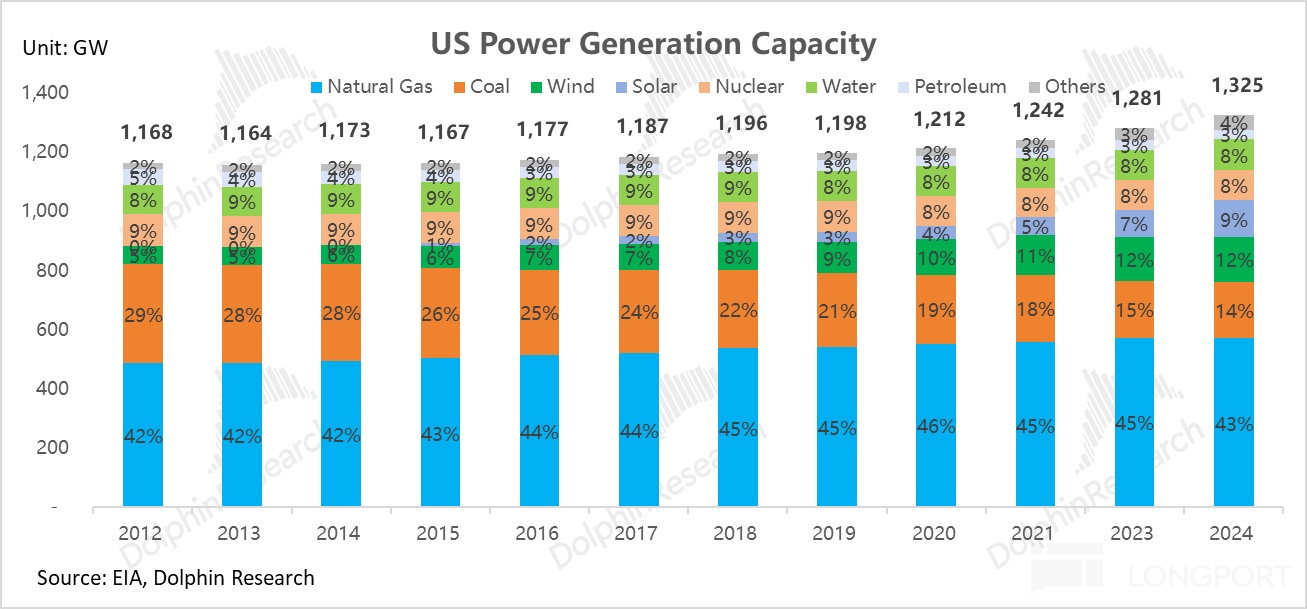
Over 2014–2024, total U.S. power rose only modestly (CAGR ~1.2%), but the generation mix shifted dramatically. The seeds of today’s shortage were sown on the supply side during this period.
① Reliable baseload is bleeding out
Coal retirements accelerated: Environmental policy and gas cost advantages forced rapid coal retirements, with capacity nearly halved from 318 GW in 2011 to 174 GW in 2024. Coal’s share fell from ~30% to ~14%, weakening the system’s foundation.
Gas shifted from peaker to ballast: Shale gas economics, dispatch flexibility, and cleaner profile versus coal pushed gas capacity steadily higher. Gas has stabilized at 40%+ share and become the mainstay.
Overall, by 2025, dispatchable and reliable baseloads (thermal, hydro, nuclear) are still down 77 GW vs. 2011, steadily eroding the system’s reliability base.
The aging problem: 528 GW (50%+) of quality baseload (thermal/hydro/nuclear) has served for 30+ years, pushing a thermal retirement wave since 2010. EIA projects 2020–2030 retirements will exceed additions annually, implying a persistent net loss of reliable capacity into the AI demand surge.
② Mismatch: wind/solar replace energy, not firm capacity
Coal’s gap has been backfilled not by firm baseloads, but by intermittent wind and solar. This substitution shifts the character of supply.
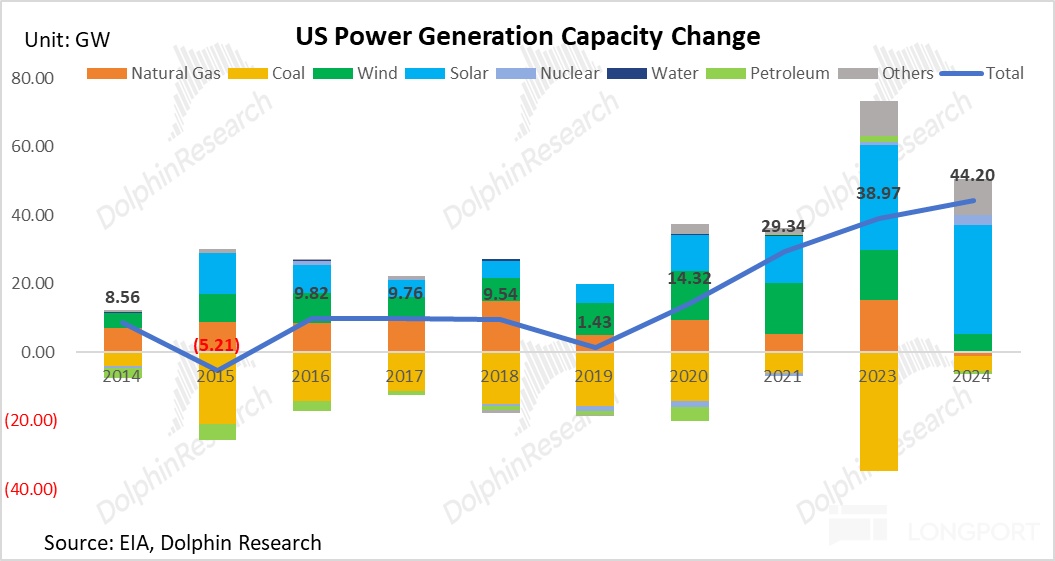
From 2011–2024, wind+solar capacity jumped 5.5x from <50 GW to 329 GW, accounting for 121% of net capacity additions and replacing coal in terms of energy output. But that does not equate to firm capacity at peak.
③ Intermittent backfill conflicts with rigid AI demand
The mix of baseload bleed and intermittent backfill is the structural root of the crisis, fundamentally mismatched with AI loads.
a. Effective capacity for wind/solar is deeply discounted: In planning, PV has 10–20% effective load-carrying capability, wind 30–40%, while coal/gas/nuclear are typically 80–90%. Intermittency and variability drive the gap.
b. The more wind/solar you add in a region, the less reliable each marginal MW becomes: ELCC declines with penetration, weakening top-of-peak support from incremental builds.
c. Physics mismatched to AI’s 24/7 rigidity: AI DCs are dense, high load-factor, and require firm 24/7 power. New supply is intermittent and volatile.
With limited interregional transmission, abundant wind in the Midwest cannot flow in real time to East Coast AI hubs. This spatial mismatch further fractures local supply-demand balances.
Using EIA, NERC, and DOE planning guidance, Dolphin Research forecasts generation additions for 2026–2030E.
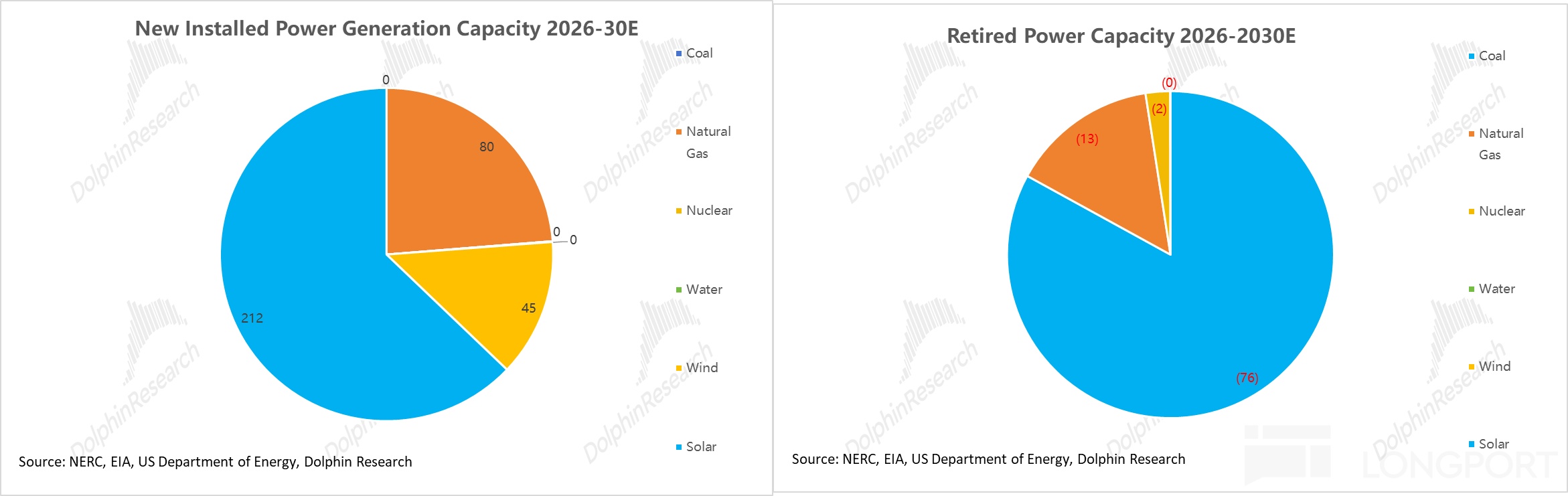
We estimate 337 GW of added capacity over 2026–2030E. Intermittents (solar/wind) contribute 76%+ (~257 GW), while dispatchable gas adds only ~80 GW (~24%).
Concurrently, 92 GW of retirements are planned, almost entirely reliable baseloads (coal ~76 GW, gas ~13 GW). Thus, within a net +245 GW on paper, the net firm contribution is negligible and the system keeps bleeding.
Given stark differences in effective capacity at peak, we convert the net +245 GW using effective capacity factors (coal/gas/nuclear/hydro/wind/solar at 90%/90%/95%/80%/40%/10%). The result is only ~28 GW of net effective capacity added over five years.
In other words, nearly 90% of nameplate additions fail to translate into reliable support at peak stress.
④ Supply-demand gap: a large and certain reliability shortfall
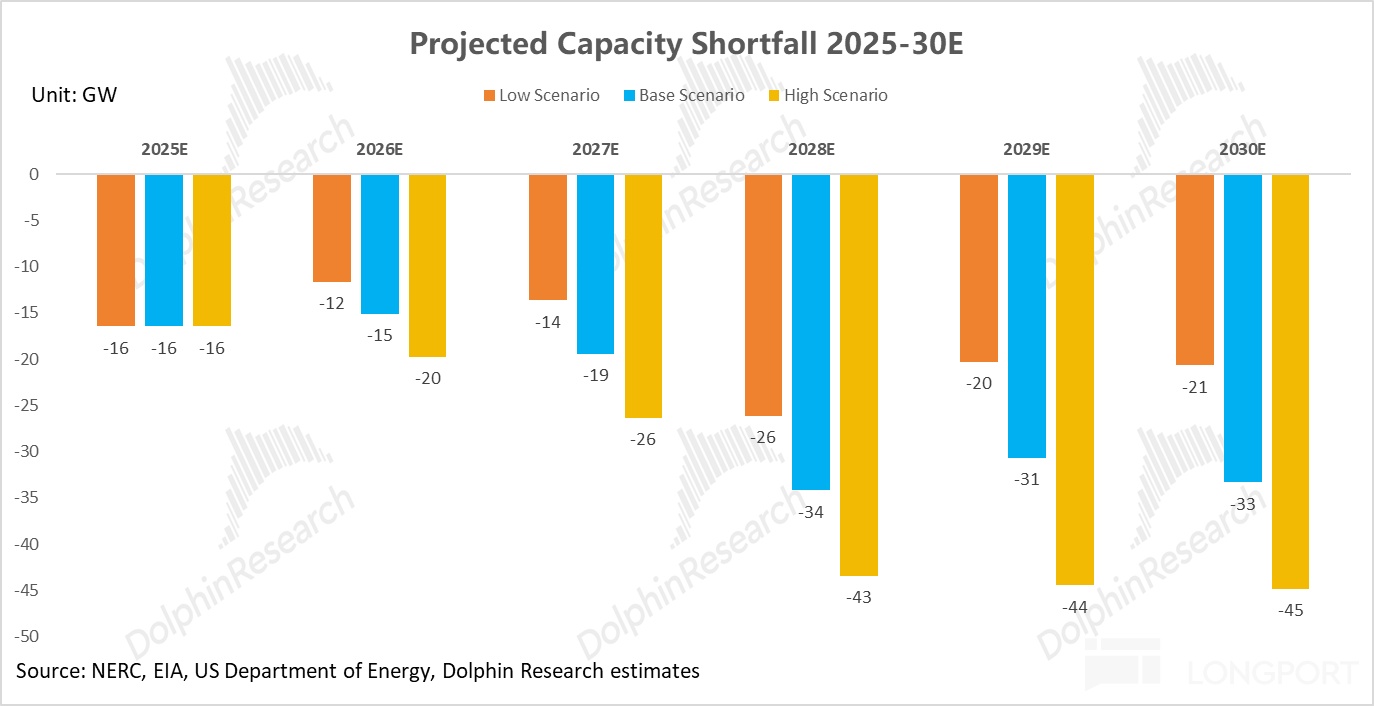
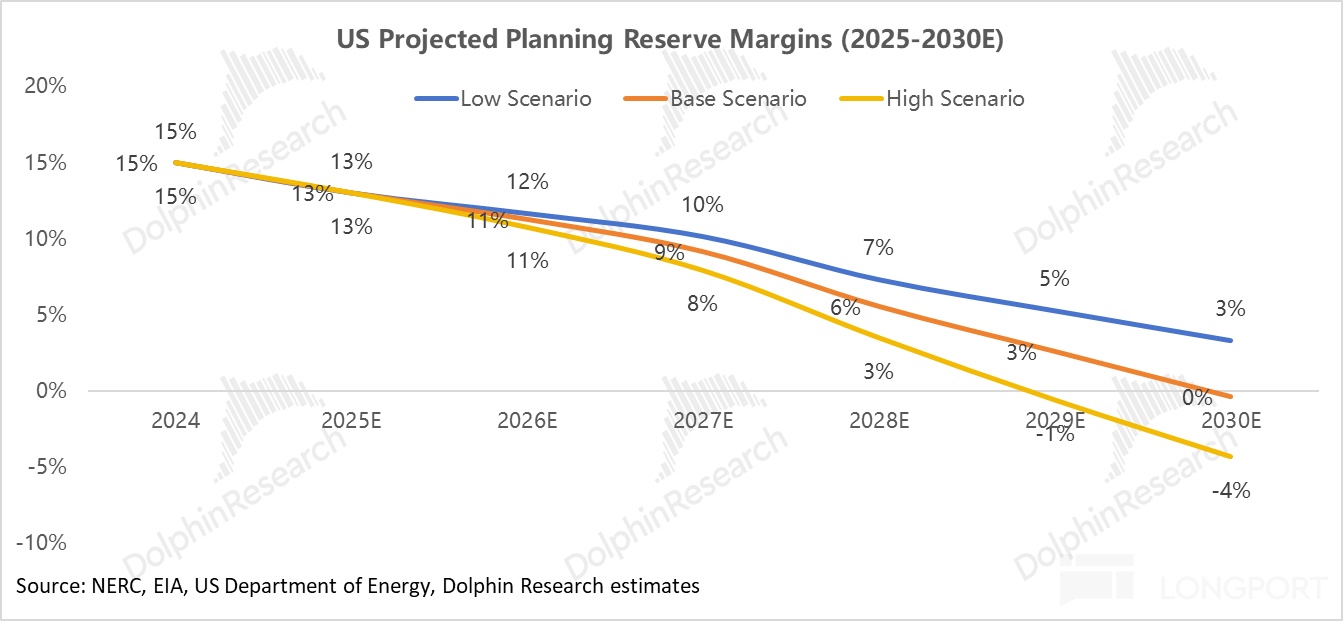
Assuming the planning reserve margin stays at 15% (2024 level) and combining the AI demand surge, we project by 2030 a sizable U.S. reliability shortfall of 109/149/195 GW in bear/base/bull demand scenarios.
(Note: Reserve margin = (effective total capacity − peak load) / peak load. The industry benchmark of 15% buffers against outages, forecast errors, or extreme weather.)
The U.S. power system is thus 'prosperous on paper but weak in substance'.
Wind/solar’s nameplate boom paints a green transition, but their low and declining effective capacity cannot fill the reliability hole left by retiring baseloads. Nor can it support AI-driven peak-load spikes.
The result is an absolute shortage of reliable capacity, the primary root of the current power crunch.
2.2 Grid (transmission):
The crisis is not just generation; transmission faces its own constraints. Aging infrastructure is ill-suited for AI DC 'power behemoths'.
① Physical bottlenecks: an old grid cannot carry the new giants
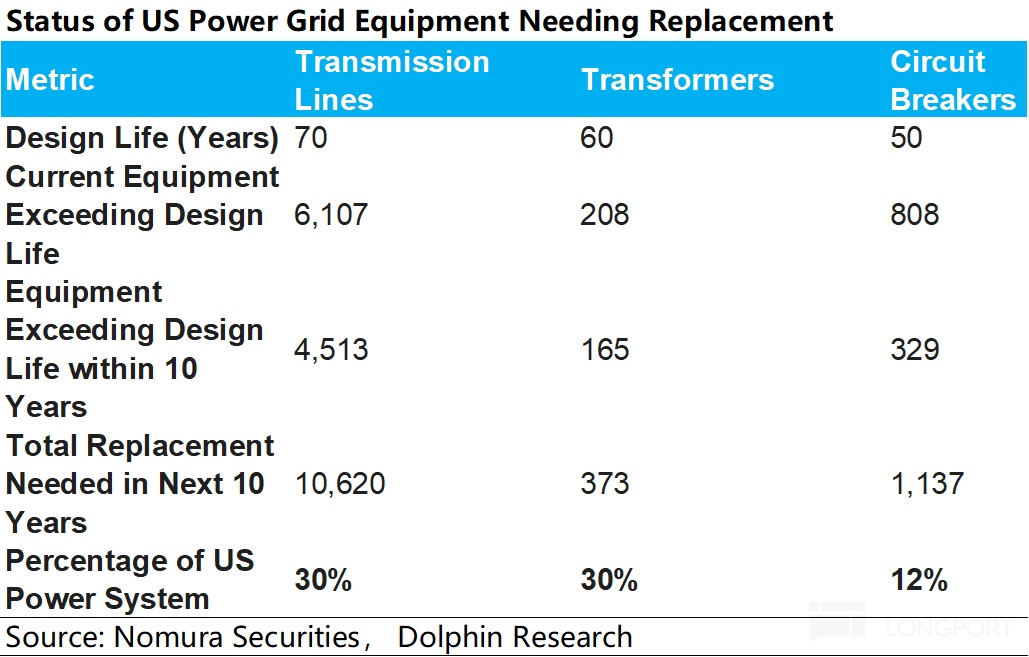
The U.S. grid largely took shape by the mid-20th century. DOE data indicate 70% of transmission lines and transformers are 35+ years old, and about 30% of core assets (incl. breakers) have exceeded design life, sharply reducing system reliability.
Grid investment: chronically low and biased away from expansion
With demand growth sluggish post-2000, domestic equipment manufacturing hollowed out, and ownership fragmented (mostly private), grid investment stayed low for years (~$20–30 bn annually, only topping $30 bn in 2024). Skilled labor and transformer imports are additional constraints.
Spending also skews toward replacing aged assets and shoring up reliability. Expansion driven by load growth commands a small share.
Grid buildout: large shortfall
Since 2013, annual miles of new high-voltage lines have dropped sharply. In 2024, only 888 miles of ≥345 kV lines were added, less than 20% of DOE’s ~5,000 miles per year plan.
Transformers: the chokepoint for grid expansion
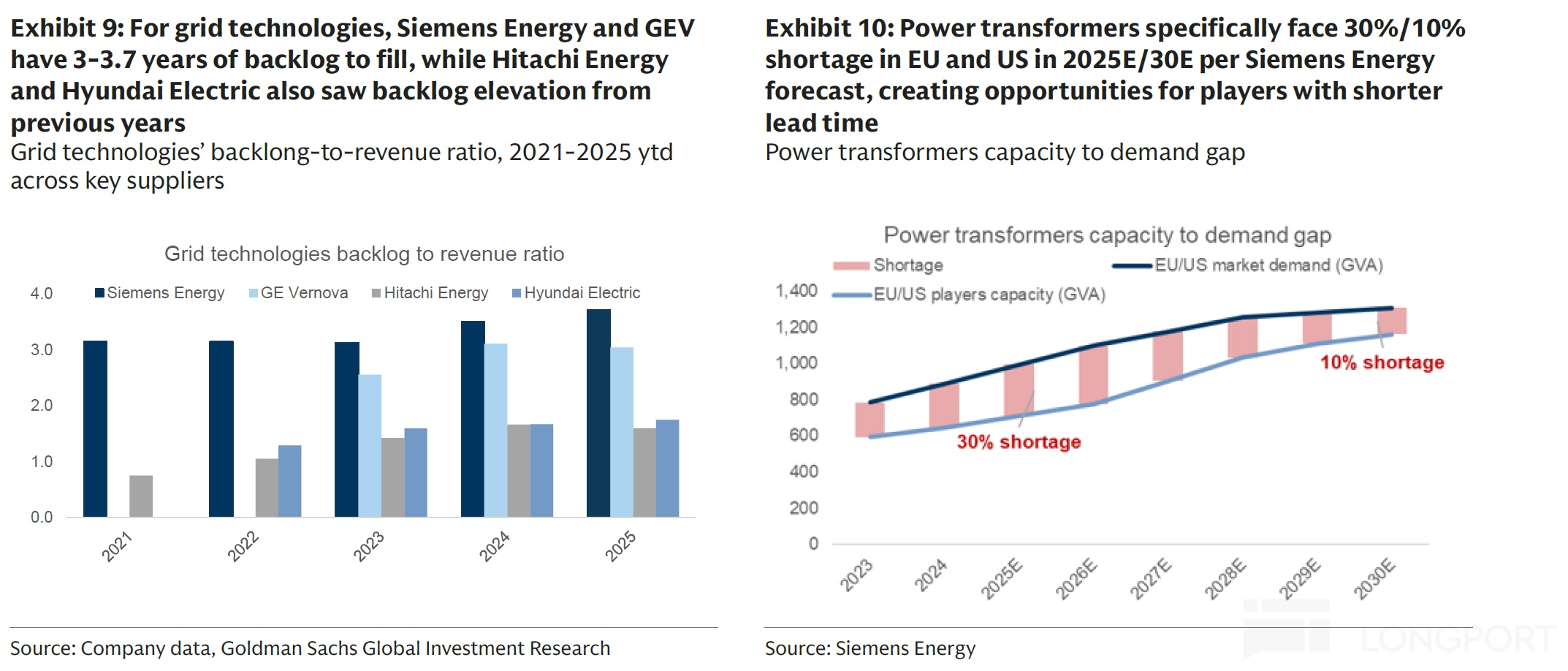
Transformers are highly customized, labor-intensive, and face stringent certification, preventing rapid, standardized ramp-up. Each unit must meet unique specs on impedance, cooling, tap changers, overload, and seismic standards.
U.S. domestic suppliers currently meet only ~30% of demand, and even with announced expansions, may reach ~40% by 2027E. That leaves the EU/U.S. with ~30% shortages in 2025, and lead times for critical units have stretched from 6–9 months to 2–3 years, foreclosing rapid grid expansion.
② New shocks: 'low-quality loads' as the last straw
GW-scale AI DC interconnection requests bring instantaneous power needs beyond local physical limits. The system cannot absorb them without major upgrades.
A single high-density AI DC can equal several mid-sized cities. It instantly consumes local transmission headroom and forces end-to-end upgrades from substations to trunk lines.
Millisecond load steps inject high-frequency disturbances into old grids, threatening regional reliability. RTOs/ISOs thus extend system impact studies, further clogging the interconnection queue.
③ Core mismatch: destructive build-cycle timing
These physical bottlenecks create a lethal timing mismatch between load and grid.
AI DCs take 18–24 months to build in theory, but the associated transmission upgrades and interregional lines need 5–7 years or more due to permitting, environmental review, and long-lead equipment such as transformers. Administrative streamlining alone cannot fix physics.
Despite FERC Order 2023 simplifying approvals (theoretically 1–2 years), insufficient physical expansion worsens queue congestion. The national interconnection queue’s median wait is now ~5 years, and in hubs like Northern Virginia (VA) waits stretch to ~7 years.
This is devastating for operators: even if a DC is finished within ~18 months, GPUs worth hundreds of millions could sit unpowered and depreciate rapidly. High sunk costs (depreciation) would erode profits and break the ROI model for AI investment.
Takeaway: the shortage is structural
The U.S. power shortfall is not a short-term imbalance. It is a structural conflict between surging AI compute and long-lagging energy and grid infrastructure.
On demand, re-shoring and rigid AI DC loads put demand into an acceleration channel, driving peak loads higher. On supply, retiring firm baseloads and energy-only wind/solar cannot fill the capacity gap, leaving effective supply short.
On the grid, aging assets, underinvestment, critical equipment shortages, and cycle mismatches amplify the imbalance. The next installment will discuss solutions and the investable sub-sectors behind them. Stay tuned.
The copyright of this article belongs to the original author/organization.
The views expressed herein are solely those of the author and do not reflect the stance of the platform. The content is intended for investment reference purposes only and shall not be considered as investment advice. Please contact us if you have any questions or suggestions regarding the content services provided by the platform.
