


SMIC: Doubling Down in a Downcycle — The Last Hope for Homegrown AI Chips?

SMIC (0981.HK) released its Q4 2025 results (quarter ended Dec 2025) after Hong Kong market close on Feb 10, 2026 Beijing time. Key takeaways:
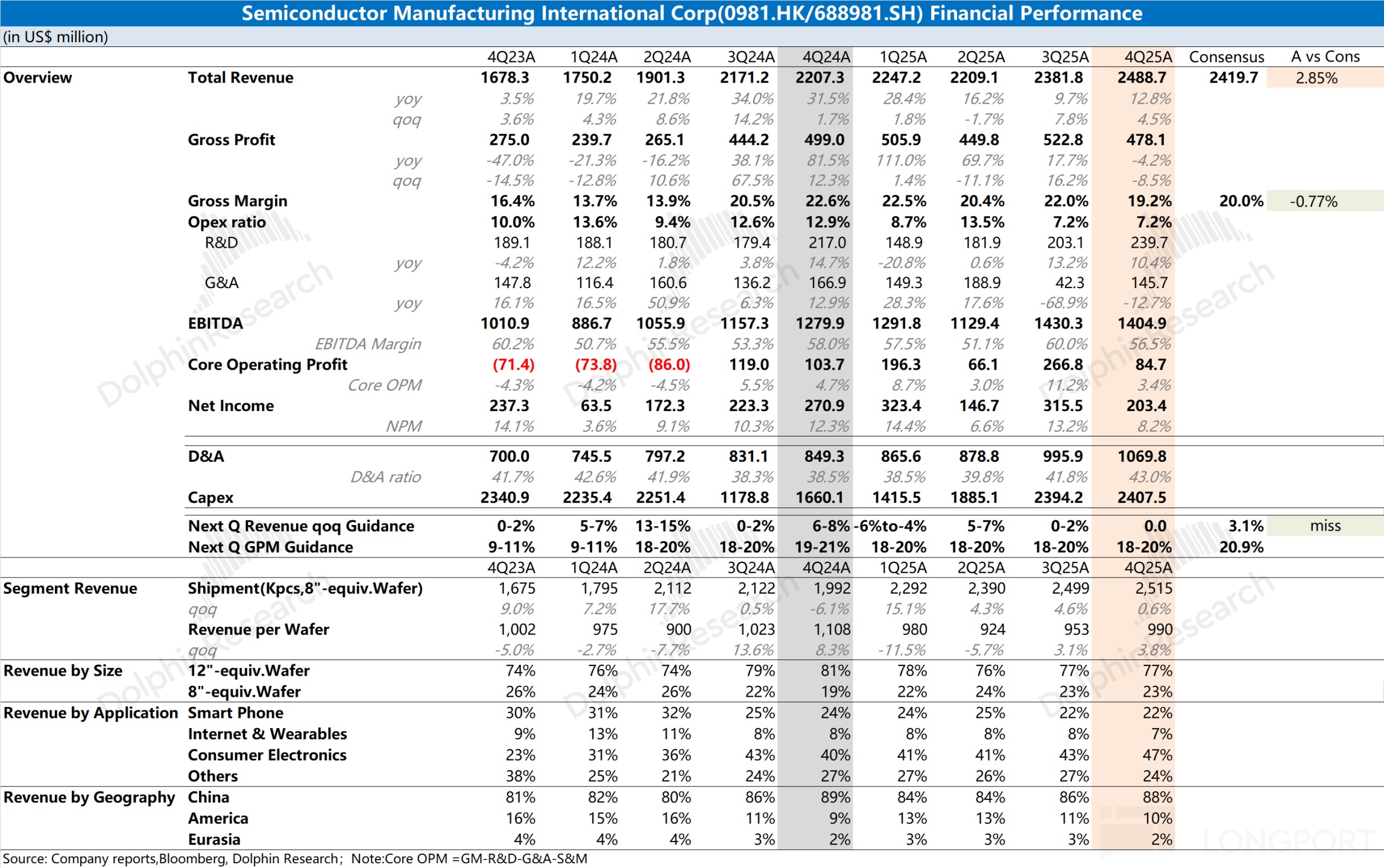
1) Headline results: Q4 revenue came in at $2.49bn, in line with consensus ($2.42bn), up 4.5% QoQ, above guidance (0–2% QoQ). The sequential growth was mainly driven by restocking in consumer electronics.
GPM was 19.2%, within guidance (18–20%). Margin softened primarily due to low yield on the company's advanced node (7nm-equivalent).
2) Three core metrics: revenue, GPM and utilization. By price/volume mix, $SMIC(00981.HK) Q4 topline growth was mainly price-led. A higher mix of 12-inch wafers lifted ASP.
Shipment volume edged up 0.6% QoQ, while ASP rose 3.8% QoQ.
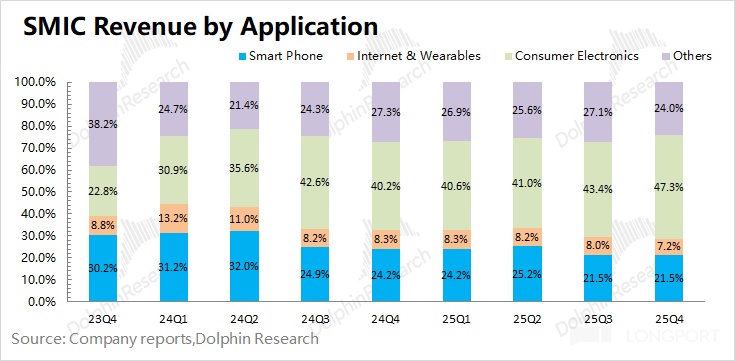
3) Biz. updates: Supported by import substitution, China accounted for close to 90% of revenue. Consumer electronics grew 10% QoQ on restocking for small-form-factor devices, the primary driver this quarter.
Consumer electronics is now the largest revenue stream at nearly 50%. Smartphone contribution has retreated to ~20%; with memory price hikes, smartphones will likely remain a drag on results.
4) Opex and capex: Operating expenses are mainly R&D and G&A. R&D rose 10% YoY, reflecting continued investment. G&A fell 12% YoY on lower plant start-up related expenses.
$SMIC(688981.SH) Q4 capex was $2.4bn, implying FY capex of $8.1bn (+11% YoY), above prior guidance (flat YoY). Despite a soft legacy semi cycle, SMIC is still stepping up investment to expand capacity and upgrade technology.
5) Q1 2026 guidance: revenue flat QoQ at $2.49bn, below the Street ($2.5bn); GPM at 18–20%, below consensus (21%).
Dolphin Research view: Sustained volume ramp of AI chips underpins confidence.
Quarter was mixed: revenue met expectations, but margin was soft.
On margin drivers, ASP rose $37 per wafer QoQ, while unit cost increased $56, directly compressing GPM. Although the company has pushed its advanced capability to a 7nm-equivalent, low yield remains a headwind for margins.
Guidance matters more than the print, and management stayed cautious. They guide Q1 revenue flat QoQ vs. Street at +3%; GPM at 18–20% vs. Street at 21%. The conservative stance suggests yields at advanced nodes remain low, keeping pressure on margins.
Beyond quarterly metrics, key focus areas include:
a) Capex and capacity: Q4 capex was $2.4bn; full-year reached $8.1bn (+11% YoY), topping guidance (flat).
Legacy semi has not truly recovered, with GPM ~20%. Yet SMIC is still spending $7–8bn per year, pursuing counter-cyclical expansion.
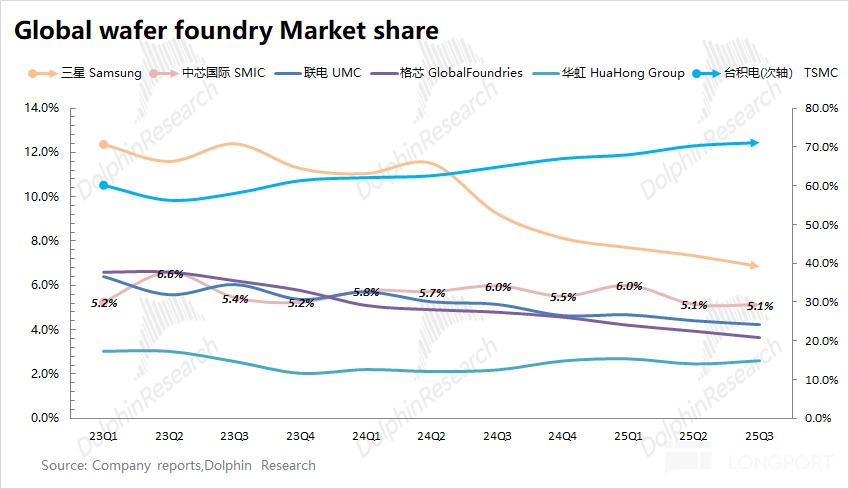
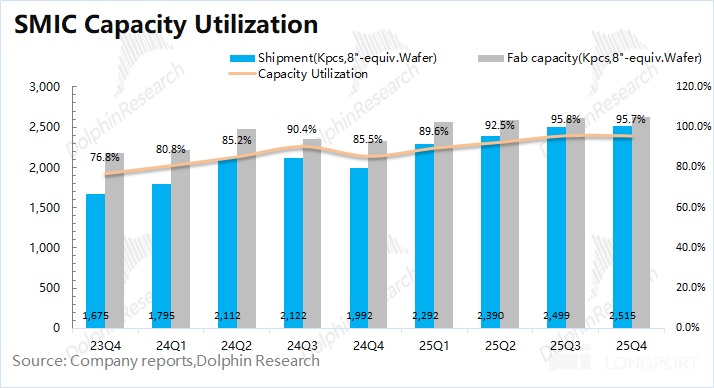
Backed by sustained investment, quarterly capacity has reached 2,515k wafers (8-inch eq.). Capacity growth mainly serves domestic customers, and SMIC is now firmly the No.3 foundry globally.
b) GPM and cash flow: With GPM ~20%, annual operating profit is around $1bn. Even adding back $3–4bn of D&A per year, FCF cannot cover $7–8bn of capex. [FCF = NOPAT + D&A − ΔWC − Capex]
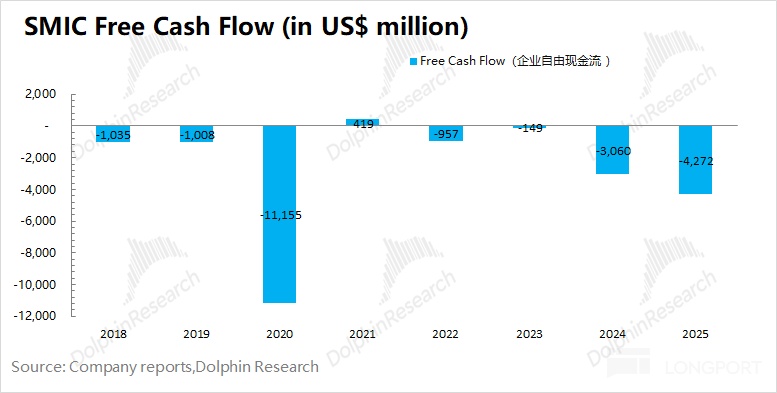
Historically, FCF was positive only in 2021. In that upcycle, GPM exceeded 30% and capex was trimmed, turning FCF positive.
Assuming NOPAT, D&A and $7–8bn annual capex, the funding gap may only close when GPM climbs back to ~28% by 2028.
c) Competitiveness and node progress: SMIC is firmly in the second tier of foundries, alongside UMC and GlobalFoundries, but remains the only one actively pushing toward first tier.
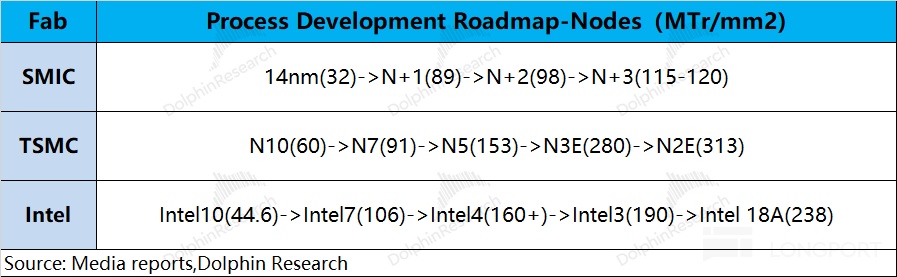
Without EUV, SMIC iterates via multi-patterning on N+1/N+2. N+2 achieves transistor density roughly at 7nm, while N+3 approaches TSMC's N7+.
At the current market cap of HKD 572.4bn, SMIC trades at roughly ~70x 2026 NOPAT (assumptions: revenue +19% YoY, GPM 20.6%, tax rate 6.7%). The multiple looks rich and needs margin expansion and earnings growth to digest.
While SMIC's revenue scale is closer to UMC and GlobalFoundries, it leads both on node progress yet still trails the first tier. On PB: TSMC 10.7 > SMIC 3.5 > GlobalFoundries 2.1 > UMC 2.0.
TSMC carries the highest PB (PEG < 1) because a large share of its assets sit in advanced nodes, giving it clear advantages amid rising AI demand.
Investor views diverge between onshore and offshore. Domestic brokers are broadly bullish, while foreign houses such as JP Morgan have stayed bearish.
Reasons include: 1) domestic capital often embraces a strategic mandate to support national champions, committing long-term capital; 2) offshore funds do not need strategic holdings before self-funding is achieved, and they have ample alternatives like TSMC and UMC, while also facing FX and geopolitical risks in SMIC.
Overall, near-term results are secondary. SMIC is China's leading advanced-node foundry and cannot settle into second-tier comfort. With EUV constrained, it is pushing N+2/N+3 iterations at almost any cost.
Peers like UMC in the second tier have paused at 14nm, while SMIC has reached 7nm-equivalent. If advanced nodes ramp to volume and domestic AI demand (e.g., from Cambricon) holds, SMIC, as a near single-source domestic AI foundry link, can justify a PB premium over peers such as UMC and GlobalFoundries.
Below is Dolphin Research's detailed breakdown of SMIC:
I. Core metrics: revenue, GPM and utilization
Q4 2025 revenue was $2.49bn, +4.5% QoQ, above guidance (0–2% QoQ), driven by restocking in consumer electronics (small-form-factor devices).
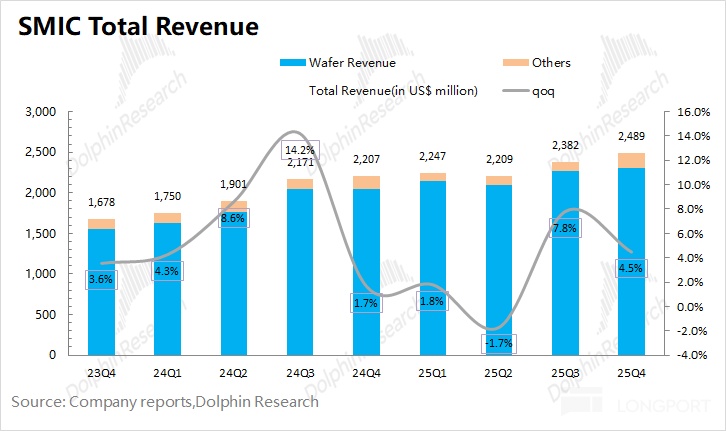
By volume and price, the main drivers this quarter were:
1) Volume: wafer shipments (8-inch eq.) reached 2,515k, +0.6% QoQ.
2) Price: revenue per wafer (8-inch eq.) was $990, +3.8% QoQ.
In short, elevated capex lifted capacity and output. The ASP recovery was structural, led by a higher 12-inch mix.
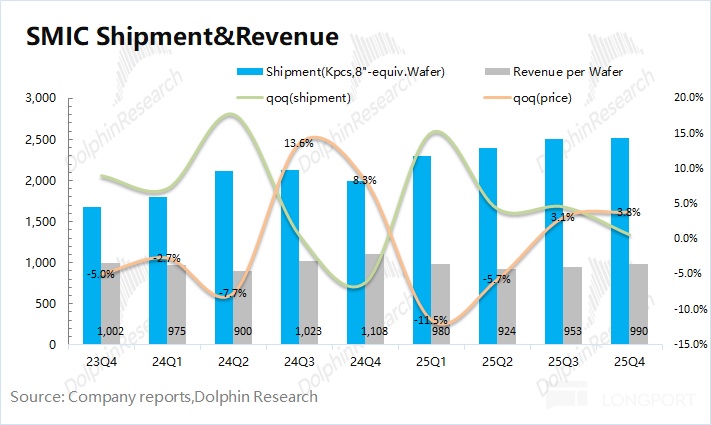
For Q1 2026, SMIC guides flat QoQ revenue at $2.49bn, below the Street (+3% QoQ). Given industry dynamics, Dolphin Research believes cautious restocking in smartphones and related markets signals continued softness across legacy semi demand.
Core metric 2: GPM
Q4 2025 GPM was 19.2%, down 280bps QoQ, below consensus (20%).
We analyze the cost structure to explain the margin move:
Per-wafer GP = per-wafer revenue − per-wafer fixed cost − per-wafer variable cost
1) Per-wafer revenue: $990 (8-inch eq.), +$37 QoQ.
2) Per-wafer fixed cost (D&A): $368, +$47 QoQ. Quarterly D&A was $927mn, +15% QoQ, driven by ongoing capex additions.
3) Per-wafer variable cost (other mfg. costs): $431, +$9 QoQ. A higher 12-inch mix lifted unit variable costs; advancing nodes also add variable costs.
4) Per-wafer GP: $190, −$19 QoQ.
Conclusion: ASP gains did not offset the rise in unit costs, pushing GPM below 20%.
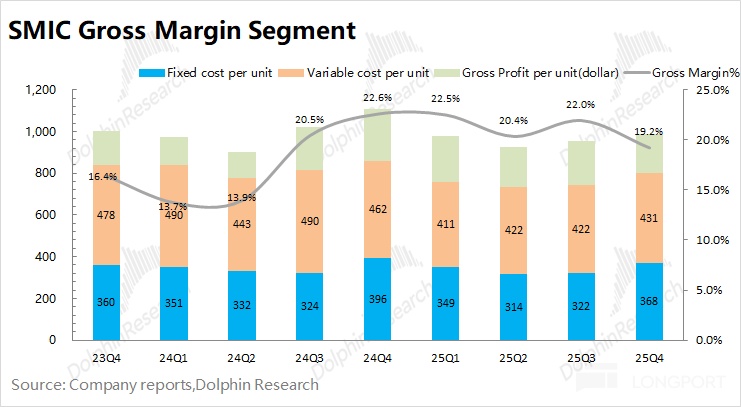
For Q1 2026, GPM guidance remains 18–20%, below consensus (21%). The muted outlook reflects a still-sluggish legacy semi view.
Margin headwinds persist: 1) memory shortage implies 2026 smartphone units down ~15%; 2) rising capex inflates fixed costs; 3) low yields at advanced nodes cap margins.
At this stage the push on advanced nodes is pursued 'regardless of cost'. Lower yields will weigh on margins, but if AI chips reach volume production, the near-term margin trade-off is acceptable to meet domestic AI demand.
Core metric 3: Utilization
Utilization reflects both SMIC's quarterly ops and broader foundry cycle health. In a soft cycle, tracking utilization helps gauge supply-demand trends for the company and the industry.
Q4 2025 utilization was 95.7%, remaining elevated.
Based on utilization and shipments, total capacity reached 2,628k wafers this quarter, +0.7% QoQ. Q4 capex was $2.4bn and FY capex $8.1bn (a record), underscoring determination to expand.
Taken with margins, operations have exited the trough but not fully recovered. Utilization is high, but there is no 'shortage → price hike' dynamic, keeping GPM around 20%.
II. Biz. view
After the three core metrics, we review the quarterly business in detail:
2.1 End-markets
Consumer electronics remained the largest revenue stream at 47%, lifted by restocking in small-form-factor devices.
Smartphone revenue was $490mn, now about 20% of total. With 'memory shortage', 2026 smartphone outlook is weak (~15% YoY decline). As OEMs cut shipment plans, smartphones will likely drag 2026 results.
2.2 Wafer size mix
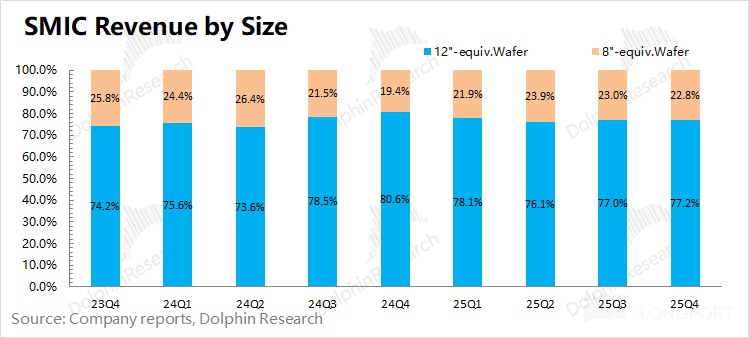
Since Q1 2022 SMIC no longer discloses node-level revenue shares, only 8-inch vs. 12-inch, limiting node granularity.
Q4 12-inch revenue mix rose to 77.2%, supported by restocking in consumer electronics. 12-inch revenue grew 4.8% QoQ vs. 8-inch at +3.6% QoQ.
2.3 Geographic mix
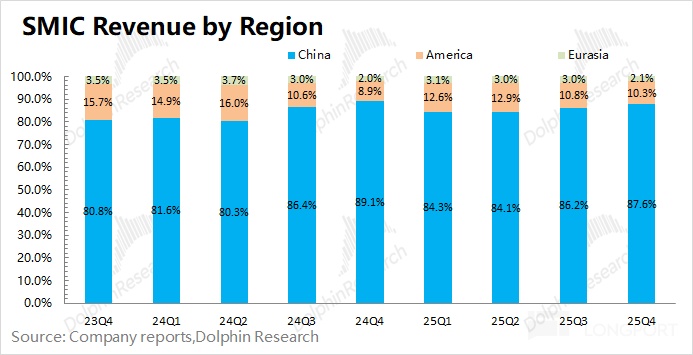
SMIC revised its regional disclosure from 'North America/Mainland China & Hong Kong/Europe & Asia' to 'China/US/Eurasia', creating slight discontinuities.
In Q4, China held at 88% of revenue, remaining the core market. The US and Eurasia accounted for 10% and 2%, respectively.
China revenue was $2.18bn, +6% QoQ, driven by stronger demand in small-form-factor consumer electronics. With nearly 90% of revenue onshore, localization remains the key growth engine.
III. Operating data
3.1 Opex
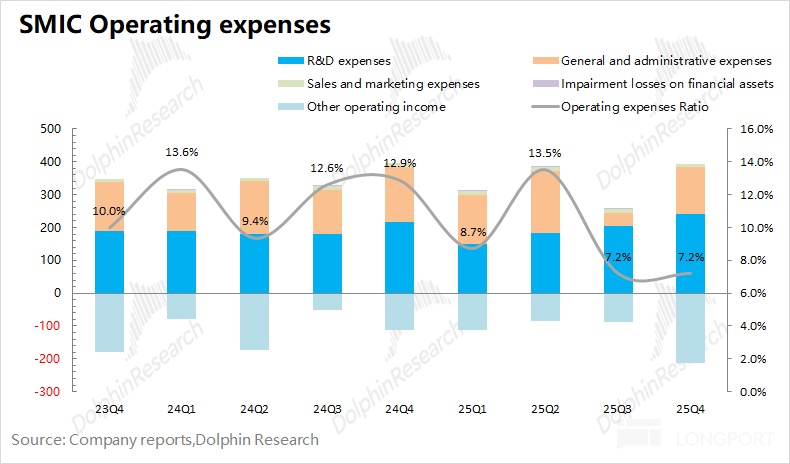
Operating expenses were $180mn, aided by higher gov. subsidies this quarter. Opex ratio stayed low at 7.2%.
Breakdown: R&D $240mn, G&A $150mn, and S&M $8mn. Core expense lines were stable; prior-quarter G&A decline reflected lower plant start-up costs.
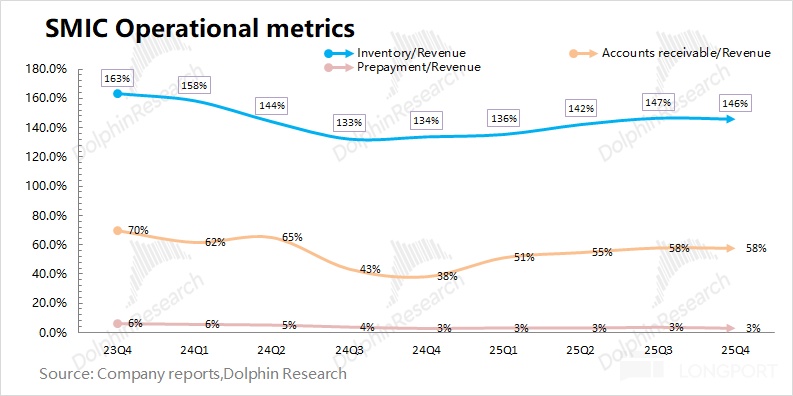
3.2 Operating metrics
Key balance items: 1) Inventories were $3.63bn, +4% QoQ; 2) Receivables were $1.43bn, +4% QoQ.
Inventory/revenue and AR/revenue stood at 146% and 58%, respectively. Working-capital ratios remain stable and broadly reasonable.
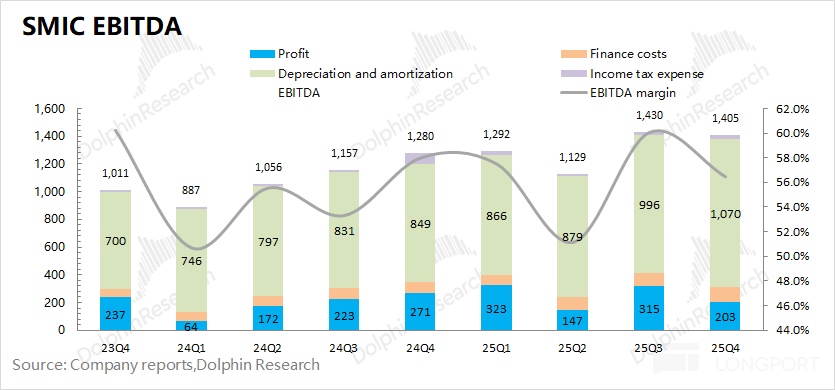
3.3 EBITDA
EBITDA was $1.4bn, slightly lower QoQ.
EBITDA is driven by OP and D&A. We estimate the EBITDA margin slipped to 56.5%, mainly on weaker GPM.
<End here>
Risk disclosure and disclaimer: Dolphin Disclaimer and General Disclosure
The copyright of this article belongs to the original author/organization.
The views expressed herein are solely those of the author and do not reflect the stance of the platform. The content is intended for investment reference purposes only and shall not be considered as investment advice. Please contact us if you have any questions or suggestions regarding the content services provided by the platform.
