

TCOM (Trans): No update on regulatory issues
Dolphin Research summarizes the FY25 Q4 earnings call for $Trip.com(TCOM.US). For our take on the print, see 'Trip.com: Can it stay 'small but beautiful' after the regulatory crackdown?'
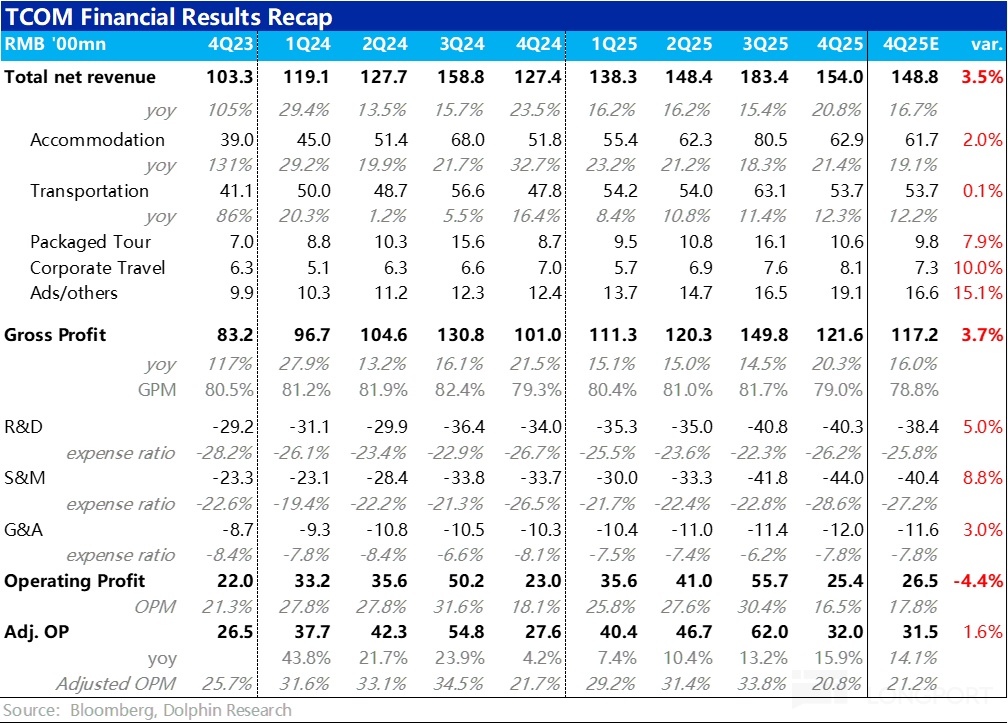
I. Key financials recap
II. Earnings call details
2.1 Management highlights
1) Three investment priorities ahead:
Inbound travel: viewed as a structural growth driver for both the platform and destination economies.
Social impact initiatives: long-term value creation requires ongoing reinvestment in the ecosystem.
AI innovation: positioning AI and vertical LLMs as core pillars of the tech strategy, aiming to build intelligent infrastructure to strengthen long-term edges. The company will develop sector-specific travel models, embedding them in search, recommendation and ops to lift efficiency, empower partners and deliver personalized experiences.
2) Inbound travel: core strategic pillar and progress
Key 2025 metrics:
Served approx. 20 mn inbound travelers.
Connected inbound demand to about 150k hotels on the platform, with over 63k hosting inbound guests for the first time.
Inbound demand benefited 6,000+ attractions, over 40% newly opened to inbound visitors.
Invested over RMB 1 bn to drive inbound growth.
Online + offline enablement: built comprehensive support capabilities, including the online platform and one-stop inbound service counters at major airports.
Product innovation: rolled out tailored inbound products (90%+ are premium); launched the immersive dining program 'Flavors of China'.
Shopping experience: enhanced tax-refund convenience via a global tax-free program, now covering 3,400+ local merchants.
3) Intl biz (outbound travel and overseas platforms)
Outbound: demand remained strong and steady, with travelers showing resilience by shifting to alternative destinations.
Overseas platforms: total bookings on intl OTA platforms rose ~60% YoY. The company strengthened its position in APAC and received multiple industry awards.
Overseas corporate travel: emerged as a new growth driver. In 2025, the company served overseas travel needs for 28k Chinese enterprises, supporting 440k+ Chinese professionals traveling to 206 countries and regions.
4) China biz
Overall performance: demand stayed stable, with consumers showing a strong preference for service quality and reliability.
Private-group tours: revenue grew 20%+. About 3,500 SMEs offered customized private tours on the platform, generating RMB 11 bn in incremental GMV and creating 30k+ jobs.
Silver economy: 'Old Friends Club' members and total GMV both more than doubled YoY in Q4. The company launched themed products around culture, leisure and wellness, opened offline flagships, and used AI tools to lower planning barriers for seniors.
Shows + travel: delivered triple-digit growth. Users increasingly planned trips around a single show, and the company pioneered one-stop bundled products, selling tickets to 1,540 shows globally for the year.
Corporate travel management: revenue up 13% YoY in 2025.
5) Compliance investigation
In Jan, the company received notice from the State Administration for Market Regulation (SAMR) launching a compliance review. It is fully cooperating and reiterated that compliant operations remain a core priority. The company will stay focused on serving users and partners and continue to execute its long-term strategy.
2.2 Q&A
Q: On the recent SAMR investigation, could management share the latest update? How do you assess the potential impact on 2026 and the long term?
A: Trip.com Group is actively cooperating with SAMR, maintaining constructive and transparent communication, and will provide further updates as permitted by applicable laws and regulations. The company is committed to a transparent and sustainable environment for all stakeholders.
It will focus on three priorities: first, scale inbound travel to create new growth for domestic partners and foster a more open and globally connected market.
Second, deepen social impact initiatives by investing in communities, empowering partners and supporting local economies, while encouraging innovation that drives sustainable growth.
Third, accelerate AI innovation by building scalable AI infrastructure to boost partner efficiency, improve visibility and remove friction, enabling the industry to deliver better content and reach more customers.
The company believes a fair, collaborative ecosystem is critical for the sector's long-term development. With 26 years of experience, a broad global network and advanced tech capabilities, Trip.com will stay focused on serving users and partners and creating long-term, sustainable value for shareholders.
Q: On AI agents, models like Gemini show strong capabilities in personalization and closed-loop transactions. How do you assess the impact on the OTA model, and how will Trip.com defend its value proposition?
A: The rapid progress of GenAI is a catalyst that validates and accelerates our long-term strategy. The rise of AI agents is among the most important tech shifts in recent years, and the company is actively shaping their role in travel rather than merely adapting.
The OTA model rests on three pillars: inspiration, transactions and service. AI agents excel at inspiring trips but also highlight the importance of the transaction and service layers, which are core to OTAs.
A true travel closed loop requires more than generating an itinerary; it demands deep integration with a complex global supply chain across airlines, hotels and in-destination providers, including real-time pricing, secure payments and fulfillment guarantees. This is where the company's operational and service capabilities stand out.
The company views general-purpose AI agents as the next-gen user entry point, poised to take share from traditional search and social. Externally, it is moving beyond simple partnerships to build direct agent-to-agent transaction capabilities with leading AI partners worldwide; internally, it is investing in native AI agents to execute complex, multi-step trip planning and booking.
The company is confident it can lead in the AI era by focusing on three areas that general-purpose models struggle to replicate:
First, proprietary data and vertical AI. The rise of open-source models accelerates the strategy: the company leverages best-in-class AI as a base, but the real edge comes from fine-tuning with decades of proprietary data (real bookings, user preferences, millions of verified reviews) to create a vertical travel expert. In-house tools like TripGenie and TripPlanner deliver personalized recommendations and bookable results based on real-time inventory and prices.
Second, a strong supply chain. The company maintains deep, long-term relationships with hundreds of thousands of partners globally, with comprehensive inventory, real-time pricing and direct tech integrations. AI agents may make suggestions, but Trip.com can confirm bookings instantly at reliable real-time prices, and that last-mile guarantee is core.
Third, end-to-end service and trust. Travel is a high-involvement, emotional purchase, and when things go wrong travelers need reliable support, not just algorithms. Through a one-stop platform and 24/7 global support, the company provides full-journey management that independent AI agents cannot match, making it a true travel partner rather than just a booking tool.
Q: On inbound travel, you flagged it as a core growth pillar, and the market is watching closely. Any color on the growth trajectory into 2026 and beyond?
A: The company believes inbound travel is at the start of a major, sustainable upcycle. Inbound currently contributes roughly 0.5% of China's GDP, vs. 10%+ in top markets like Thailand and around 5–6% in Europe (France, Italy, Spain), implying at least 5–10x headroom.
Trip.com's edge is the synergy between deep local expertise and a growing global footprint. On the domestic side, it has decades of experience building products and services tailored to China's market.
The company has invested heavily to drive growth: first, promoting 'super destinations' via integrated online+offline campaigns to reach global audiences. Second, enabling local partners to go global by investing in multilingual infrastructure, offering tech integrations and training so they can serve intl visitors effectively.
Third, elevating the traveler experience by optimizing the end-to-end journey for those unfamiliar with the local market, including 24/7 global customer care, on-site guidance at transport hubs, simplified payments and expanded tax refunds.
Q: Any updates on Lunar New Year booking trends and recent consumer sentiment? Also, can you break down performance by region?
A: The 2026 Lunar New Year was the longest in recent years, one day longer than last year. The extended holiday stimulated travel demand and supported robust overall performance. Domestic hotels delivered double-digit growth with ADR up modestly YoY, pointing to healthy demand. Outbound also posted double-digit growth, with long-haul destinations, especially Europe, standing out.
Internationally, the globalization strategy continued to deliver, with steady growth across the intl OTA platforms. Quarter-to-date, intl OTA platforms are up around 60% YoY. As the company scales in key APAC markets this year, it will continue to invest to build brand, localize products and drive sustainable growth.
In 2025, user spend per capita stayed broadly stable YoY, reflecting healthy and sustainable demand for travel. Corporate travel also remained strong over the past year, and the company is capturing this with a comprehensive suite of enterprise travel solutions, particularly supporting the global expansion of Chinese companies.
Intl contributed about 40% of total revenue and total bookings in 2025, up from roughly 35% in 2024. Momentum should continue, driven primarily by the rapid growth of the Trip.com brand.
Q: On competition, is the domestic travel market getting more competitive? How will Trip.com sustain its edge?
A: Competition at home remains dynamic, reflecting strong growth potential and ongoing vitality in the sector. The company sees this as a healthy sign for the industry.
Its advantages anchor on several fronts: first, a relentless focus on high-quality service, with 24/7/365 best-in-class customer support. Global call centers operate around the clock, and any agent can resolve issues efficiently.
Second, a very comprehensive product set.
The platform covers flights, hotels, packages, car rentals and more, offering convenience across the trip. In unexpected events such as earthquakes or regional conflicts, the company can reach customers within two minutes and move them to safety, with broad product coverage enabling timely repatriation.
Third, global coverage. Beyond superior domestic service and product, the company has built strong capabilities and inventory worldwide, supporting customers whether they travel within China or around the globe.
Q: Trip.com posted another strong quarter overseas. Any 2025 operating highlights and outlook for 2026?
A: In 2025, intl OTA platforms grew total bookings by ~60% YoY. APAC remains the primary expansion region, while markets like the Middle East show very strong potential, contributing meaningfully to intl growth.
Looking to 2026, the company will keep prioritizing APAC while prudently exploring other regions. As scale, product innovation and brand penetration improve, the profitability trajectory of intl OTAs should improve, particularly in APAC.
Given the strong potential of intl travel, the company will continue to invest for sustainable growth. A mobile-first strategy, paired with intuitive front-end design and reliable back-end services and product capabilities, should lift global brand awareness and support steady international expansion.
Q: How is the intl business performing, especially in APAC amid intensifying competition from players like Agoda?
A: In 2025, the company stayed focused on expanding across APAC. Consistent execution in key markets has lifted brand awareness among local users. As localization deepens, market-specific strategies are being deployed to better fit local travel needs, and stronger product competitiveness and better mobile booking experiences are driving solid active-user growth in major APAC markets.
In Q4 2025, international bookings hit a record high. This growth and strong performance underscore the effectiveness of the globalization strategy built on long-term experience and supported by disciplined marketing investment. Looking ahead, as online penetration and travel sentiment continue to improve, the company will keep prioritizing APAC, focusing on execution, comprehensive products, localized services, localized marketing and superior supply to further penetrate the region and serve a growing customer base.
Q: Any update on capital return plans?
A: In 2025, the company fully utilized its authorized share repurchase under the 2025 plan and executed additional buybacks in Q4. Looking ahead, it remains committed to creating long-term value for shareholders through sustainable growth and disciplined capital return.
<End>
Risk disclosure and statements:Dolphin Research Disclaimer and General Disclosure
