

Tencent (Trans): Sees clear opportunity to ramp up AI investment, expects impact on margin and buybacks
Below is Dolphin Research's transcript of Tencent FY25 Q4 and full-year earnings call. For our earnings take, see Tencent: Time to ship, AI reaching the right heat.
I. Results recap
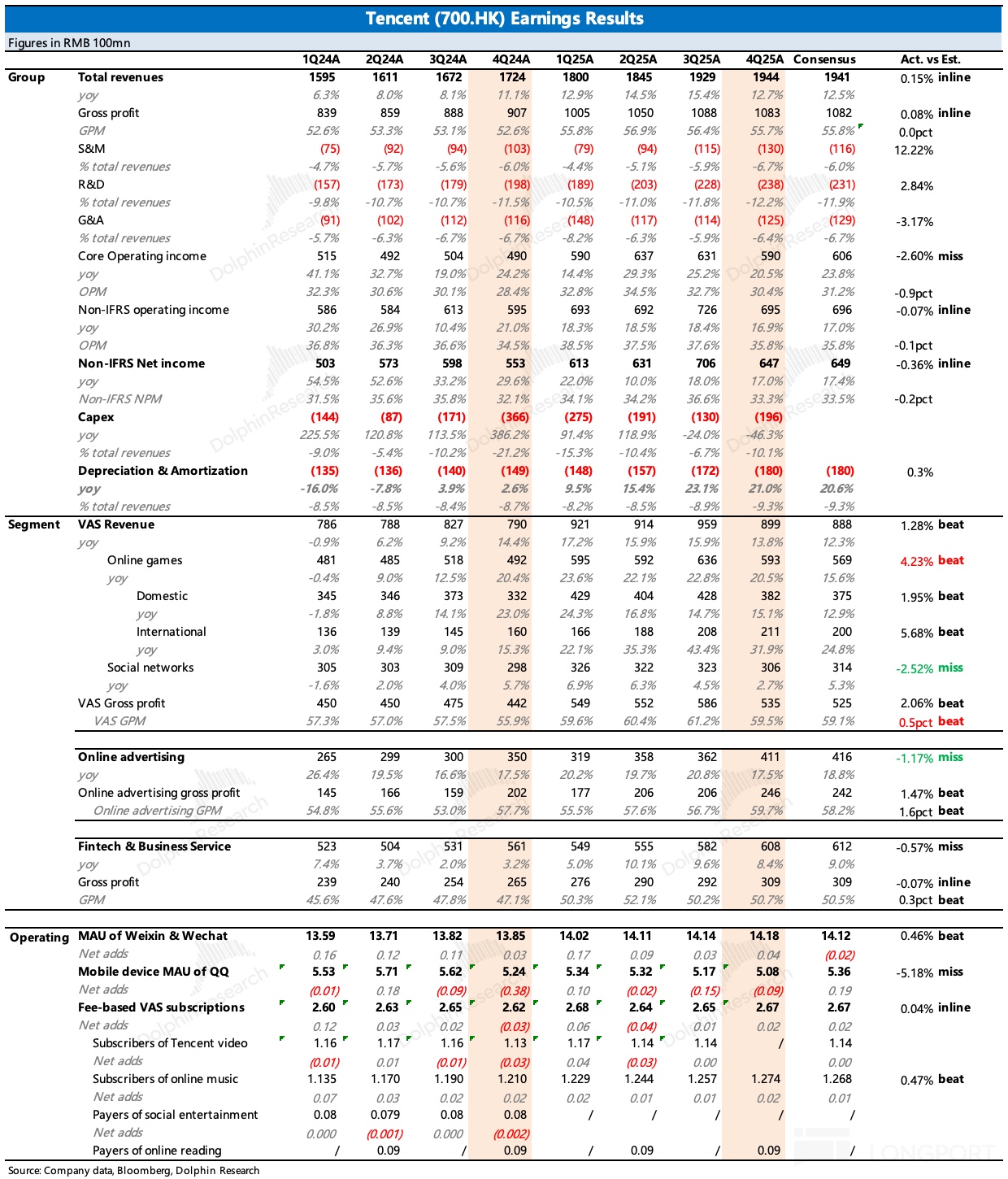
1. Shareholder returns: Proposed full-year DPS of HKD 5.3 (+18% YoY), and FY25 buybacks of ~153.4 mn shares for a total of HKD 80 bn. Given clear AI investment opportunities, 2026 buybacks may be lower than 2025, but the dividend payout will rise.
2. AI investment breakdown: New AI products such as Hunyuan and Yuanbao incurred RMB 7 bn in Q4 and RMB 18 bn for FY25, with 2026 spend expected to more than double. Management frames this as front‑loaded strategic spend akin to CapEx or JV investments, rather than recurring OpEx.
3. Margin trend: Q4 non‑IFRS OP was RMB 69.5 bn (+17% YoY) with OPM at 36% (+100bps YoY). GPM was 56% (+300bps YoY), with VAS at 60% (+400bps), Online Marketing at 60% (+200bps), and Fintech & Business Services at 51% (+400bps). In 2026, revenue growth may outpace profit growth.
4. CapEx: Q4 operating CapEx was RMB 16.9 bn (+41% QoQ / -51% YoY due to a high base), and non‑operating CapEx was RMB 2.7 bn (+60% YoY). Compute infrastructure deployment will accelerate in 2H.
5. Cash flow & net cash: Q4 FCF was RMB 34 bn (up ~6x YoY, driven by last year's high CapEx base and strong operating cash flow); net cash stood at RMB 107.1 bn (+40% YoY / +5% QoQ). Tencent Cloud targets RMB 5 bn in adj. OP in 2025.
II. Details from the call
2.1 Management remarks
1. AI strategy overview (Pony Ma & Martin Lau)
a. AI underpinned growth all year: Expanded evergreen titles (Delta Force breakout; ongoing growth in Honor of Kings and Peacekeeper Elite). Video Accounts time spent rose 20%+ on upgraded AI recommendations, and Marketing Services outgrew the industry with the AIM+ ad model. Cloud achieved scale profitability.
b. Resilience framework for the AI era: Martin outlined six criteria—network effects (C2C > C2Creator > C2B), deep supply chain integration, regulatory licenses, scarce resources/IP, low fee rates with high value, and proprietary closed‑loop data. By this yardstick, Communications (WeChat/QQ/Tencent Meeting), Games (PVP network effects + IP), and Fintech (licenses + payment network + ultra‑low take rates) exhibit high resistance to AI substitution.
c. AI enablement leadership: In games, AI accelerates content production and improves UA/retention via targeted ads and personalized highlights, while AI teammates/NPCs enrich gameplay. Tencent Games revenue grew 22% in 2025 vs. +7% for the global industry, reflecting outperformance.
On ads, scaling foundational ad models improved conversions, with GenAI creative tools and the AIM+ automated solution driving adoption. Marketing Services grew 19% in 2025 vs. +14% for the industry.
Video Accounts rolled out long‑sequence AI recommendation, lifting DAU to No. 2 among China short‑video platforms. In enterprise software, AI Agents handle auto meeting notes and customer‑service summaries, with WeCom and Tencent Meeting leading in usage and revenue in China within their categories.
d. New AI product roadmap (code: MAP): At the model layer, Hunyuan 3.0 is in internal testing, showing a larger leap vs. 2.0 than 2.0 vs. 1.0. 3D text‑to‑image and world models are in early leadership positions.
Yuanbao is focused on product‑market fit—integrated search, ASR, multimodal and group‑chat exploration—and will step up materially once Hunyuan 3.0 is deployed. WeChat AI now embeds AI across content consumption, information retrieval, product recommendations and customer service, and is building AI Agents to autonomously operate Mini Programs for users. The 'Claw' family—QClaw for individuals, WorkBuddy for enterprises, Tencent Cloud Lighthouse for developers, plus Skill Hub—upgrades from 'thinking' to 'execution', letting users control agents via WeChat/QQ command‑line interfaces.
e. AI investment economics: New AI products will absorb RMB 18 bn in 2025 (RMB 7 bn in Q4), and are expected to more than double in 2026, funded by incremental profits from core businesses. Management classifies MAP spending as CapEx‑like, front‑loaded fixed investment rather than recurring OpEx, to be evaluated separately from existing business profits. The long‑term monetization path is analogous to Tencent Cloud—from losses to scaled profitability.
2. Games
a. Domestic Q4 revenue was RMB 38.2 bn (+15% YoY): Delta Force surpassed 50 mn peak DAU in Feb 2026 with record monthly grossing; AI coding raised dev efficiency and AI companions boosted stickiness. Valorant PC revenue rose 30% YoY to record DAU, while the mobile version was the No. 1 new mobile title by grossing in 2025 with a record Feb. Cross‑platform FPS 'Niezhan: Future' launched in Jan, drawing several million DAU.
b. Intl Q4 revenue rose 32% YoY: Clash Royale ranked No. 3 by DAU in Q4 with both DAU and revenue more than tripling YoY to record highs (10th‑anniv. in Mar). Wuthering Waves won TGA 2025 Players' Voice, with rapid YoY growth in Q4 revenue and DAU. Warframe set record DAU and revenue in Dec 2025 after a major update. Full‑year overseas game revenue topped USD 10 bn for the first time.
3. Marketing Services
a. Q4 revenue was RMB 41.0 bn (+17% YoY), led by internet services and local services, partly offset by e‑commerce platforms shifting budgets from ads to subsidies and a slowdown in financial services due to online‑lending policy changes.
b. Since Q1 2026 to date, Marketing Services YoY growth is running faster than in Q4. Tencent is deepening partnerships with e‑commerce platforms to drive merchant ad spend within its ecosystem, while expanding rewarded video and Video Accounts ad inventory.
c. Video Accounts time spent benefited from upgraded recommendation algorithms, lifting ad impressions while ad load remains below peers. WeChat Search query volumes are growing rapidly with AI enhancement, with commercial queries and search pricing both rising.
4. Fintech & Business Services
a. Q4 revenue was RMB 61.0 bn (+8% YoY): Fintech services grew low single digits, supported by gains in wealth‑management AUM and users, and higher commercial payment transactions even as ticket size contraction narrowed. Business Services revenue rose 22% YoY on faster cloud growth and higher tech service fees from small‑store e‑commerce GMV.
b. Cloud revenue growth accelerated as tight memory and CPU supply improved pricing. Media‑cloud revenue grew strongly as short‑video platforms and AI video generation drove streaming‑processing demand, showcasing Tencent's leading streaming quality and competitive pricing.
5. Social network & WeChat ecosystem
a. Social‑network revenue was RMB 31.0 bn (+3% YoY), driven by Video Accounts live streaming and music subscriptions (ARPU and users both up 13% YoY). Long‑form video subs rose 1% YoY.
b. WeChat Stores revamped the e‑commerce entry page with cart, friend recommendations, and store notifications, driving sizable GMV, and rolled out 'like‑to‑save' promotions. Mini Programs time spent rose 20% YoY, led by productivity tools, mini‑games, and short dramas. CodeBuddy now supports natural‑language Mini Program development, with free compute for AI‑native Mini Program developers.
2.2 Q&A
Q: With higher AI spend, how should we think about 2026 margins? How do you prioritize GPUs vs. AI talent?
A: As hinted in our opening, revenue growth may outpace profit growth in 2026 because we are stepping up investment in new AI products. We see clear opportunities to expand our business footprint and create new user value, and strong user enthusiasm suggests compelling product‑market fit.
On talent, we have aggressively recruited world‑class AI experts into the Hunyuan team and will continue hiring selectively, as we already have a top‑tier core. We attract talent not only with compensation, but also with the right culture, clear internal positioning, strong leadership, ample compute, and Tencent‑unique application scenarios.
On GPUs, we are actively deploying more capacity, which will ramp through the year and accelerate in 2H—sourced via rented capacity, purchases of re‑available high‑end imported GPUs, and increasing volumes of domestic GPUs. Compute priority goes to Hunyuan and new AI products, while Claw products are natively distributed and can tap on‑device and multi‑cloud resources.
Q: How do you assess ROI and timeline for AI investments? How do you choose between building vs. renting, and which layers of the AI stack are most critical vs. commoditized?
A: From an ROI perspective, we already see very strong returns when applying AI to existing businesses. If you disaggregate the financials, legacy businesses plus AI‑enabling spend are growing solidly, and excluding new AI products, operating leverage is very clear.
The second layer is new AI products. Here, we will see the investment first—particularly in China, where consumer subscriptions and high‑priced coding agents are less prevalent than in the US. These are front‑loaded investments, but over time we expect revenues and attractive returns, much like Tencent Cloud, which started with losses and scaled to profitability.
On build vs. rent: with a strong balance sheet, we prefer to buy when possible to avoid lease markups. But given supply‑chain and regulatory constraints, we sometimes must rent to secure capacity, and we will do so when necessary.
On the stack, the market is very dynamic, so it is hard to rank layers. We have resources and teams across the stack, and have built a strong core from scratch at the model layer. At the application layer, we lean into product, orchestration, ecosystem connectivity, security, and cross‑PC/mobile capabilities, investing across layers and letting market dynamics play out.
Q: What is the potential for QClaw and WorkBuddy as AI Agents? Any analogy to the Android platform model, and how will you differentiate at the model layer?
A: Clawbot is an exciting concept that enables a decentralized mode of AI operation. Early internet had browsers as gateways and search engines as distributors, then services evolved on their own; in mobile, native apps and ports from PC proliferated.
AI is undergoing a similar shift. The notion of AGI dominance has given way to a multi‑model world—some models excel at chat, others at coding, others at multimodal, with strong open‑source options too. Chatbots once seemed the only gateway, but Claw opens a decentralized field where many companies can run their own claws on different models and cloud backends, each finding a unique value proposition.
Claw also leverages device tools and file systems, making the decentralized world even more compelling. With QClaw and WorkBuddy, many existing apps will develop their own claws and agent capabilities, while models compete to be chosen by these claws. We must build expertise at the model, product, and infrastructure layers, each with a distinct value proposition.
Q: In the Agent era, where does Tencent add unique value? How do you prevent other LLMs from diluting Hunyuan's value?
A: Tencent has natural advantages in the Claw era as a cross‑platform company spanning PC, mobile, and cloud, across apps and the web. We operate centralized apps and host a highly decentralized, vibrant ecosystem—especially Mini Programs.
Historically, mobile internet favored app experiences over decentralized web pages. With Agents and Claw, decentralized experiences like Mini Programs are empowered far beyond before. This makes our capabilities naturally aligned with agent deployment, helping drive strong adoption by consumers and developers.
On dilution, users inside Claw can choose a high‑performance, higher‑price model A, a lower‑price moderate‑performance model Z, or anything in between. That flexibility is Claw's appeal, and Hunyuan is one of those options. As the Hunyuan team advances, Hunyuan will improve faster and attract growing usage, but this will not be a monopoly—successful claws let users choose on the price‑performance curve. We aim to be a leading choice, not the only one.
Q: Will widespread agent adoption in traditional industries accelerate demand for 3D/world models? What is Tencent's edge in physical AI?
A: That is a reasonable view—existing CAD capabilities naturally invite AI augmentation, which is important in industrial design and architecture, and increasingly meaningful in video games. We are uniquely positioned with breadth and depth of 3D graphical assets from our games, giving us strong training data.
That said, this is a large but specialized sub‑sector. We are well positioned, but it is not our biggest opportunity today, as there are larger and more immediate opportunities elsewhere.
Q: How will AI affect game dev cost and staffing? Does distribution vs. development importance change, and will supply surge as AI lowers barriers?
A: At last week's GDC, AI in games was a hot topic. Two observations: first, showcases focused on upgrading existing content and accelerating creation with AI rather than building full games from scratch, which is not yet feasible; second, many standout talks were from Tencent IEG colleagues, demonstrating AI in graphics, gameplay, and companionship, with industry feedback that we are at the forefront.
On supply glut and distribution vs. development, gaming has always had excess supply—~200k new mobile titles annually and ~18k on Steam. Whether 200k becomes 2 mn, 2 bn, or more, the marginal impact fades, and success still hinges on building and operating the best games with top talent and frontier tech. The value balance will not fundamentally flip—advantage remains with the best developers.
Two additions: first, AI disruption is a net positive—people will have more leisure time, structurally lifting game demand, one of the few certainties in the AI era. Second, great tools are available to both newcomers and mature teams, but teams with resources and player bases can leverage them better to accelerate output and keep games evergreen. As innovation surges, large games with large user bases can iterate faster and absorb new experiences, turning games into platforms.
Q: With AI server costs rising (DRAM/HBM), how will Tencent Cloud price and capture value?
A: Demand is not limited to AI GPUs. As users create and execute software via agents, execution is largely CPU‑based with substantial memory needs, so demand is broad‑based across CPU, RAM, SSDs, and HDDs.
On pricing, China cloud providers have long operated at thin margins as customers could procure infra directly from suppliers. Now supply is pre‑sold months or years ahead, and vendors prioritize hyperscalers, so smaller providers and end‑customers can no longer reliably self‑procure and must turn to hyperscalers. With industry margins low and demand rebounding, we have little choice but to pass through higher prices, and multiple price‑hike rounds have emerged across China cloud in the past 24 hours.
For value capture, the principle is to move up the value stack—bare chip rental yields low prices and margins, while virtualizing into tokens drives better unit economics, and wrapping into PaaS/SaaS delivers the best pricing and margins. This underpinned our turnaround from large losses four years ago to solid profit last year, and we will keep moving from bare chips to tokens to platforms to software.
Q: How do you address late‑mover disadvantages in AI? In the US, later entrants struggle despite ample resources—why won't Tencent face the same?
A: If this were a single race, catch‑up would be hard. But AI is a collection of many races, with new frontiers opening constantly—first chatbots, then coding, then multimodal, then Clawbot further decentralized the landscape.
Like apps in an app store, AI will be packaged in many ways—from models to products to agents—with existing services adding agent capabilities across mobile and PC. We are still early, fragmentation is already visible and will only increase, making foundational capabilities crucial.
We bring many application‑layer foundations—WeChat ecosystem, presence across PC and mobile, security, cloud, payments—and these can be recombined for new AI competitions. It is not a single race but a world of many, offering ample opportunities for latecomers to innovate from behind. I worry less about being late and more about innovating fast enough, and with the Hunyuan reorg and product teams energized around AI, progress is exciting.
Q: How will Apple's lower App Store commission in China impact Tencent's margins?
A: This is not hypothetical; Apple has formally announced changes now in effect. On distribution, there should be good pass‑through—when we publish games as the distributor with dev partners (a small portion of gaming revenue), revenue shares are typically based on gross rather than net of store fees, so reductions should flow to us.
If you refer to the 15% enterprise income tax on incremental profit, the impact depends on how much we reinvest into new AI products. More importantly, the key is not the numerical change from 30%→25% or 15%→12%, but Apple's statement that China developers will be offered minimum rates equivalent to the lowest elsewhere globally.
As the industry evolves, we expect App Store take rates to normalize downward worldwide over time, and Apple has now stated that China will move in tandem. This is a very positive first step in what we view as a multi‑step positive journey.
Q: With peers investing in in‑house chips, where do self‑developed chips rank in Tencent's AI priorities?
A: This is not our top focus currently. Training chips and inference chips differ: training chips are extremely hard to design and manufacture, so we aim to secure the most advanced training chips and use them flexibly. Inference is primarily about cost, with many suppliers in China and much lower margins than training, where one or two vendors command outsized profits, so there are many inference options.
Our priority is to use the best training chips to train the best models and keep focus. Hunyuan 3.0 will be significantly better than 2.0, and this is just the start, as training iteration speed will rise over time. With focus, I am confident Hunyuan will reach SOTA levels, which is our most important goal.
The second priority is to unleash our product‑development and integration strengths to design the most compelling AI products. Once done, we will then address lowering inference cost.
Risk disclosure and disclaimers: Dolphin Research disclaimer and general disclosure
